Should I Use React or Next.js? Complete Comparison Guide 2026
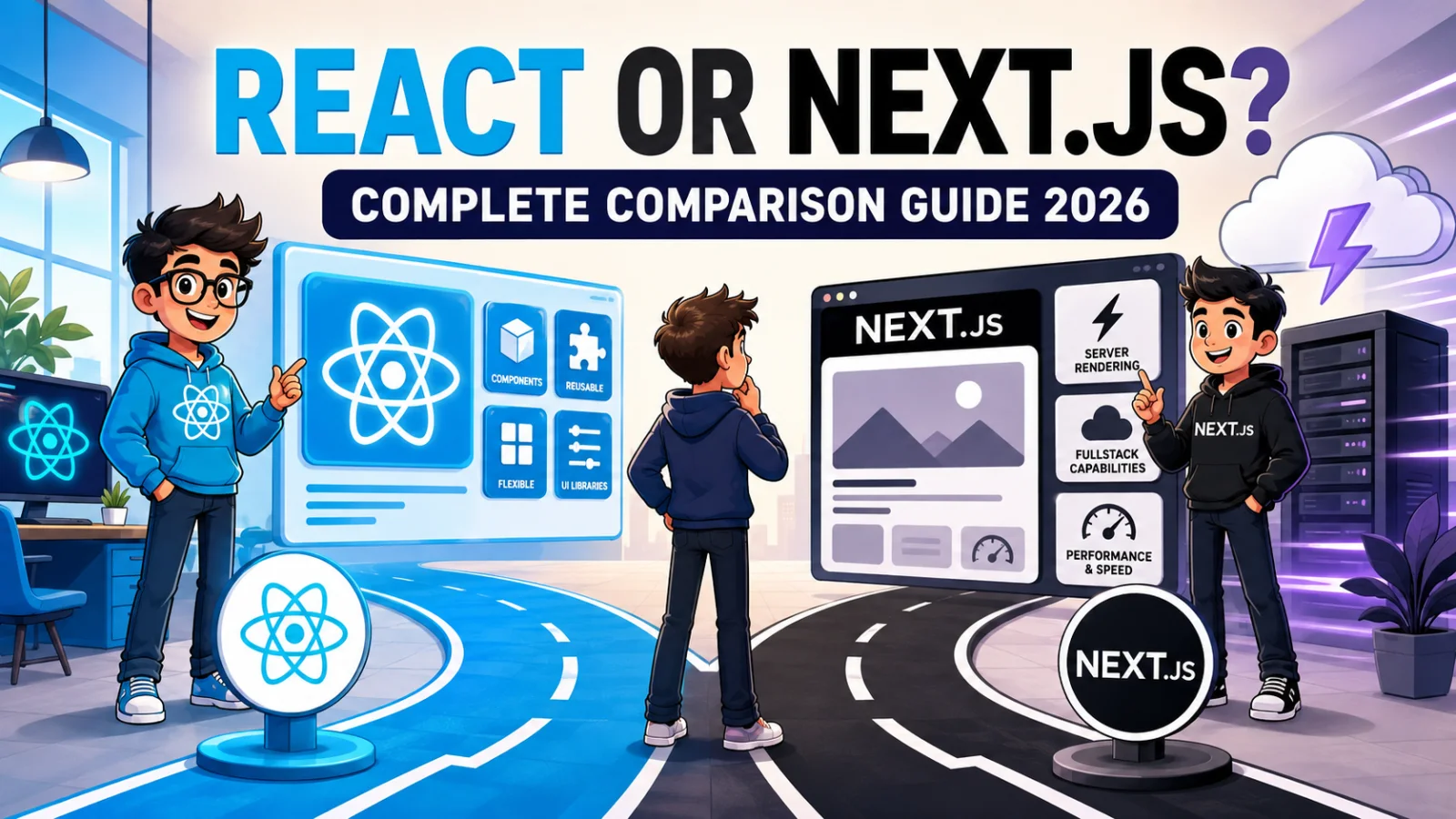
Quick Analogy
Table
React | The engine of a car — it powers everything, but you build the rest yourself. |
Next.js | A complete car — engine included, plus wheels, frame, navigation, and safety features. |
Core Difference
Table
React | Next.js | |
|---|---|---|
What it is | A JavaScript library for building UI components | A framework built on top of React |
Created by | Meta (Facebook) | Vercel |
Rendering | Client-Side Rendering (CSR) only | CSR, Server-Side Rendering (SSR), Static Site Generation (SSG), Incremental Static Regeneration (ISR) |
Routing | None built-in (use React Router, etc.) | File-based routing built-in ( |
Setup | Manual — configure Webpack, Babel, routing, etc. | Zero-config — works out of the box |
API routes | Not included | Built-in API routes ( |
SEO | Poor by default (empty HTML on first load) | Excellent — server-rendered HTML for crawlers |
Feature Comparison
Table
Feature | React | Next.js |
|---|---|---|
Component-based UI | ✅ Yes | ✅ Yes (uses React) |
Virtual DOM | ✅ Yes | ✅ Yes |
JSX | ✅ Yes | ✅ Yes |
Hooks | ✅ Yes | ✅ Yes |
Server-Side Rendering | ❌ No | ✅ Yes |
Static Site Generation | ❌ No | ✅ Yes |
File-based routing | ❌ No | ✅ Yes |
Image optimization | ❌ Manual | ✅ Built-in ( |
Font optimization | ❌ Manual | ✅ Built-in |
API endpoints | ❌ No | ✅ Built-in |
Middleware | ❌ No | ✅ Yes |
Internationalization (i18n) | ❌ Manual | ✅ Built-in support |
Fast Refresh (HMR) | Needs setup | ✅ Built-in |
Production build optimization | Manual config | ✅ Automatic |
Code Example: Same Page, Different Approach
React (with React Router)
jsx
// App.jsx
import { BrowserRouter, Routes, Route } from 'react-router-dom'
import Home from './Home'

function App() {
  return (
    <BrowserRouter>
      <Routes>
        <Route path="/" element={<Home />} />
      </Routes>
    </BrowserRouter>
  )
}

// Home.jsx — fetches data on client
import { useState, useEffect } from 'react'

function Home() {
  const [posts, setPosts] = useState([])

  useEffect(() => {
    fetch('/api/posts')
      .then(res => res.json())
      .then(data => setPosts(data))
  }, [])

  return (
    <div>
      <h1>My Blog</h1>
      {posts.map(post => <p key={post.id}>{post.title}</p>)}
    </div>
  )
}
Next.js (App Router)
jsx
// app/page.jsx — server component by default
async function getPosts() {
  const res = await fetch('https://api.example.com/posts', {
    next: { revalidate: 60 } // ISR: regenerate every 60s
  })
  return res.json()
}

export default async function Home() {
  const posts = await getPosts() // Runs on server!

  return (
    <div>
      <h1>My Blog</h1>
      {posts.map(post => <p key={post.id}>{post.title}</p>)}
    </div>
  )
}
Key difference: Next.js fetches data on the server, sends fully-rendered HTML to the browser. React fetches in the browser after a blank page loads.
Rendering Strategies in Next.js
Table
Strategy | How It Works | Best For |
|---|---|---|
SSR (Server-Side Rendering) | Server renders HTML on every request | Dynamic content, personalized pages |
SSG (Static Site Generation) | HTML generated at build time | Blogs, marketing pages, docs |
ISR (Incremental Static Regeneration) | Static + revalidate in background | News sites, large e-commerce |
CSR (Client-Side Rendering) | Traditional React behavior | Dashboards, highly interactive apps |
React only supports CSR natively.
When to Use What?
Use React alone when:
You're building a Single Page Application (SPA) behind a login wall
You need complete control over build tools and architecture
You're integrating into an existing non-React backend
You're learning — understanding React fundamentals first
Your app is heavily interactive with minimal SEO needs (e.g., admin dashboards, web apps)
Use Next.js when:
You need SEO (blogs, e-commerce, marketing sites)
You want faster initial page loads (SSR/SSG)
You need a full-stack framework (API routes, auth, middleware)
You want zero-config setup with best practices built-in
You're building a SaaS with public-facing pages
You want performance optimizations out of the box (images, fonts, code splitting)
Featured Articles

The 10 Largest Frontend Performance Challenges in 2026 (And How to Fix Them)

Build an Offline-First SaaS with Laravel & React: Complete PWA Tutorial 2026

Build a Private AI Notes Assistant
Turn a folder of Markdown notes into a searchable assistant without exposing private drafts.
Comments
0 commentsNo approved comments are visible yet. New community replies may wait for moderation.