Edge Computing: The Next Frontier
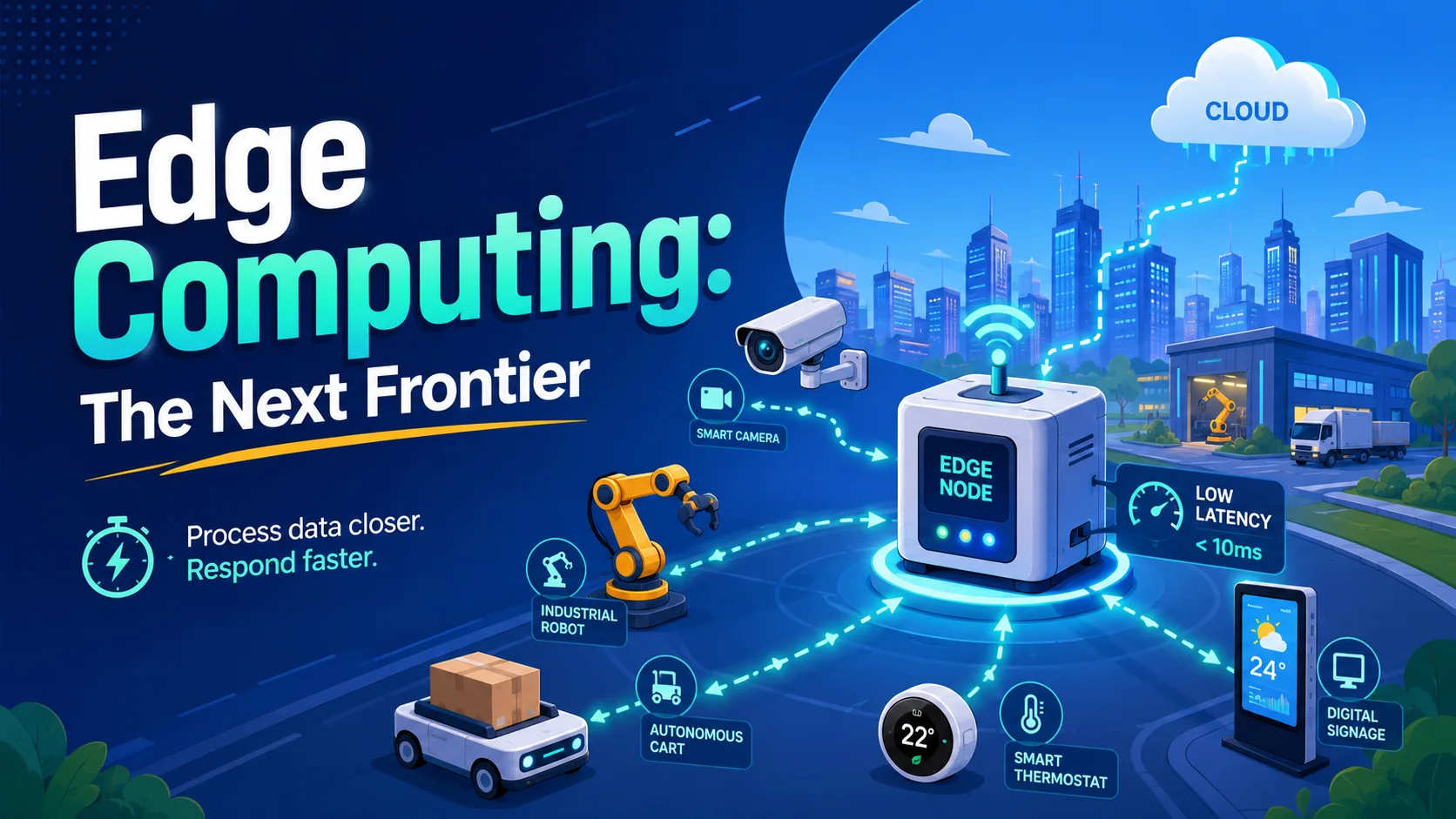
Edge computing processes data closer to where it is generated rather than sending it to a centralized cloud data center. As IoT devices proliferate and real-time applications demand sub-10ms latency, edge computing has moved from a niche concept to a mainstream architectural pattern. In 2026, edge and cloud are not competing paradigms — they are complementary layers in a distributed computing continuum.
Introduction
Edge computing processes data closer to where it is generated rather than sending it to a centralized cloud data center. As IoT devices proliferate and real-time applications demand sub-10ms latency, edge computing has moved from a niche concept to a mainstream architectural pattern. In 2026, edge and cloud are not competing paradigms — they are complementary layers in a distributed computing continuum.
Why Edge Computing Now?
Several converging trends make edge computing essential:
| Driver | Challenge | Edge Solution |
|---|---|---|
| IoT explosion | 30B+ devices generate petabytes of data | Process at source, send only insights to cloud |
| Latency requirements | Autonomous vehicles: sub-5ms decisions | On-device inference, 5G edge nodes |
| Bandwidth costs | Sending raw video to cloud is expensive | Edge filters and compresses before transmission |
| Data sovereignty | GDPR, local data residency laws | Keep data within geographic boundaries |
| Offline operation | Remote locations, intermittent connectivity | Edge operates autonomously, syncs when connected |
| Privacy | Sensitive data (healthcare, biometrics) | Process locally, never transmit raw data |
Real-World Latency Comparison
| Application | Cloud (round-trip) | Edge | Why It Matters |
|---|---|---|---|
| Autonomous braking | 100ms (too slow) | 2ms | Life safety |
| Industrial robot control | 200ms | 5ms | Production quality |
| Video analytics (retail) | 300ms | 50ms | Real-time customer insights |
| AR/VR rendering | 50ms | 10ms | Motion sickness prevention |
| Smart grid balancing | 500ms | 20ms | Grid stability |
Edge Computing Architecture
Layered Architecture
                    ┌──────────────────────┐
                    │   Central Cloud       │
                    │ (AWS, Azure, GCP)     │
                    │ Training, dashboards, │
                    │ long-term storage     │
                    └──────────┬───────────┘
                               │
                    ┌──────────▼───────────┐
                    │   Regional Edge       │
                    │ (Local Zones, 5G MEC) │
                    │ Regional aggregation  │
                    └──────────┬───────────┘
                               │
                    ┌──────────▼───────────┐
                    │   Local Edge          │
                    │ (Gateway, on-prem)    │
                    │ Real-time processing  │
                    └──────────┬───────────┘
                               │
                    ┌──────────▼───────────┐
                    │   Device Edge         │
                    │ (Sensors, actuators,  │
                    │  smartphones)         │
                    │ Data collection       │
                    └──────────────────────┘
1. Device Edge
Computing happens on the device itself. Examples:
- Smartphone runs ML inference locally (on-device AI).
- IoT sensor aggregates data before sending.
- Autonomous vehicle processes sensor data in real time.
Hardware:
- ARM Cortex, x86 embedded processors.
- Edge TPU, NVIDIA Jetson for ML acceleration.
- Microcontrollers (ESP32, STM32) for simple sensors.
2. Local Edge (Gateway)
On-premises servers or gateways that aggregate and process data from multiple devices.
Example — Factory floor:
Sensors ──► PLC ──► Edge Gateway ──► Factory Server ──► Cloud
                       │
                   Local analytics
                   Real-time decisions
                   (e.g., stop machine if vibration exceeds threshold)
Hardware: Dell PowerEdge, HPE EdgeLine, AWS Outposts, Azure Stack Edge.
3. Regional Edge
Small-scale data centers located near population centers:
- AWS Local Zones — 30+ locations worldwide, single-digit ms latency.
- Azure Edge Zones — Integrated with 5G networks.
- GCP Distributed Cloud Edge — Edge locations for low-latency workloads.
4. Central Cloud
Traditional cloud regions for heavy computation, model training, global dashboards, and archival storage.
Edge Computing Use Cases
1. Autonomous Vehicles
A modern autonomous vehicle generates 5+ TB of data per hour:
| Data Source | Volume | Edge Action |
|---|---|---|
| LiDAR | 20 GB/hour | Object detection, depth mapping |
| Cameras (8+) | 100 GB/hour | Lane detection, traffic sign recognition |
| Radar | 5 GB/hour | Velocity measurement, obstacle detection |
| GPS/IMU | 100 MB/hour | Localization, path planning |
Edge requirement: Sub-5ms inference for safety-critical decisions. Cloud handles map updates, fleet analytics, and model retraining.
2. Industrial IoT (IIoT)
Predictive maintenance using edge computing:
# Edge device code: vibration anomaly detection
import numpy as np
from edge_ml import AnomalyDetector

detector = AnomalyDetector.load('vibration_model.tflite')

while True:
    sample = sensor.read_vibration(1024)
    fft = np.fft.fft(sample)
    prediction = detector.predict(fft)

    if prediction > 0.95:
        # Anomaly detected — act immediately
        controller.emergency_stop()
        gateway.send_alert('Anomaly detected on Machine #7')
    elif prediction > 0.7:
        # Warning — send for cloud analysis
        gateway.send_data(sample, priority='analysis')
    else:
        # Normal — discard raw data, send summary
        gateway.send_summary({'machine_id': 7, 'avg_vibration': np.mean(sample)})
3. Retail Analytics
Edge-based computer vision in retail stores:
- Customer counting and foot traffic analysis.
- Shelf inventory monitoring (detect empty shelves).
- Queue length detection → auto-open new checkout lanes.
- Demographics analysis → tailored digital signage.
Privacy-first approach: Edge processes video locally, sends only aggregated, anonymized data to the cloud.
4. Content Delivery and Gaming
- Cloud gaming (NVIDIA GeForce Now, Xbox Cloud Gaming) — Edge nodes render and stream at <20ms latency.
- Video streaming (Netflix Open Connect) — Caches at ISP edge, reduces backbone traffic by 95%.
- CDN (Cloudflare, Fastly) — Serve static/dynamic content from edge locations.
5. Healthcare
- Remote patient monitoring — Edge devices analyze vital signs locally, alert on anomalies.
- Medical imaging — Edge AI pre-screens X-rays/MRIs for critical findings.
- Hospital IoT — Asset tracking, environmental monitoring, access control.
Edge Computing vs. Cloud Computing
| Factor | Cloud | Edge |
|---|---|---|
| Latency | 50-200ms | <1-10ms |
| Compute power | Virtually unlimited (GPUs, TPUs) | Constrained (CPU, edge TPU) |
| Storage | Petabytes | Gigabytes to terabytes |
| Network | High bandwidth, consistent | Variable, potentially intermittent |
| Cost | Pay-as-you-go (opex) | Higher upfront (capex) |
| Management | Centralized | Distributed (challenging) |
| Security | Provider-managed, share responsibility model | Physical access risk, must secure distributed devices |
| Data retention | Long-term | Short-term (processed or forwarded) |
| Offline capability | Requires connectivity | Must operate offline |
Edge Platforms and Technologies
Compute Platforms
| Platform | Type | Best For |
|---|---|---|
| Cloudflare Workers | Serverless at edge | Lightweight compute, CDN |
| AWS Lambda@Edge | Serverless at CloudFront | Request transformation, A/B testing |
| AWS Wavelength | 5G edge | Ultra-low latency mobile apps |
| Azure Stack Edge | Hardware appliance | On-premises edge with cloud management |
| Google Distributed Cloud | Edge + on-prem | AI/ML at edge, retail, manufacturing |
| OpenYurt | Open-source edge K8s | Kubernetes-native edge management |
| KubeEdge | CNCF edge K8s | Large-scale edge deployments |
Edge ML Inference
| Tool | Hardware | Model Format | Performance |
|---|---|---|---|
| TensorFlow Lite | CPU, GPU, Edge TPU | TFLite | Optimized for edge |
| ONNX Runtime | CPU, GPU, NPU | ONNX | Cross-platform |
| NVIDIA TensorRT | NVIDIA GPU | TensorRT | Max throughput on Jetson |
| Apple Core ML | Apple Neural Engine | MLModel | On-device iPhone/iPad |
| OpenVINO | Intel CPU, GPU, VPU | IR | Intel hardware optimized |
Edge Networking
| Protocol | Range | Bandwidth | Power | Use Case |
|---|---|---|---|---|
| WiFi 6/7 | 50m | 1-9 Gbps | Medium | Local area edge |
| 5G | 500m-10km | 100 Mbps-20 Gbps | Medium | Wide area, low latency |
| LoRaWAN | 2-15km | 50 kbps | Very low | IoT sensor networks |
| NB-IoT | 1-10km | 250 kbps | Low | Smart meters, asset tracking |
| Bluetooth LE | 10-100m | 2 Mbps | Very low | Wearables, beacons |
| Zigbee | 10-100m | 250 kbps | Very low | Home automation |
Edge Security Challenges
Edge computing introduces unique security concerns:
| Challenge | Mitigation |
|---|---|
| Physical tampering — Devices in uncontrolled environments | Tamper-proof enclosures, secure boot, hardware root of trust (TPM) |
| OTA update security — Firmware updates over potentially insecure networks | Signed updates, verified boot, rollback protection |
| Data at rest — Data stored on device | Full disk encryption (AES-256), TPM-based key storage |
| Network security — Edge devices on untrusted networks | mTLS for all communication, network segmentation |
| Device identity — Authenticating devices | X.509 certificates, device registry, hardware attestation |
| Limited resources — Encryption impacts battery/CPU | Hardware-accelerated crypto, lightweight protocols (MQTT with TLS) |
Edge Security Best Practices
# Device security baseline
device_security:
  secure_boot: enabled
  disk_encryption: AES-256-XTS
  software_updates:
    method: signed_OTA
    frequency: monthly
    automatic: true
  network:
    mTLS: required
    allowlist_ports: [443, 8883]
    block_public_internet: true
  monitoring:
    log_retention: 90_days
    anomaly_detection: enabled
Operational Challenges
Device Management at Scale
Managing thousands of distributed devices requires:
- Provisioning — Zero-touch enrollment (cellular, Bluetooth, QR code).
- Monitoring — Health metrics from each device (CPU, memory, connectivity).
- Updates — Staged rollouts with rollback capability.
- Debugging — Remote shell access (restricted, audited).
- Decommissioning — Secure wipe and certificate revocation.
Connectivity
- Intermittent connectivity — Design for offline-first operation.
- Bandwidth constraints — Prioritize data, compress aggressively.
- Protocol heterogeneity — Edge gateway normalizes diverse protocols.
Data Management
- Data gravity — Processing decisions affect what data moves where.
- Data lifecycle — Define retention policies for edge-stored data.
- Data synchronization — Conflict resolution for offline modifications.
Edge Computing with Kubernetes
K8s is increasingly deployed at the edge for consistent management:
# KubeEdge — Edge node configuration
apiVersion: edge.kubeedge.io/v1
kind: EdgeNode
metadata:
  name: factory-floor-01
spec:
  resources:
    cpu: "4"
    memory: "8Gi"
    storage: "100Gi"
  networking:
    offline_capability: true
    sync_interval: 5m
  workloads:
    - service: vibration-monitor
      replicas: 1
      restart_policy: Always
Conclusion
Edge computing is not replacing the cloud — it is extending it. The winning strategy is a cloud-edge continuum where:
- Device edge handles real-time, safety-critical decisions.
- Local edge aggregates and processes within a facility or region.
- Regional edge provides low-latency compute near population centers.
- Central cloud manages orchestration, model training, and global analytics.
When evaluating edge, start with a specific use case that demands low latency, offline operation, or data sovereignty. Use cloud management platforms to operate edge devices at scale. Invest in security from day one — distributed devices are harder to secure than centralized data centers.
Featured Articles
The 10 Largest Frontend Performance Challenges in 2026 (And How to Fix Them)
Should I Use React or Next.js? Complete Comparison Guide 2026

Build an Offline-First SaaS with Laravel & React: Complete PWA Tutorial 2026
Comments
0 commentsNo approved comments are visible yet. New community replies may wait for moderation.