Cloud Computing Trends in 2026
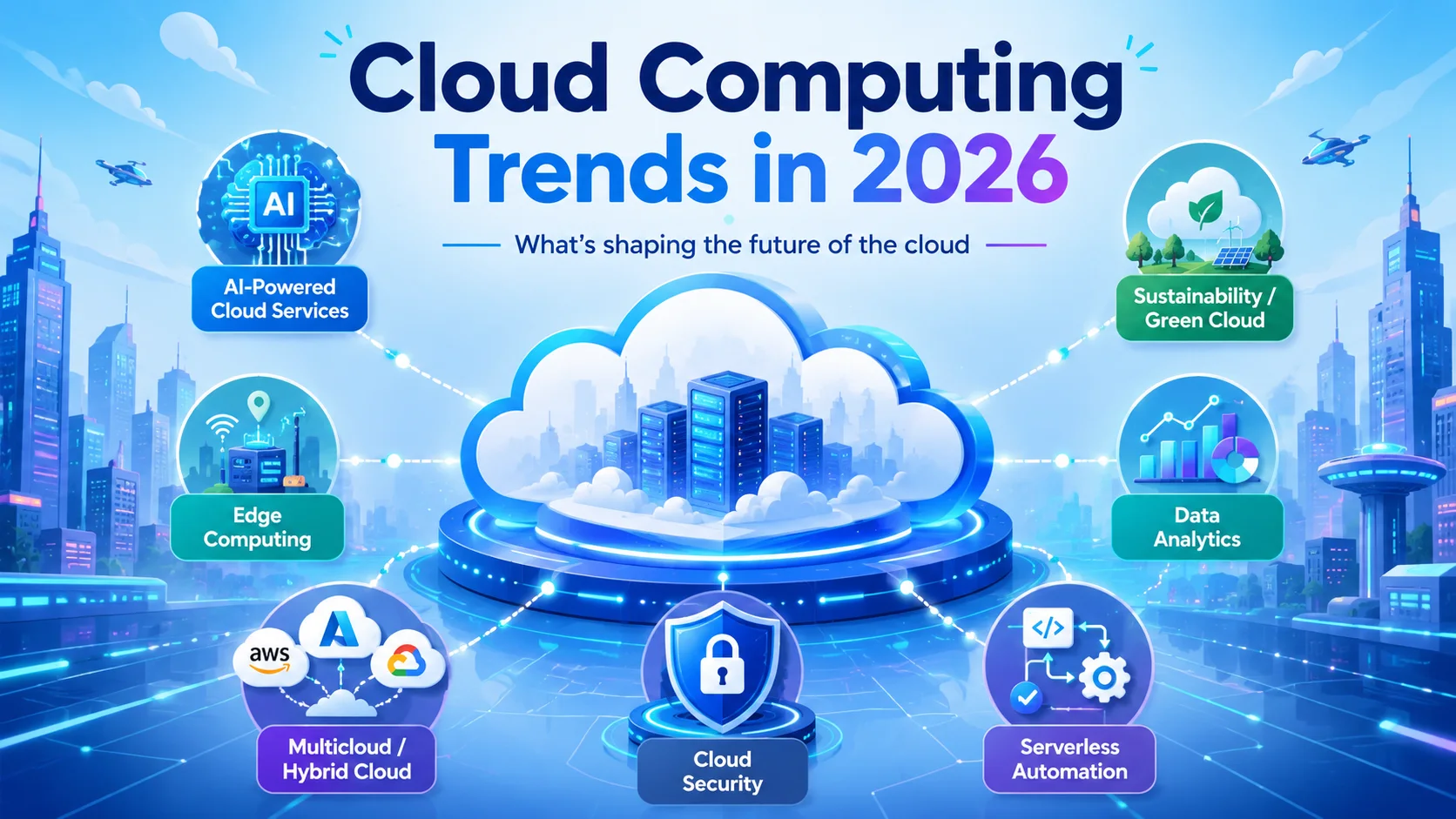
Cloud computing has shifted from a cost-saving initiative to a business transformation engine. In 2026, the cloud is not just where applications run — it is the operating model for how organizations build, deploy, and scale technology. This article explores the eight most significant trends shaping cloud computing today.
Introduction
Cloud computing has shifted from a cost-saving initiative to a business transformation engine. In 2026, the cloud is not just where applications run — it is the operating model for how organizations build, deploy, and scale technology. This article explores the eight most significant trends shaping cloud computing today.
1. Multi-Cloud and Hybrid Cloud Dominance
No single cloud provider meets every need. Organizations now routinely run workloads across AWS, Microsoft Azure, and Google Cloud Platform, alongside on-premises infrastructure.
Why Multi-Cloud?
| Reason | Explanation |
|---|---|
| Avoiding vendor lock-in | Freedom to choose best-of-breed services |
| Price optimization | Leverage competitive pricing between providers |
| Regulatory compliance | Data sovereignty requires specific geographic locations |
| Resilience | No single point of failure |
| Mergers and acquisitions | Inherited infrastructure must be integrated |
Hybrid Cloud Architecture
Hybrid cloud connects public cloud with on-premises (or edge) infrastructure:
┌─────────────────────────────────────────────────────┐
│                   Management Layer                   │
│           (Terraform, Crossplane, Anthos)            │
├─────────────┬──────────────┬──────────────┬─────────┤
│  AWS        │  Azure       │  GCP         │ On-Prem │
│  EC2, S3    │  VMs, Blob   │  Compute, GCS│  vSphere │
├─────────────┴──────────────┴──────────────┴─────────┤
│            Networking (AWS Direct Connect,           │
│          Azure ExpressRoute, GCP Interconnect)       │
└─────────────────────────────────────────────────────┘
Key enablers:
- Terraform — Provider-agnostic infrastructure as code.
- Kubernetes — Consistent orchestration across any environment.
- Istio — Service mesh for multi-cluster connectivity.
- Consul — Multi-cloud service discovery and networking.
Case study: Spotify runs critical workloads across GCP and its own data centers, using Kubernetes (via their Backstage platform) as the abstraction layer.
2. AI-Native Cloud Services
Cloud providers have embedded AI into every layer of their platforms. In 2026, AI is not a separate service — it is a built-in capability.
Managed AI/ML Services
| Provider | Training | Deployment | Specialized |
|---|---|---|---|
| AWS | SageMaker | SageMaker Inference | Bedrock (LLMs), Rekognition |
| Azure | Azure ML | Managed Online Endpoints | OpenAI Service, Cognitive Services |
| GCP | Vertex AI | Vertex Prediction | Gemini API, Document AI |
AI-Optimized Hardware
Cloud providers now offer specialized instances for AI workloads:
- AWS — Trainium (training), Inferentia (inference).
- Azure — ND-series with NVIDIA H100 and AMD MI300X.
- GCP — Cloud TPU v5p, A3 instances with H100 GPUs.
AI-Powered Cloud Management
Cloud providers also use AI to optimize themselves:
- AWS — Compute Optimizer recommends instance families based on ML analysis.
- Azure — Advisor provides cost and reliability recommendations.
- GCP — Active Assist identifies idle resources and right-sizing opportunities.
Cost impact: Organizations using AI-optimized instances report 40-50% lower inference costs compared to general-purpose GPUs.
3. Serverless Everywhere
Serverless computing has evolved far beyond simple functions (FaaS). In 2026, entire applications are built without provisioning a single server.
Serverless Ecosystem in 2026
| Layer | AWS | Azure | GCP |
|---|---|---|---|
| Compute | Lambda | Functions | Cloud Functions |
| Containers | Fargate | Container Instances | Cloud Run |
| Databases | DynamoDB | Cosmos DB | Firestore |
| Storage | S3 | Blob Storage | Cloud Storage |
| Messaging | SQS/SNS | Queue/Topics | Pub/Sub |
| Workflows | Step Functions | Logic Apps | Workflows |
| API | API Gateway | API Management | Cloud Endpoints |
Event-Driven Architecture Pattern
# Serverless event pipeline example
events:
  - source: S3 (file upload)
  → trigger: Lambda (process file)
  → store: DynamoDB (results)
  → notify: SNS (email notification)
  → archive: S3 Glacier (long-term storage)
Cold Start Mitigation
Serverless cold starts remain a concern but have been largely mitigated:
| Mitigation | How It Works |
|---|---|
| Provisioned Concurrency | Keep N instances always warm |
| SnapStart (AWS) | Pre-initialize and snapshot the execution environment |
| Function URLs | Direct HTTP endpoints without API Gateway overhead |
| Lighter runtimes | Node.js and Python cold start in <100ms vs. Java in ~1s |
Real-world adoption: Fidelity runs production trading workloads on Lambda processing 50,000+ requests per second.
4. Edge Computing Expansion
Processing is moving closer to users and devices. Edge computing addresses the latency, bandwidth, and data sovereignty limitations of centralized cloud.
Edge Tiers
| Tier | Location | Latency | Examples |
|---|---|---|---|
| Device Edge | On-device | <1ms | Smartphones, IoT sensors |
| Local Edge | On-premises | <5ms | Factory servers, 5G base stations |
| Regional Edge | Near population centers | <10ms | AWS Local Zones, Azure Edge Zones |
| Cloud Regions | Centralized | 50-200ms | Traditional cloud data centers |
Real-World Edge Deployments
Autonomous vehicles (Waymo):
- Sensor data processing on the vehicle (device edge).
- Map updates via 5G edge nodes (regional edge).
- Training models in centralized cloud.
Industrial IoT (Siemens):
- Machine sensors send data to on-premises edge gateways.
- Edge runs inference models for predictive maintenance.
- Aggregated data synchronizes to Azure for dashboards.
Content delivery (Netflix):
- Open Connect Appliances deployed at ISP locations.
- Caches popular content at the edge.
- Reduces backbone traffic by 95%.
5. FinOps and Cost Optimization
Cloud spend has become one of the largest IT expenses. FinOps (Financial Operations) brings financial accountability to cloud usage.
The FinOps Lifecycle
    ┌──────────────┐
    │   Inform     │ ← Visibility, allocation, benchmarking
    └──────┬───────┘
           │
    ┌──────▼───────┐
    │  Optimize    │ ← Right-sizing, reservations, discounts
    └──────┬───────┘
           │
    ┌──────▼───────┐
    │   Operate    │ ← Governance, automation, culture
    └──────────────┘
Cost Optimization Strategies
1. Right-Sizing:
# Check underutilized EC2 instances
aws ec2 describe-instances --filters "Name=instance-state-name,Values=running" \
  --query 'Reservations[*].Instances[*].{ID:InstanceId,Type:InstanceType}' \
  --output table

# Compare CPU utilization
aws cloudwatch get-metric-statistics \
  --namespace AWS/EC2 \
  --metric-name CPUUtilization \
  --dimensions Name=InstanceId,Values=i-12345 \
  --start-time 2024-01-01 --end-time 2024-01-31 \
  --period 3600 --statistics Average
2. Reserved and Spot Instances:
| Purchase Option | Discount | Commitment | Use Case |
|---|---|---|---|
| On-Demand | 0% | None | Variable workloads |
| Reserved (1yr) | 30-40% | 1 year | Steady-state workloads |
| Reserved (3yr) | 50-60% | 3 years | Predictable baselines |
| Spot | 70-90% | None | Fault-tolerant, batch, ML training |
3. Storage Tiering:
| Tier | Cost/GB/month | Access | Use Case |
|---|---|---|---|
| S3 Standard | $0.023 | Immediate | Active data |
| S3 Infrequent Access | $0.0125 | Immediate | Backups, old logs |
| S3 Glacier | $0.004 | Minutes to hours | Archives |
| S3 Glacier Deep Archive | $0.001 | 12 hours | Compliance archives |
FinOps Tools
- CloudHealth — Multi-cloud cost management, governance policies.
- AWS Cost Explorer — Native cost visualization.
- Vantage — Modern FinOps platform with AI recommendations.
- Infracost — Terraform cost estimation in CI/CD.
6. Sustainability and Green Cloud
Cloud providers are racing to reduce their carbon footprint, and customers are following suit.
Provider Commitments
| Provider | Target | Progress |
|---|---|---|
| AWS | 100% renewable by 2025, net-zero carbon by 2040 | 90% renewable in 2024 |
| Azure | Carbon-negative by 2030 | 100% renewable since 2014 |
| Google Cloud | Carbon-free energy 24/7 by 2030 | 64% carbon-free energy |
Measuring Cloud Carbon
# AWS Carbon Footprint Tool
aws ce get-custom-metrics --region us-east-1

# GCP Carbon Footprint (BigQuery)
SELECT *
FROM `region-us.INFORMATION_SCHEMA.CARBON_FOOTPRINT`
WHERE project_id = 'my-project'
Optimization Strategies
- Choose low-carbon regions (e.g., Sweden has 98% renewable energy).
- Schedule batch jobs for times when grid carbon intensity is lowest.
- Use serverless — auto-scaling means no idle resources.
- Delete orphaned resources (unattached EBS volumes, unused load balancers).
7. Kubernetes as the Universal Orchestrator
Kubernetes has won the container orchestration war. In 2026, it runs everywhere — on laptops, in data centers, and across all major clouds.
Managed Kubernetes Comparison
| Feature | EKS | AKS | GKE |
|---|---|---|---|
| Control plane cost | $0.10/hr | Free | $0.10/hr |
| Node management | Managed node groups | Node pools | Node auto-provisioning |
| Auto-scaling | Cluster Autoscaler | Cluster Autoscaler | Autopilot |
| Network | VPC CNI, Calico | Azure CNI, Cilium | VPC-native, Cilium |
| Storage | EBS, EFS, FSx | Azure Disk, Files | Persistent Disk, Filestore |
| Serverless | Fargate | Virtual Nodes | Autopilot |
Kubernetes + AI Workloads
Kubernetes has become the platform for ML workloads:
- Kubeflow — ML workflows on K8s.
- Ray on Kubernetes — Distributed ML training.
- KServe — Model inference serving.
- Volcano — Batch scheduling for AI/ML.
Service Mesh Evolution
Service meshes solve networking, security, and observability for K8s:
- Istio — Feature-rich, mature ecosystem.
- Linkerd — Lightweight, simpler.
- Cilium — eBPF-based, no sidecar required.
8. Zero Trust Cloud Security
Security in the cloud has fundamentally shifted. The perimeter is dead — there is no "inside" and "outside."
Cloud Security Posture Management (CSPM)
Tools that continuously assess cloud configurations against best practices:
- Wiz — Agentless cloud security scanning.
- Orca Security — Side-scanning for vulnerabilities.
- Prisma Cloud — Comprehensive CSPM + CWPP.
- AWS Security Hub — Native security findings aggregation.
Cloud-Native IAM Best Practices
{
  "Version": "2012-10-17",
  "Statement": [
    {
      "Effect": "Allow",
      "Action": ["s3:GetObject"],
      "Resource": ["arn:aws:s3:::data-bucket/*"],
      "Condition": {
        "IpAddress": {"aws:SourceIp": "10.0.0.0/16"}
      }
    }
  ]
}
- Use IAM roles instead of access keys.
- Implement least privilege — grant only what is needed.
- Use Conditions for context-aware policies.
- Enable IAM Access Analyzer to identify unintended access.
- Rotate credentials automatically.
Conclusion
The cloud in 2026 is characterized by multi-provider strategies, AI integration at every layer, and serverless-first thinking. Edge computing complements centralized cloud rather than replacing it. FinOps discipline ensures cloud spend is controlled. Security follows the zero trust model — no implicit trust anywhere.
Organizations that embrace these trends will gain speed, resilience, and cost efficiency. Those that ignore them risk falling behind in an increasingly competitive digital landscape.
Featured Articles
The 10 Largest Frontend Performance Challenges in 2026 (And How to Fix Them)
Should I Use React or Next.js? Complete Comparison Guide 2026
Build an Offline-First SaaS with Laravel & React: Complete PWA Tutorial 2026
Comments
0 commentsNo approved comments are visible yet. New community replies may wait for moderation.