Why a Simple CLAUDE.md Makes AI Coding Agents Better
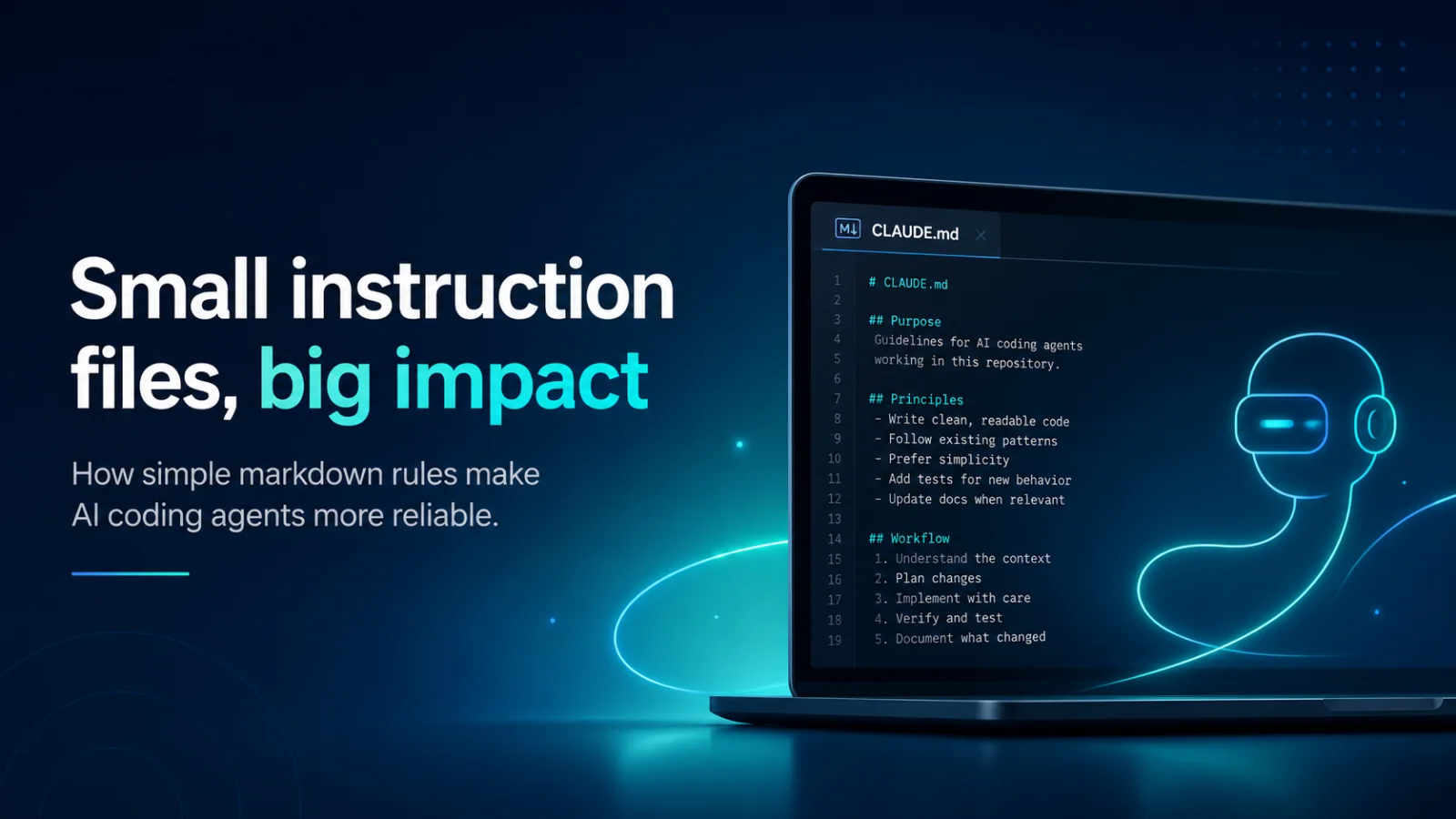
The most useful AI coding setup may be a short file that teaches the agent how to work, not a longer prompt describing what to build. AI coding agents are impressive in demos because demos are usually clean. The repository is small, the goal is obvious, and the cost of a wrong as
The Small File That Makes AI Coding Agents Much More Reliable
Meta Description:
AI coding agents like Claude Code, Codex, and Cursor become far more useful when they receive clear project rules. Learn why short instruction files such as CLAUDE.md and AGENTS.md can dramatically improve AI-assisted software development.
Introduction
AI coding agents can look impressive at first glance. In demos, they write code, generate components, explain bugs, and deliver seemingly complete solutions within minutes. But real software projects are very different from controlled demos.
Mature codebases contain old architectural decisions, hidden business rules, legacy behavior, incomplete migrations, implicit knowledge inside tests, and files that may look unnecessary but still protect important production behavior.
This is where many problems with AI coding agents begin. Not because they cannot write valid code, but because they often act too quickly. They edit before understanding the context, refactor too much, introduce unnecessary abstractions, or report success when the code only looks plausible.
A small instruction file can significantly improve this behavior.
What Is a CLAUDE.md or AGENTS.md File?
A CLAUDE.md file is a Markdown file that gives Claude Code persistent project instructions. OpenAI Codex uses a similar concept with AGENTS.md. Cursor and other AI development tools also support related forms of project rules.
The exact filename is less important than the concept behind it.
This file is not just a prompt for one task. It is more like a lightweight operating manual for the coding agent. It does not only describe what should be built. It explains how the agent should work inside the project.
A good instruction file can define:
how the agent should inspect the codebase before making changes;
which architectural boundaries must be respected;
which tests or commands should be run after changes;
when the agent should ask before continuing;
what the team considers “done”;
which parts of the project must not be changed without approval.
This makes the agent not only faster, but also more predictable and easier to review.
The Real Problem: AI Agents Are Often Too Eager
Many developers give AI coding agents tasks like:
“Add this endpoint.”
“Fix this validation bug.”
“Optimize this query.”
“Build this feature.”
The result may be useful, but not always safe. Most prompts describe the desired outcome, not the expected working process.
An experienced developer would usually inspect the existing flow, read relevant tests, understand edge cases, and then make a focused change. An AI agent, however, often builds a likely solution and starts implementing immediately.
In real projects, that can cause serious issues. An agent might:
change five files when one targeted change would be enough;
replace an existing project pattern with a newer but unnecessary one;
add a dependency even though the framework already provides the feature;
refactor nearby code that was not part of the task;
skip the right tests;
hide uncertainty behind a confident summary.
The more autonomous coding agents become, the more important clear working rules become.
Why Short Rules Work Better Than Long Prompts
Many teams try to control AI agents with very long prompts. This can seem reasonable at first, but it often creates new problems. Long prompts mix product requirements, coding style, architectural history, examples, exceptions, and personal preferences.
The agent then has to decide which instruction matters most at each step. That creates ambiguity again.
Short, concrete rules usually work better.
Instead of:
Write high-quality code.
Use:
Read the affected files and tests first. Then briefly explain the likely root cause before changing code.
Instead of:
Avoid overengineering.
Use:
Do not introduce a new abstraction if the existing structure can solve the requirement cleanly.
Instead of:
Test your work.
Use:
Run the narrowest relevant test first and clearly state what could not be verified.
Good rules are short, reusable, and verifiable.
Rule 1: Understand Before Coding
An AI agent should not immediately start editing files. First, it needs to understand where the problem happens and which parts of the application are involved.
For a backend bug, this might mean checking:
the route;
the middleware;
the controller;
the service or action;
the model logic;
migrations or database constraints;
existing tests;
the expected response format.
Only after that should the agent write a short implementation plan.
A useful rule is:
Before changing code, explain the likely cause, name the affected files, and describe how the change will be verified.
This reduces wrong assumptions before they become code.
Rule 2: Prefer Simple Solutions
AI models know many modern software patterns: factories, interfaces, events, listeners, repositories, pipelines, services, and configuration layers. This knowledge is useful, but it can also become dangerous.
Not every small change needs a new architecture.
If an existing Laravel validation rule solves the problem, the agent should not create a custom validation framework. If an existing service is already used by the project, the agent should not introduce a parallel service. If a database constraint is the correct place to protect an invariant, it is often safer than relying only on application-level checks.
Simple does not mean weak or careless. Simple means the solution satisfies the current requirement with the least necessary complexity and fits the existing codebase.
A good rule is:
Choose the simplest solution that satisfies the current requirement and follows the existing project patterns.
Rule 3: Make Surgical Changes
A good AI-generated change is not always the shortest change, but it should be focused.
A surgical change modifies exactly what is necessary for the task. Nothing more.
This can still involve several files. A correct fix may require a migration, validation, a test, and documentation. The key point is that every changed line must have a clear reason.
The agent should avoid:
unnecessary formatting changes;
refactoring unrelated code;
changing public APIs without approval;
renaming things without functional value;
deleting code that only appears unused;
creating parallel architectural paths.
If the agent discovers a separate issue, it should report it instead of silently expanding the scope.
A strong rule is:
Make the smallest coherent diff that correctly solves the problem. Do not refactor unrelated code unless explicitly asked.
Rule 4: Do Not Say “Done” Before Verification
Code that compiles is not automatically correct. Code that looks logical is not automatically production-ready.
After every change, the agent should show what was verified.
Depending on the project, this may include:
the narrowest relevant unit or feature test;
the affected test suite;
static analysis;
linting;
formatting;
a final diff review;
a clear statement about anything that was not verified.
An honest summary is more useful than a confident but incomplete success message.
For example:
The feature test for duplicate subscriptions passes. The full test suite was not run. Redis-related queue jobs could not be verified locally.
That is far more useful than:
Done, everything works.
Example from a Laravel Project
Imagine a team wants to prevent duplicate subscription records.
An overly eager agent might restructure the service, add a repository layer, and check for duplicates using an application query. That may look correct at first, but it can still fail under concurrent requests.
A better-instructed agent would first read the migrations, model, service, controller, and tests. Then it would likely recognize that the database is the right boundary for enforcing this rule reliably.
A better solution would probably include:
adding a composite unique index;
translating the database error into the existing validation response;
keeping the current service structure;
adding a feature test for duplicate subscriptions;
avoiding unnecessary architectural changes.
For Laravel projects, rules like these are especially useful:
use Form Requests for HTTP validation;
preserve existing Service and Resource patterns;
avoid queries inside loops;
protect critical invariants with database constraints;
do not edit already-deployed migrations; create a new migration instead;
do not add new dependencies without approval;
respect existing response formats.
How Teams Should Use Instruction Files in Real Projects
The best starting point is not a huge policy document. A better approach is to begin with ten to twenty precise rules based on real review comments and recurring AI-agent mistakes.
If the team repeatedly says, “Do not edit generated files,” that belongs in the instruction file.
If every prompt repeats the same test command, that command should be documented there.
If a specific architectural pattern must always be respected, it should be clearly written down.
This file should be maintained like code. Outdated rules should be removed, contradictions should be fixed, and vague instructions should be replaced with concrete commands.
An instruction file does not replace proper safeguards. It is not a hard security boundary. Branch protection, CI, code reviews, permissions, tests, and hooks are still necessary.
Example of a Short AGENTS.md or CLAUDE.md File
# AI Coding Agent Instructions

## Before changing code
- Read the relevant files and understand the existing flow.
- Check existing tests before implementing a solution.
- State the likely root cause and a short implementation plan.
- Ask before adding dependencies or changing public behavior.

## While changing code
- Prefer the simplest solution that satisfies the requirement.
- Make the smallest coherent diff.
- Preserve existing conventions, APIs, naming, and response formats.
- Do not refactor unrelated code.
- Do not edit generated files unless explicitly requested.

## Verification
- Run the narrowest relevant test first.
- Run the broader affected suite when practical.
- Run formatting, linting, or static analysis required by the repository.
- Review the final diff for accidental changes.
- Report what changed, what was verified, and what remains uncertain.
This file is intentionally short. It is not meant to replace every technical decision. It is meant to remind the agent how a professional developer should work inside this repository.
Conclusion
The most important lesson behind CLAUDE.md, AGENTS.md, and similar project rules is simple: AI-assisted development depends not only on the model, but also on the process.
A powerful model with a vague task can generate impressive but risky code. A powerful model with clear working rules is more likely to produce a small, reviewable, and maintainable engineering change.
Teams should treat AI coding agents like very fast junior developers with broad technical knowledge but incomplete local judgment. They can do a lot, but they need project rules, clear boundaries, and reliable verification.
The future of AI-assisted software development does not belong to the longest prompt. It belongs to teams that translate good engineering judgment into short, persistent, and verifiable rules.
Keywords
CLAUDE.md
AGENTS.md
AI coding agents
Claude Code
OpenAI Codex
Cursor AI
AI-assisted software development
AI coding agent instructions
better prompts for AI agents
software development with AI
Alternative Titles
Why a Small Instruction File Makes AI Coding Agents More Reliable
CLAUDE.md and AGENTS.md: Better Rules for Better AI Development
Stop Writing Longer Prompts — Give Your AI Agent Clear Working Rules
How Teams Can Use AI Coding Agents More Safely and Productively
The Most Important File for Reliable AI-Assisted Software Development
Sources and Further Reading
Featured Articles

Kafka in Production: Partition Strategy, Consumer Lag, Reliability, and an Incident Playbook
A production Kafka cluster needs more than brokers. Learn to choose partition keys, plan retention and capacity, monitor lag, handle rebalances, and rehearse failure recovery.

Laravel and Kafka Without Lost Events: The Transactional Outbox, Idempotent Consumers, and PostgreSQL
A database commit and a Kafka publish cannot safely be treated as one ordinary transaction. This guide builds an outbox and consumer design that survives crashes and duplicate delivery.

Apache Kafka Explained: Topics, Partitions, Consumer Groups, and Your First Event Pipeline
Follow one order event from producer to consumers, then run a local Kafka topic and learn what partitions, offsets, keys, and consumer groups actually do.
Comments
0 commentsNo approved comments are visible yet. New community replies may wait for moderation.