The 50 Claude Skills That Can Save Hours Every Week
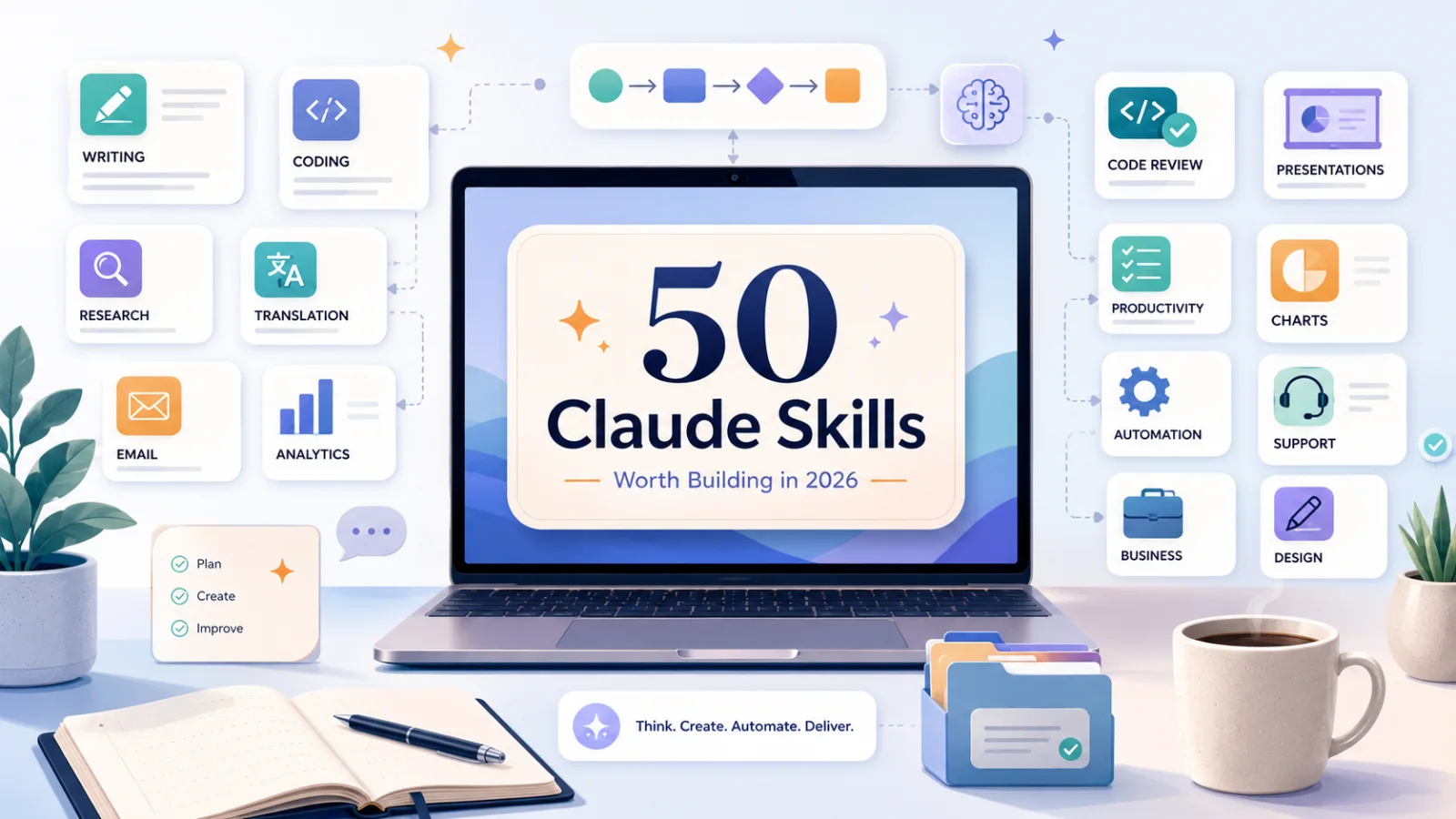
50 Claude Skills Worth Building in 2026
Meta Description:
Claude Skills can turn repeated prompts into reusable workflows. Here are 50 practical Claude Skills for writing, coding, research, business, productivity, design, analysis, and everyday work.
Introduction
Most people do not have an AI problem.
They have a repeatability problem.
They ask Claude the same kind of thing again and again: write this email, summarize this document, improve this article, review this code, create a report, clean this data, make this presentation better, or turn messy notes into something useful.
The first time, a prompt is fine.
The tenth time, the prompt becomes a waste.
That is where Claude Skills become useful.
A Claude Skill is not just another prompt. It is a reusable workflow. It tells Claude how to handle a specific type of task with your rules, your format, your tone, your standards, and your preferred output style.
Instead of explaining the same instructions every time, you package the workflow once and reuse it.
I would not build hundreds of skills randomly. Most people do not need that. What they need is a focused library of skills that remove repeated work.
Here are 50 Claude Skills worth building.
Writing and Content Skills
1. Blog Article Writer Skill
This skill turns a topic, outline, or rough idea into a complete blog article.
It should include rules for structure, introduction style, heading depth, SEO keywords, examples, conclusion, slug, and meta description.
Best for bloggers, marketers, developers, and founders who publish regularly.
2. SEO Rewriter Skill
This skill rewrites existing content to make it more search-friendly without making it sound robotic.
It should improve titles, headings, keyword placement, internal linking suggestions, readability, and meta descriptions.
Use it when an article is good but not optimized.
3. Multilingual Article Translator Skill
This skill translates articles into multiple languages while keeping the meaning, tone, SEO intent, and formatting.
It should avoid literal translation and rewrite naturally for each language.
Useful languages could include Arabic, English, German, Spanish, Turkish, and French.
4. Technical Blog Simplifier Skill
This skill takes complex technical content and rewrites it in a simpler way.
It should keep the technical accuracy but reduce unnecessary jargon.
Useful for explaining AI, cybersecurity, programming, cloud, DevOps, or backend concepts to a wider audience.
5. Medium-Style Article Skill
This skill creates readable, story-driven articles with a strong hook, short paragraphs, clear sections, and practical takeaways.
It should not copy any specific writer, but it can follow a modern online article rhythm.
Best for thought-leadership posts.
6. Newsletter Writer Skill
This skill turns a topic or weekly update into a polished newsletter.
It should include a subject line, short opening, main sections, bullet summary, useful links, and a call to action.
Best for creators, startups, and internal company updates.
7. LinkedIn Post Skill
This skill turns an idea into a strong LinkedIn post.
It should create a hook, short paragraphs, professional tone, clear lesson, and optional hashtags.
Best for developers, founders, consultants, and professionals building personal brands.
8. X/Twitter Thread Skill
This skill converts a long idea into a short thread.
It should create a strong first post, numbered points, concise wording, and a final takeaway.
Best for sharing technical lessons, startup ideas, AI workflows, and productivity tips.
9. Case Study Writer Skill
This skill turns project notes into a professional case study.
It should include problem, context, solution, implementation, results, lessons learned, and business impact.
Useful for agencies, freelancers, SaaS teams, and developers.
10. Content Repurposing Skill
This skill takes one piece of content and turns it into many formats.
For example, one article can become a LinkedIn post, email newsletter, short thread, video script, and SEO summary.
Best for getting more value from one strong idea.
Coding and Software Engineering Skills
11. Code Review Skill
This skill reviews code like a senior engineer.
It should check readability, correctness, edge cases, security, performance, maintainability, naming, duplication, and test coverage.
The output should separate critical issues from suggestions.
12. Laravel Backend Review Skill
This skill reviews Laravel code specifically.
It should check controllers, Form Requests, services, resources, migrations, database constraints, queues, policies, observers, and performance risks.
Best for Laravel teams.
13. API Design Skill
This skill reviews or designs API endpoints.
It should check routes, request validation, response structure, status codes, pagination, filtering, authentication, authorization, and error handling.
Best for backend developers and API teams.
14. Database Query Optimization Skill
This skill analyzes SQL queries or ORM code and suggests performance improvements.
It should check indexes, joins, N+1 queries, pagination, query plans, filtering, and unnecessary loading.
Useful for Laravel, PostgreSQL, MySQL, and general backend systems.
15. Migration Safety Skill
This skill reviews database migrations before deployment.
It should check destructive changes, locking risks, large-table impact, rollback behavior, naming, constraints, and zero-downtime concerns.
Best for production systems.
16. Bug Investigation Skill
This skill helps investigate bugs methodically.
It should ask for symptoms, expected behavior, actual behavior, logs, reproduction steps, recent changes, and affected files.
Then it should produce likely causes and a debugging plan.
17. Refactoring Planner Skill
This skill creates a safe refactoring plan without changing behavior.
It should identify risk, dependencies, tests needed, files affected, and step-by-step migration.
Best for legacy codebases.
18. Test Case Generator Skill
This skill creates unit, feature, integration, and edge-case test scenarios.
It should cover happy path, failure cases, boundary values, permissions, concurrency, and regression cases.
Best for improving test coverage.
19. Pull Request Description Skill
This skill turns code changes into a clean PR description.
It should include summary, motivation, changed files, testing, screenshots if needed, risks, and rollback notes.
Very useful for engineering teams.
20. Error Message Improver Skill
This skill rewrites technical errors into clear user-facing messages.
It should keep messages accurate, short, helpful, and consistent with product tone.
Best for SaaS products and dashboards.
AI and Prompt Workflow Skills
21. Prompt Builder Skill
This skill turns vague requests into structured prompts.
It should define role, context, task, constraints, output format, examples, and quality checks.
Best for users who often ask AI tools for complex work.
22. Claude Skill Creator Skill
This skill helps create new Claude Skills.
It should ask what workflow is repeated, what input is expected, what output format is required, and what rules must always be followed.
Then it should generate the skill instructions.
23. AI Output Critic Skill
This skill reviews AI-generated answers critically.
It should check accuracy, missing assumptions, weak reasoning, vague claims, unsupported facts, and overconfidence.
Best for improving AI reliability.
24. Anti-Flattery Decision Skill
This skill prevents Claude from simply agreeing with the user.
It should challenge assumptions, identify trade-offs, provide counterarguments, and recommend a decision only after weighing evidence.
Useful for business, leadership, architecture, and product decisions.
25. Research Prompt Skill
This skill creates strong research prompts.
It should specify sources, comparison criteria, date sensitivity, citation requirements, and expected depth.
Best for deep research workflows.
Business and Strategy Skills
26. Business Idea Evaluator Skill
This skill evaluates startup or project ideas.
It should analyze market need, customer pain, competition, monetization, difficulty, risks, and first MVP.
Best for founders and product builders.
27. Product Requirements Skill
This skill turns an idea into a PRD.
It should include problem statement, goals, user stories, functional requirements, non-functional requirements, acceptance criteria, risks, and open questions.
Best for product managers and engineering teams.
28. Competitor Analysis Skill
This skill compares competitors.
It should analyze positioning, pricing, features, strengths, weaknesses, target users, marketing strategy, and differentiation opportunities.
Best for startups and marketers.
29. Business Email Skill
This skill writes professional emails.
It should support different tones: polite, direct, formal, friendly, follow-up, apology, negotiation, and escalation.
Best for daily business communication.
30. Proposal Writer Skill
This skill turns client requirements into a professional proposal.
It should include scope, deliverables, timeline, assumptions, exclusions, pricing structure, and next steps.
Best for freelancers and agencies.
Productivity and Personal Workflow Skills
31. Meeting Notes Skill
This skill turns messy meeting notes into structured output.
It should include summary, decisions, action items, owners, deadlines, risks, and follow-up questions.
Best for managers, team leads, and project teams.
32. Daily Planning Skill
This skill creates a realistic daily work plan.
It should sort tasks by priority, energy level, urgency, dependencies, and available time.
Best for busy professionals.
33. Weekly Review Skill
This skill reviews the week.
It should summarize wins, unfinished work, blockers, lessons, priorities, and next-week focus.
Best for personal productivity and team reporting.
34. Standup Update Skill
This skill turns rough notes into a clean standup update.
It should format work done, work in progress, blockers, and next steps.
Best for software teams.
35. Task Breakdown Skill
This skill breaks large tasks into smaller steps.
It should include sequence, dependencies, estimated difficulty, risks, and clear completion criteria.
Best for coding tasks, business work, and learning plans.
Research and Analysis Skills
36. Document Summarizer Skill
This skill summarizes long documents.
It should extract main points, decisions, obligations, risks, open questions, and action items.
Best for PDFs, reports, contracts, and documentation.
37. Source Comparison Skill
This skill compares multiple sources.
It should identify agreement, disagreement, missing evidence, quality of sources, and practical conclusion.
Best for research-heavy decisions.
38. Market Research Skill
This skill creates a structured market research report.
It should include market size signals, customer segments, competitors, trends, risks, and opportunity areas.
Best for business planning.
39. Legal/Policy Summary Skill
This skill summarizes legal or policy documents in plain language.
It should not replace a lawyer, but it can identify clauses, obligations, deadlines, penalties, and questions to ask.
Best for initial review.
40. Decision Matrix Skill
This skill compares options using weighted criteria.
It should define criteria, score each option, explain trade-offs, and recommend the strongest choice.
Best for choosing tools, vendors, strategies, or technical approaches.
Design, Media, and Presentation Skills
41. Presentation Builder Skill
This skill turns an article or idea into a slide outline.
It should include title slide, agenda, key sections, visual suggestions, speaker notes, and conclusion.
Best for business and educational presentations.
42. Brand Style Skill
This skill applies brand rules to content.
It should define tone, color preferences, typography notes, image style, voice, forbidden words, and formatting standards.
Best for consistent publishing.
43. Image Prompt Generator Skill
This skill turns article topics into image generation prompts.
It should include style, composition, subject, mood, color palette, aspect ratio, and negative instructions.
Best for blog covers and social media visuals.
44. Infographic Planner Skill
This skill turns complex information into an infographic structure.
It should define title, sections, icons, visual hierarchy, labels, and short copy.
Best for educational content.
45. Video Script Skill
This skill turns an article into a short video script.
It should include hook, scenes, narration, on-screen text, visuals, and call to action.
Best for YouTube Shorts, TikTok, Instagram Reels, and explainer videos.
Data and Operations Skills
46. Spreadsheet Analysis Skill
This skill analyzes spreadsheet data.
It should identify totals, trends, anomalies, missing values, duplicates, and useful charts.
Best for business operations and reporting.
47. KPI Report Skill
This skill turns raw metrics into a management report.
It should include summary, movement, causes, risks, and recommended actions.
Best for dashboards and business reviews.
48. Customer Feedback Analysis Skill
This skill groups customer feedback into themes.
It should extract complaints, feature requests, sentiment, urgency, examples, and product recommendations.
Best for SaaS and customer support teams.
49. Support Reply Skill
This skill writes customer support replies.
It should be polite, clear, helpful, and aligned with company policy.
It should also identify when escalation is needed.
50. SOP Builder Skill
This skill turns a repeated process into a standard operating procedure.
It should include purpose, when to use it, step-by-step instructions, responsible roles, checklist, examples, and quality checks.
Best for teams that want consistent operations.
How to Choose Which Skills to Build First
Do not build 50 skills on day one.
Start with the tasks you repeat every week.
A good first Claude Skill usually has three signs:
You repeat the same prompt often.
You care about consistent formatting.
Mistakes are costly or annoying.
For most people, the best first five skills are:
Blog Article Writer Skill
Code Review Skill
Meeting Notes Skill
Document Summarizer Skill
Image Prompt Generator Skill
These save time immediately because they replace repeated instructions.
What Makes a Good Claude Skill?
A good skill is specific.
Bad skill:
Help me write better.
Better skill:
Rewrite technical blog posts for a developer audience using short paragraphs, clear headings, practical examples, SEO keywords, and a direct professional tone.
A good skill should define:
when to use it;
what input it expects;
what output format it should produce;
what rules it must follow;
what it should avoid;
examples of good output;
quality checks before final response.
The narrower the skill, the more reliable it becomes.
Final Thoughts
Claude Skills are useful because they turn repeated work into reusable workflows.
Prompts are temporary.
Skills are systems.
You do not need hundreds of them. You need the right ones: skills that match the work you actually do every week.
Start small. Build one skill for one repeated workflow. Test it. Improve it. Then build the next one.
Over time, you are not just using AI.
You are building your own operating system for work.
## Sources and GitHub Links
- [Anthropic Agent Skills official repository](https://github.com/anthropics/skills)
- [Claude Skills Collection](https://github.com/abubakarsiddik31/claude-skills-collection)
- [Claude Code Skills / Agent Skills / Plugins Library](https://github.com/alirezarezvani/claude-skills)
- [Anthropic Claude Code Plugins official repository](https://github.com/anthropics/claude-plugins-official)
- [Andrej Karpathy Skills / CLAUDE.md reference](https://github.com/multica-ai/andrej-karpathy-skills)
- [Karpathy Guidelines Skill.md](https://github.com/multica-ai/andrej-karpathy-skills/blob/main/skills/karpathy-guidelines/SKILL.md)
Featured Articles

8 Claude Code Plugins That Make Everyday Development Easier in 2026
A practical shortlist of Claude Code plugins, with real use cases and a sensible way to start.

Laravel 13 AI SDK: Build a Useful First Agent Without Losing Control
A practical introduction to Laravel’s first-party AI SDK, using support-ticket triage to show where an agent helps and where application code stays in charge.

YOLO Object Detection: A Complete Practical Guide for Developers
A developer-focused, end-to-end guide to YOLO object detection covering core concepts, datasets, training, evaluation, real-time inference, deployment, optimization, production risks, and interviews.
Comments
0 commentsNo approved comments are visible yet. New community replies may wait for moderation.