6 Simple Engineering Habits That Make Code Easier to Maintain
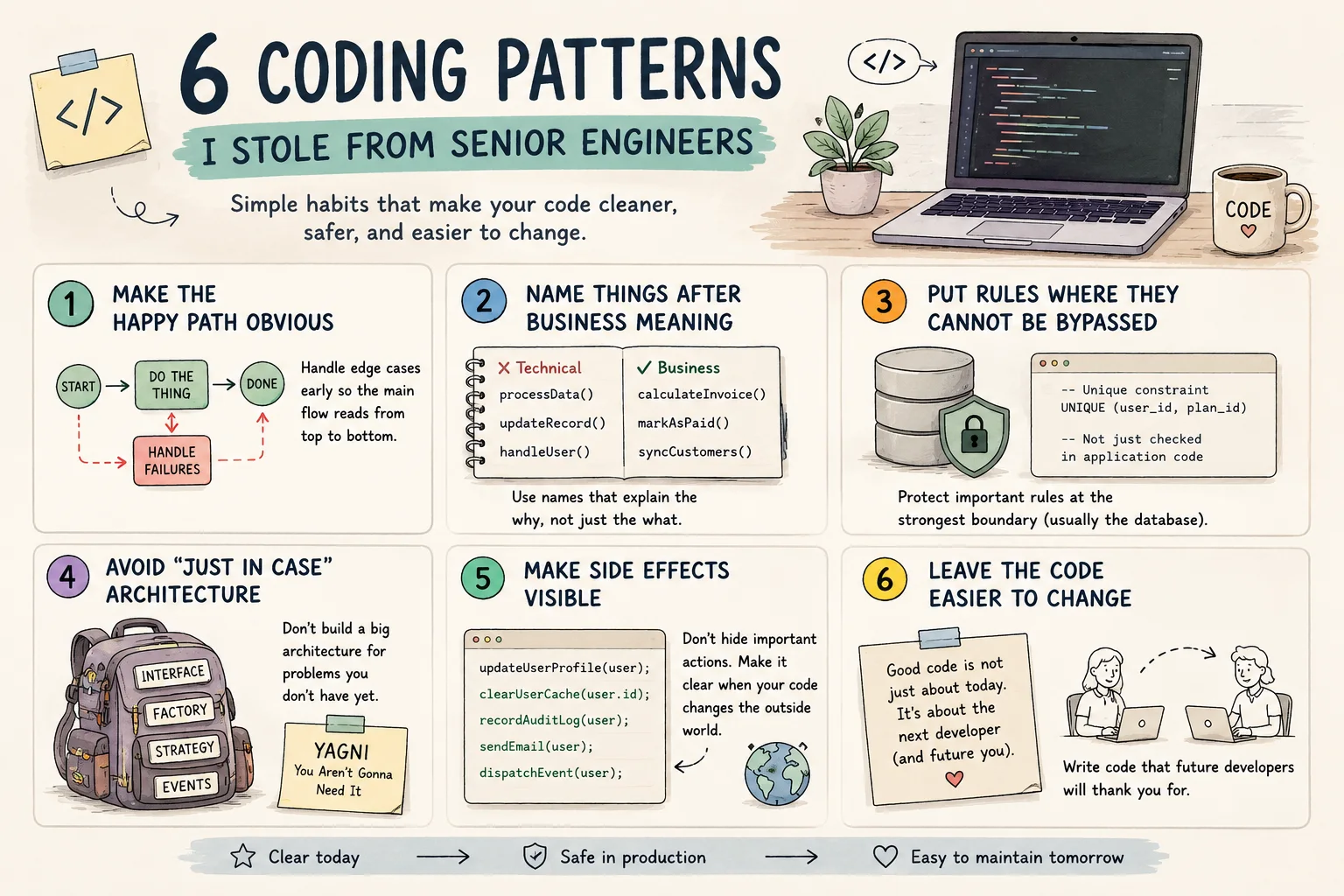
6 Coding Patterns I Stole From Senior Engineers
Meta Description:
Senior engineers do not write better code because they know more tricks. They write better code because they avoid unnecessary complexity. Here are six practical coding patterns worth stealing.
Introduction
When I was earlier in my career, I thought senior engineers were better because they knew more syntax, more frameworks, more design patterns, and more clever shortcuts.
Later, I realized that was only a small part of the story.
The best senior engineers I worked with were not always writing the most impressive-looking code. Their solutions were often simple, boring, and easy to follow. At first, that felt disappointing. I expected advanced engineering to look more advanced.
But then requirements changed. Bugs appeared. Production incidents happened. New developers joined the team. Old code had to be modified months later.
That is when their code started to make sense.
Good senior engineers do not just write code that works today. They write code that can survive tomorrow.
These are six coding patterns I quietly stole from senior engineers and still use today.
1. They Make the Happy Path Obvious
Junior code often tries to handle everything at once.
Validation, edge cases, database logic, formatting, authorization, and response handling all live in the same function. The code works, but reading it feels like solving a puzzle.
Senior engineers usually do something different.
They make the main flow easy to see.
The happy path should be readable from top to bottom. The reader should quickly understand what the function is trying to do before getting lost in details.
Instead of writing code like this:
function createOrder(user, items) {
  if (user && user.active && items && items.length > 0) {
    if (hasStock(items)) {
      const total = calculateTotal(items);
      if (total > 0) {
        const order = saveOrder(user, items, total);
        sendEmail(user, order);
        return order;
      }
    }
  }

  throw new Error("Invalid order");
}
A cleaner version separates failure cases early:
function createOrder(user, items) {
  if (!user || !user.active) {
    throw new Error("Invalid user");
  }

  if (!items || items.length === 0) {
    throw new Error("Order must contain items");
  }

  if (!hasStock(items)) {
    throw new Error("Some items are out of stock");
  }

  const total = calculateTotal(items);
  const order = saveOrder(user, items, total);

  sendEmail(user, order);

  return order;
}
This is not more clever. It is more readable.
The pattern is simple:
Handle invalid cases early, then let the main flow breathe.
This makes the code easier to scan, easier to debug, and easier to extend.
2. They Name Things After Business Meaning, Not Technical Details
Many developers name things based on what the code technically does.
Examples:
handleData()
processItems()
updateRecord()
doValidation()
manageUser()
These names are not wrong, but they do not explain much.
Senior engineers tend to name things after the business action or domain concept.
Instead of:
processItems()
They write:
calculateCartTotal()
Instead of:
updateRecord()
They write:
markInvoiceAsPaid()
Instead of:
handleData()
They write:
syncCustomerSubscriptions()
Good names reduce the need for comments. They tell the next developer what the code means, not only what it does.
This matters because most code is read more than it is written.
A technical name describes implementation.
A business name explains intention.
The pattern is:
Name functions and variables according to the problem domain, not just the operation.
This small habit makes large codebases much easier to understand.
3. They Put Rules Where They Cannot Be Bypassed
A common mistake is protecting important business rules only in application code.
For example, imagine a system where a user cannot subscribe twice to the same plan.
A weak solution checks this before inserting:
$exists = Subscription::where('user_id', $userId)
    ->where('plan_id', $planId)
    ->exists();

if ($exists) {
    throw new Exception('Subscription already exists.');
}

Subscription::create([
    'user_id' => $userId,
    'plan_id' => $planId,
]);
This may work during normal testing.
But under concurrent requests, two requests can pass the check at the same time and both create duplicate records.
Senior engineers often think differently. They ask:
Where should this rule live so it cannot be bypassed?
In this case, the answer is probably the database.
A stronger solution uses a unique constraint:
$table->unique(['user_id', 'plan_id']);
Then the application handles the database error and returns a clean validation response.
This pattern appears everywhere:
required fields should be validated;
unique rules should be enforced by the database;
permissions should be checked at the boundary;
money calculations should avoid floating point mistakes;
critical state transitions should be protected.
The pattern is:
Put important rules at the strongest boundary available.
Application checks are useful. But critical invariants should not depend only on developers remembering to call the right function.
4. They Avoid “Just in Case” Architecture
One of the most expensive habits in software development is building for imaginary future requirements.
You start with a simple feature. Then you think:
“What if we support multiple providers later?”
“What if this becomes a microservice?”
“What if we need ten different strategies?”
“What if the client asks for advanced customization?”
Suddenly, a small feature becomes a factory, an interface, a strategy layer, an event system, and three configuration files.
Senior engineers are usually more careful.
They do not ignore the future, but they do not build a full architecture for a future that may never happen.
They prefer designs that are simple now and easy to change later.
There is a big difference between flexible code and over-engineered code.
Flexible code is clear, focused, and easy to modify.
Over-engineered code adds layers before there is a real reason.
A simple example:
class InvoiceService
{
    public function generate(Customer $customer): Invoice
    {
        // clear current behavior
    }
}
This may be better than prematurely creating:
interface InvoiceGenerationStrategyInterface
{
    public function generate(Customer $customer): Invoice;
}
If there is only one invoice generation flow today, the interface may not add value yet.
The pattern is:
Do not introduce abstraction before the code has earned it.
Good architecture grows from real pressure, not from fear.
5. They Make Side Effects Visible
Some functions look harmless but secretly do too much.
For example:
updateUserProfile(user);
This sounds simple.
But what if it also:
updates the database;
clears cache;
sends an email;
writes an audit log;
triggers a webhook;
dispatches a background job?
That function is no longer just updating a profile. It is changing the outside world in several ways.
Senior engineers are careful with side effects. They try to make them visible.
A clearer version might look like this:
updateUserProfile(user);
clearUserCache(user.id);
recordProfileAuditLog(user);
dispatchProfileUpdatedEvent(user);
This is slightly longer, but much easier to reason about.
The reader can see what happens.
This matters during debugging. Hidden side effects create surprising bugs. They also make testing harder because calling one function unexpectedly triggers many other behaviors.
The pattern is:
Make important side effects explicit.
This does not mean every line must be exposed. It means important external actions should not be hidden behind innocent names.
If a function sends emails, changes payment status, deletes files, or dispatches jobs, the code should make that obvious.
6. They Leave the Code Easier to Change
A junior developer often asks:
“Does this work?”
A senior engineer asks:
“Will this still be understandable when someone changes it later?”
That difference changes how they write code.
Senior engineers think about the next developer. Sometimes that next developer is another teammate. Sometimes it is themselves six months later.
They avoid clever one-liners when a simple version is easier to maintain. They avoid mixing responsibilities. They avoid making the reader jump across ten files to understand a small behavior.
They also leave useful clues.
Not obvious comments like:
// increment count by 1
count++;
But comments that explain why something exists:
// We keep this grace period because some payment providers
// send webhook confirmations a few seconds after checkout.
const PAYMENT_CONFIRMATION_GRACE_PERIOD_SECONDS = 30;
That kind of comment protects future developers from removing code that looks unnecessary.
The pattern is:
Optimize for the next change, not only the current implementation.
Good code is not just code that passes tests. Good code is code that the next developer can safely modify.
Final Thoughts
The best coding patterns I learned from senior engineers were not flashy.
They were not about using the newest framework.
They were not about writing clever abstractions.
They were not about making code look impressive.
They were about judgment.
Make the main path obvious.
Name things by meaning.
Protect rules at strong boundaries.
Avoid architecture you do not need yet.
Make side effects visible.
Leave the code easier to change.
That is the kind of code that survives.
Not because it is perfect.
Because it is understandable.
Featured Articles

Kafka in Production: Partition Strategy, Consumer Lag, Reliability, and an Incident Playbook
A production Kafka cluster needs more than brokers. Learn to choose partition keys, plan retention and capacity, monitor lag, handle rebalances, and rehearse failure recovery.

Laravel and Kafka Without Lost Events: The Transactional Outbox, Idempotent Consumers, and PostgreSQL
A database commit and a Kafka publish cannot safely be treated as one ordinary transaction. This guide builds an outbox and consumer design that survives crashes and duplicate delivery.

Apache Kafka Explained: Topics, Partitions, Consumer Groups, and Your First Event Pipeline
Follow one order event from producer to consumers, then run a local Kafka topic and learn what partitions, offsets, keys, and consumer groups actually do.
Comments
0 commentsNo approved comments are visible yet. New community replies may wait for moderation.