The Future of Artificial Intelligence: What to Expect by 2030
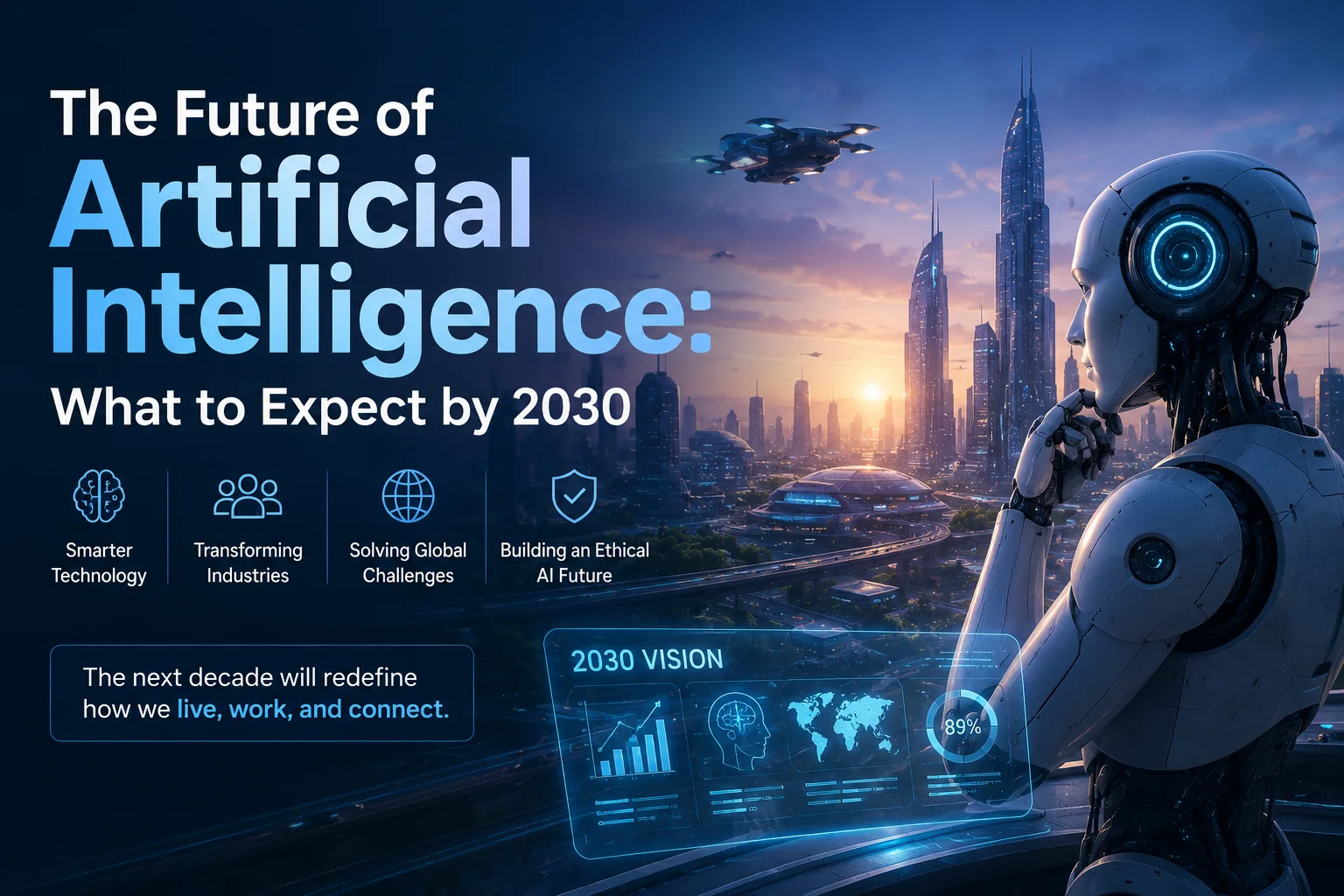
We are in the middle of the most transformative technological shift since the internet. By 2030 — just four years from now — AI will have reshaped how we work, learn, create, and interact. Here is what to expect.
A Snapshot of the AI Landscape
We are in the middle of the most transformative technological shift since the internet. By 2030 — just four years from now — AI will have reshaped how we work, learn, create, and interact. Here is what to expect.
1. AI Agents Will Do Your Work (While You Oversee)
2026 Today
We have AI assistants that write emails and generate code snippets.
2030 Prediction
Autonomous AI agents will execute multi-hour tasks without supervision. You will describe a goal — "research competitor pricing, draft a comparison report, and email it to the team" — and the agent handles it end-to-end.
- AI agents will book meetings, negotiate prices, manage supply chains
- Every knowledge worker will have a personal AI agent
- The bottleneck will shift from "doing the work" to "knowing what to ask"
2. AI Will Be Embedded in Everything
2026 Today
AI is mostly accessed through chat interfaces (ChatGPT, Claude, Gemini) or embedded in specific apps (Photos, Gmail).
2030 Prediction
Invisible AI — it is integrated into every application, device, and interface you use.
- Your OS has a built-in AI assistant that understands context across all apps
- Your phone's camera identifies plants, translates text, checks skin moles
- Your car's AI anticipates your destinations and routes proactively
- Smart glasses provide heads-up contextual information constantly
AI will be like electricity — you will not think about it, but it powers everything.
3. Programming Will Be Transformed
2026 Today
AI generates code snippets. Developers still write most logic manually.
2030 Prediction
Natural language programming becomes mainstream. You describe what you want in plain English (or whatever language you speak), and AI generates 80%+ of the code.
- Junior developer roles will shift to "AI prompt engineer + reviewer"
- Software development velocity will increase 5-10x
- The skill gap shrinks — non-programmers will build functional applications
- Legacy code maintenance will be largely automated
4. Healthcare Will Be Personalized
2026 Today
AI assists with medical imaging analysis and drug discovery.
2030 Prediction
AI-driven personalized medicine becomes standard.
- Your wearable + AI monitors your health continuously and predicts issues before symptoms appear
- Drug development cycles shrink from 10+ years to 2-3 years
- AI designs personalized treatment plans based on your genome, microbiome, and lifestyle
- AI-powered robotic surgery becomes the norm (with human oversight)
- Mental health AI companions provide accessible, 24/7 support
5. Education Will Be Individualized
2026 Today
AI tutors are a nice-to-have supplement. Most classrooms teach the same material to everyone.
2030 Prediction
AI tutors become the primary educator for most subjects.
- Every student has a personalized AI tutor that adapts to their learning style and pace
- The role of human teachers shifts to mentorship, motivation, and social-emotional development
- Language barriers in education largely disappear — real-time translation is seamless
- Lifelong learning is normal — AI helps you continuously reskill
6. The Job Market Will Shift Dramatically
Jobs That Will Grow
- AI system architects and designers
- Human-AI interaction specialists
- Data curators and ethics reviewers
- Healthcare providers (aging population + AI augmentation)
- Renewable energy and climate tech roles
Jobs That Will Decline
- Routine data entry and processing
- Basic translation and transcription
- Entry-level content creation
- Customer service tier-1 support
- Truck driving (autonomous vehicles mature)
The New Normal
- "AI + human" teams become standard
- Four-day workweeks become more common as productivity increases
- Universal Basic Income (UBI) experiments expand
7. Creative Industries Will Be Reimagined
2026 Today
AI generates images and drafts text. Human artists still do the meaningful creative work.
2030 Prediction
- Movies: AI generates entire films from a script. Independent creators compete with studios.
- Music: AI collaborates with musicians in real time, generating harmonies and arrangements.
- Design: AI generates thousands of design variations; humans curate.
- Writing: AI first drafts, human edit — the reverse of today.
The debate will shift from "Is AI art real art?" to "How do we credit and compensate human creativity?"
8. Privacy Will Be Redefined
The Challenge
AI needs data. Better AI needs more data. By 2030, AI systems will process unprecedented amounts of personal information.
What May Change
- Personal AI models — Your AI runs on your device, not someone else's server
- Federated learning — AI improves without your data leaving your device
- Data ownership laws — Stronger regulations about how companies use your data
- AI-generated content labeling — Mandatory disclosure for synthetic media
- Digital identity verification — Proving you are human becomes harder and more important
9. AI Safety Will Be Urgent
| Risk | Concern | Mitigation Progress |
|---|---|---|
| Misinformation | AI-generated fake content indistinguishable from real | Detection tools + watermarking |
| Job displacement | Millions of roles automated | Retraining programs, UBI pilots |
| Bias and fairness | AI systems perpetuate societal biases | Better training data, fairness audits |
| Security | AI-powered cyberattacks | AI-powered defense systems |
| Alignment | AI pursues unintended goals | Ongoing research (Anthropic, DeepMind) |
| Concentration of power | A few companies control AI | Open-source models, regulation |
What Is Unlikely by 2030
- AGI (Artificial General Intelligence) — AI that matches human intelligence across ALL domains. We will not reach AGI by 2030.
- AI replacing doctors, judges, or CEOs — AI will assist, but we will keep humans in the loop for consequential decisions.
- Conscious AI — No evidence AI can be conscious or sentient.
- Full self-driving everywhere — Level 5 autonomy in all conditions remains elusive.
Conclusion
By 2030, AI will not have taken over the world. It will have become an invisible, essential utility — like electricity or the internet. The countries, companies, and individuals who adapt best will thrive. The changes will be less dramatic than the headlines suggest, but more profound than most people expect.
Prepare by:
- Learning to work with AI (prompt engineering, AI-assisted workflows)
- Developing skills AI cannot easily replace (critical thinking, empathy, creativity)
- Staying adaptable — the specific tools change monthly, but the trend is clear
Featured Articles
The 10 Largest Frontend Performance Challenges in 2026 (And How to Fix Them)
Should I Use React or Next.js? Complete Comparison Guide 2026

Build an Offline-First SaaS with Laravel & React: Complete PWA Tutorial 2026
Comments
0 commentsNo approved comments are visible yet. New community replies may wait for moderation.