Yeni Başlayanlar İçin Python Programlama Eğitimi
Python yeni başlayanlar için en iyi dildir. İngilizce gibi okunur, karmaşıklığı sizin için halleder ve web geliştirmeden yapay zekaya ve veri bilimine kadar her yerde kullanılır.
Neden Python?
Python yeni başlayanlar için en iyi dildir. İngilizce gibi okunur, karmaşıklığı sizin için halleder ve web geliştirmeden yapay zekaya ve veri bilimine kadar her yerde kullanılır.
Ders 1: İlk Programınız
Python'u yükleyin
- python.org'a gidin
- 3.12+ sürümünü indirin
- Yükleyiciyi çalıştırın (Windows'ta "Python'u PATH'e Ekle" seçeneğini işaretleyin)
Merhaba Dünya!
'hello.py' adında bir dosya oluşturun:
print("Hello, World!")
Çalıştır:
python hello.py
Az önce ilk programınızı yazdınız. print() metni ekrana görüntüler.
Ders 2: Değişkenler ve Veri Türleri
Değişkenler verileri depolar:
# String (text)
name = "Alice"
greeting = 'Hello, World!'

# Integer (whole number)
age = 25
year = 2026

# Float (decimal number)
price = 19.99
pi = 3.14159

# Boolean (True or False)
is_student = True
has_graduated = False

# Print them
print(name)        # Alice
print(age + 5)     # 30
print(type(age))   # <class 'int'>
Adlandırma Kuralları
- Harf, rakam ve alt çizgi kullanın
- Bir sayıyla başlanamaz
- Büyük/küçük harfe duyarlı (
Ad≠ad) - Değişken adları için
snake_casekullanın
Ders 3: Metinle Çalışmak
# Combining strings
first = "John"
last = "Doe"
full = first + " " + last
print(full)  # John Doe

# f-strings (best way)
age = 30
print(f"My name is {full} and I am {age} years old.")
# My name is John Doe and I am 30 years old.

# String methods
text = "  Hello, Python!  "
print(text.lower())          # "  hello, python!  "
print(text.upper())          # "  HELLO, PYTHON!  "
print(text.strip())          # "Hello, Python!"
print(text.replace("o", "0"))  # "  Hell0, Pyth0n!  "
print(len(text))             # 18 (includes spaces)
Ders 4: Sayılar ve Matematik
# Basic operations
print(5 + 3)    # 8
print(10 - 4)   # 6
print(3 * 4)    # 12
print(10 / 3)   # 3.333... (always gives float)
print(10 // 3)  # 3 (integer division, no decimal)
print(10 % 3)   # 1 (remainder / modulo)
print(2 ** 3)   # 8 (exponent: 2³)

# Useful math functions
print(round(3.14159, 2))  # 3.14
print(abs(-5))            # 5
print(max(3, 7, 2))       # 7
print(min(3, 7, 2))       # 2
print(sum([1, 2, 3, 4]))  # 10
Ders 5: Listeler (Öğe Koleksiyonları)
# Creating lists
fruits = ["apple", "banana", "cherry"]
numbers = [1, 2, 3, 4, 5]
mixed = ["hello", 42, True, 3.14]

# Accessing items (index starts at 0)
print(fruits[0])     # "apple"
print(fruits[-1])    # "cherry" (last item)
print(fruits[1:3])   # ["banana", "cherry"] (slicing)

# Modifying lists
fruits.append("orange")  # Add to end
fruits.insert(1, "grape")  # Insert at position
fruits.remove("banana")  # Remove by value
last = fruits.pop()      # Remove and return last item
print(len(fruits))       # How many items

# Looping through a list
for fruit in fruits:
    print(fruit)
Ders 6: If İfadeleri (Karar Verme)
age = 18

if age >= 18:
    print("You can vote!")
elif age >= 16:
    print("You can drive!")
else:
    print("Too young.")

# Comparison operators
# ==  (equal to)
# !=  (not equal to)
# >   (greater than)
# <   (less than)
# >=  (greater than or equal)
# <=  (less than or equal)

# Logical operators
temperature = 75
is_raining = False

if temperature > 70 and not is_raining:
    print("Perfect day for a walk!")
elif temperature > 70 and is_raining:
    print("Warm but wet. Bring an umbrella.")
Ders 7: Döngüler (İşleri Tekrar Tekrar Yapmak)
Döngü için
# Loop through a range of numbers
for i in range(5):          # 0, 1, 2, 3, 4
    print(i)

for i in range(1, 6):      # 1, 2, 3, 4, 5
    print(i)

# Loop through a list
colors = ["red", "green", "blue"]
for color in colors:
    print(f"The color is {color}")
Döngü sırasında
count = 0
while count < 5:
    print(f"Count is {count}")
    count += 1  # Increment (same as: count = count + 1)

# Be careful! This loop never ends:
# while True:
#     print("Infinite loop!")
Ders 8: İşlevler (Yeniden Kullanılabilir Kod)
# Define a function
def greet(name):
    return f"Hello, {name}!"

# Call the function
message = greet("Alice")
print(message)  # Hello, Alice!

# Function with multiple parameters
def calculate_total(price, tax_rate):
    tax = price * tax_rate
    total = price + tax
    return round(total, 2)

print(calculate_total(29.99, 0.08))  # 32.39

# Function with default parameter
def greet_with_title(name, title="Mr."):
    return f"Hello, {title} {name}"

print(greet_with_title("Smith"))        # Hello, Mr. Smith
print(greet_with_title("Jones", "Dr."))  # Hello, Dr. Jones
Ders 9: Sözlükler (Anahtar-Değer Çiftleri)
# Creating a dictionary
person = {
    "name": "Alice",
    "age": 30,
    "city": "New York",
    "is_student": False
}

# Accessing values
print(person["name"])      # Alice
print(person.get("age"))   # 30 (safer — returns None if missing)

# Modifying
person["age"] = 31
person["job"] = "Engineer"  # Adds new key-value

# Looping through dictionary
for key, value in person.items():
    print(f"{key}: {value}")

# Check if key exists
if "name" in person:
    print("Name exists!")
Ders 10: İlk Mini Projeniz
Yapılacaklar Listesi oluşturalım:
# todo.py — A simple to-do list
tasks = []

def show_menu():
    print("\n=== To-Do List ===")
    print("1. View tasks")
    print("2. Add task")
    print("3. Remove task")
    print("4. Quit")

def view_tasks():
    if not tasks:
        print("No tasks yet!")
    else:
        for i, task in enumerate(tasks, 1):
            print(f"{i}. {task}")

def add_task():
    task = input("Enter task: ")
    tasks.append(task)
    print(f"Added: {task}")

def remove_task():
    view_tasks()
    if tasks:
        try:
            num = int(input("Task number to remove: "))
            if 1 <= num <= len(tasks):
                removed = tasks.pop(num - 1)
                print(f"Removed: {removed}")
            else:
                print("Invalid number!")
        except ValueError:
            print("Please enter a number!")

# Main loop
while True:
    show_menu()
    choice = input("Choose an option: ")

    if choice == "1":
        view_tasks()
    elif choice == "2":
        add_task()
    elif choice == "3":
        remove_task()
    elif choice == "4":
        print("Goodbye!")
        break
    else:
        print("Invalid choice!")
Çalıştır: 'python todo.py'
Sırada Ne Öğrenmeli?
| Konu | Neden Öğrenmeli? |
|---|---|
| Sınıflar ve OOP | Daha büyük programları yapılandırın |
| Dosya G/Ç | Dosyaları okuma/yazma |
| Kütüphaneler | Güçlü özellikler eklemek için 'içe aktarma'yı kullanın |
| Hata işleme | 'dene/hariç' bloklar |
| API'ler | 'İstekler' ile web hizmetlerine bağlanma |
| Web çerçeveleri | Web uygulamaları için Flask veya Django |
| Veri bilimi | Pandalar, veri analizi için NumPy |
Devam Edecek Ücretsiz Kaynaklar
- docs.python.org — Resmi belgeler
- Sıkıcı Şeyleri Python ile Otomatikleştirin (kitap) — Ücretsiz çevrimiçi
- Codecademy Python Kursu — Etkileşimli, ücretsiz katman
- Egzersiz Python Parkuru — Zorlu alıştırmalar yapın
Öne Çıkan Makaleler

2026’da Oluşturmaya Değer 50 Claude Skill
Claude Skills, tekrarlanan promptları yeniden kullanılabilir workflow’lara dönüştürebilir. İşte yazma, kodlama, araştırma, iş, üretkenlik, tasarım, analiz ve destek için 50 pratik Claude Skill.
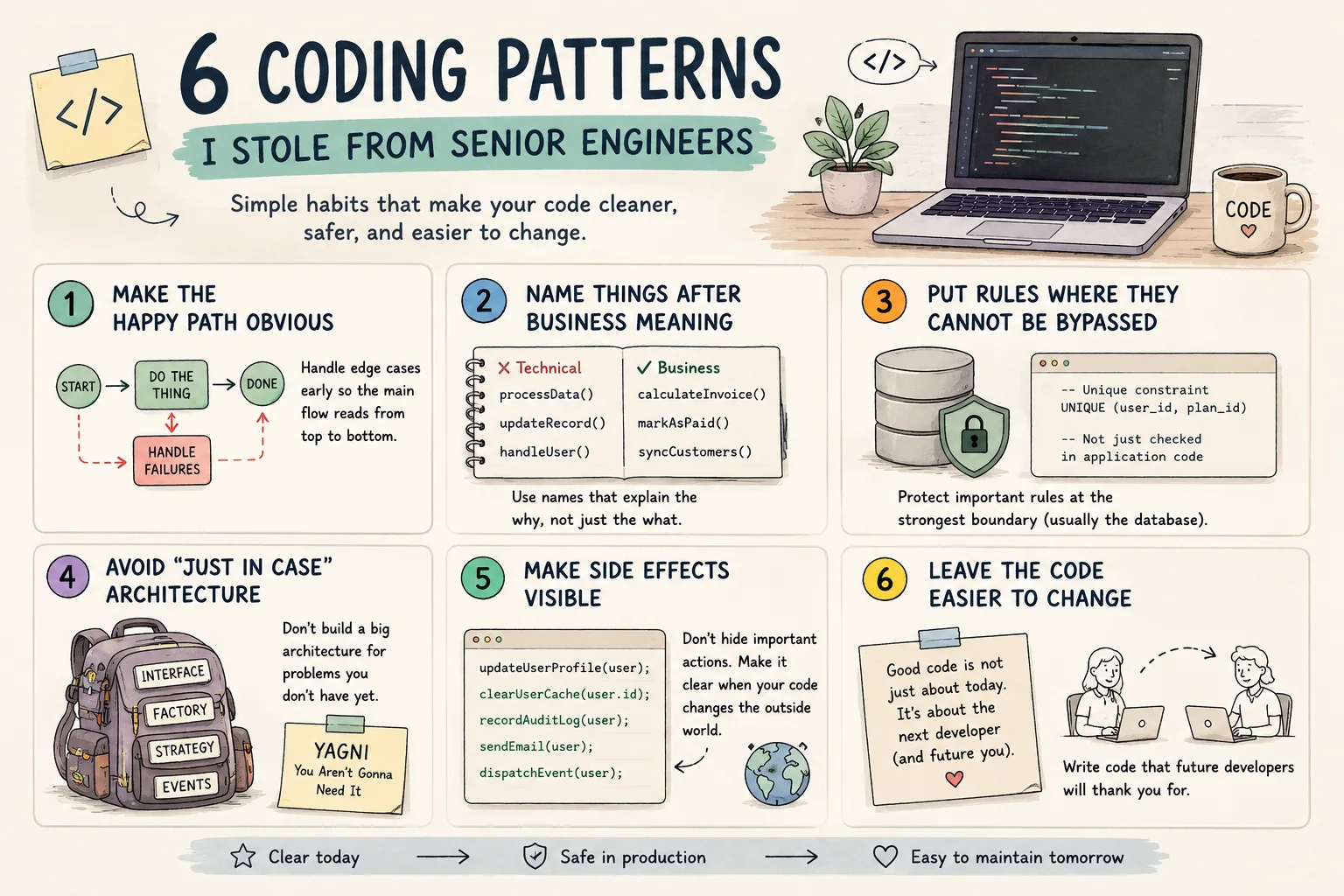
Senior Engineer’lardan Öğrendiğim 6 Kodlama Pattern’i

Özel Bir Yapay Zeka Not Asistanı Kurun
Markdown notlarını özel taslakları açığa çıkarmadan aranabilir bir asistana dönüştürün.
Yorumlar
0 yorumHenüz onaylı yorum yok. Yeni yanıtlar moderasyon bekleyebilir.