Quantum Computing: An Overview for IT Professionals
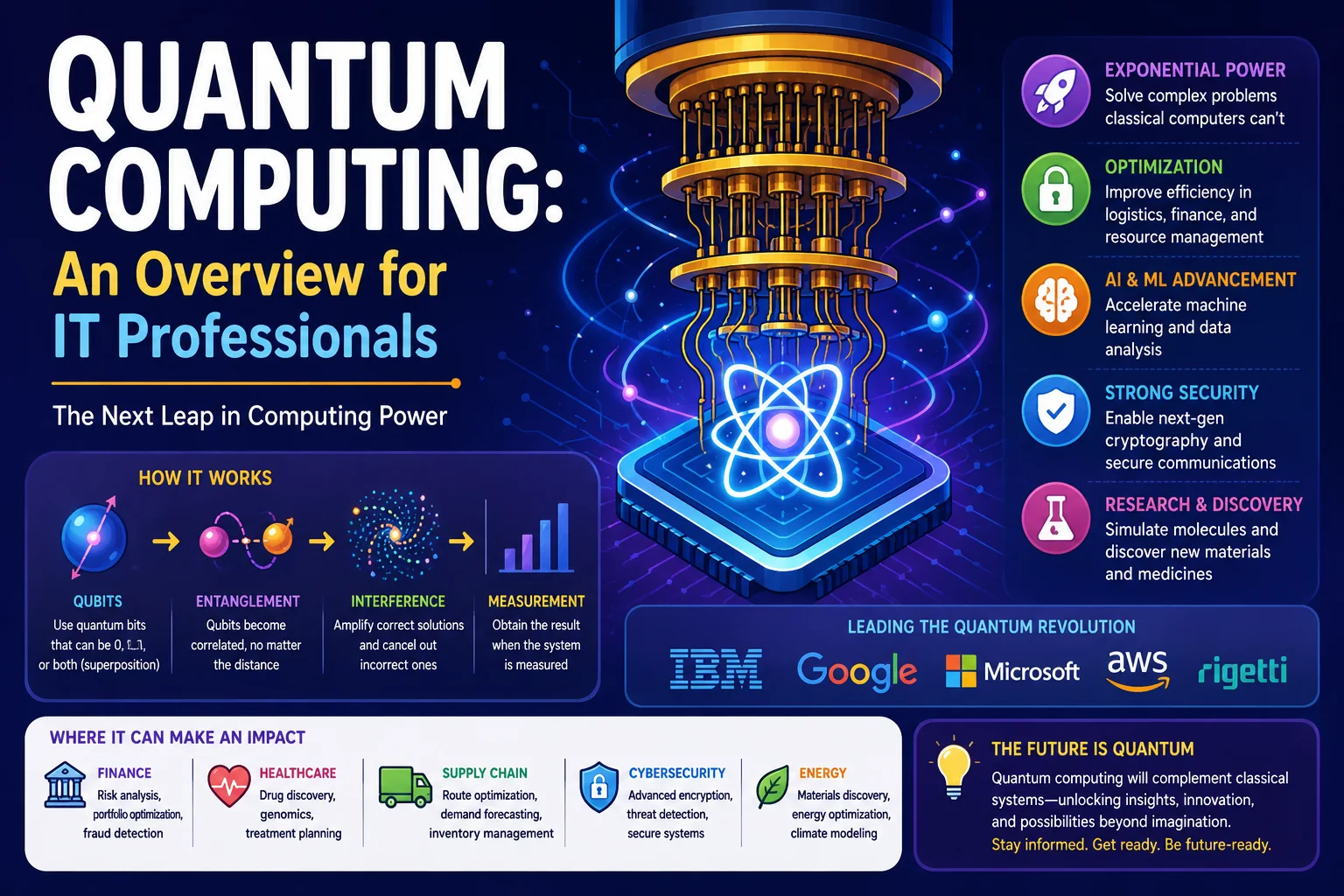
Quantum computing represents a fundamental shift in how we process information. While classical computers operate on bits (0 or 1), quantum computers use quantum bits, or qubits, which leverage quantum mechanical phenomena — superposition, entanglement, and interference — to perform computations that are intractable for classical machines.
Introduction
Quantum computing represents a fundamental shift in how we process information. While classical computers operate on bits (0 or 1), quantum computers use quantum bits, or qubits, which leverage quantum mechanical phenomena — superposition, entanglement, and interference — to perform computations that are intractable for classical machines.
This article provides a comprehensive overview of quantum computing concepts, current capabilities, practical applications, and what IT professionals need to know to prepare for the quantum era.
Classical vs. Quantum Computing
Fundamental Differences
| Aspect | Classical Computing | Quantum Computing |
|---|---|---|
| Basic unit | Bit (0 or 1) | Qubit (0, 1, or superposition) |
| State | Deterministic | Probabilistic |
| Operations | Boolean logic gates | Quantum gates (reversible) |
| Memory | Registers, RAM | Quantum registers (coherent states) |
| Parallelism | Multiple cores/threads | Superposition enables exponential parallelism |
| Output | Deterministic (given same input) | Probabilistic (multiple runs needed) |
| Error rate | Extremely low (~10^-18) | Currently high (~10^-3 per gate) |
| Temperature | Room temperature | Near absolute zero (~15 mK) |
What Quantum Computers Are Good At
Quantum computers excel at specific types of problems:
- Factoring large numbers — Shor's algorithm factors integers exponentially faster than classical algorithms. This threatens RSA encryption.
- Searching unsorted databases — Grover's algorithm provides quadratic speedup over classical search.
- Simulating quantum systems — Molecules, materials, and chemical reactions are inherently quantum.
- Optimization — Finding optimal solutions among exponentially many possibilities.
- Sampling and Monte Carlo — Financial risk analysis, portfolio optimization.
What Quantum Computers Are NOT Good At
- General-purpose computing (word processing, web browsing).
- Database transactions (SQL queries).
- Machine learning (though quantum ML may help with specific subproblems).
- Any problem where classical computers already perform well.
Key Quantum Concepts
Superposition
A classical bit is either 0 or 1. A qubit can exist in a superposition of both states simultaneously:
|ψ⟩ = α|0⟩ + β|1⟩
Where α and β are complex probability amplitudes, and |α|² + |β|² = 1.
This means a qubit can "explore" both 0 and 1 at the same time. With N qubits, a quantum computer can exist in a superposition of all 2ᴺ possible states simultaneously — exponential parallelism.
Entanglement
When two qubits become entangled, their states are correlated such that measuring one instantly determines the state of the other, regardless of the distance between them.
# Creating a Bell state (entangled pair) using Qiskit
from qiskit import QuantumCircuit

qc = QuantumCircuit(2)
qc.h(0)          # Hadamard gate on qubit 0
qc.cx(0, 1)      # CNOT gate with control=0, target=1
qc.measure_all()

# Result: 00 or 11 with equal probability (never 01 or 10)
Quantum Gates
Quantum gates operate on qubits and are fundamentally different from classical logic gates — they are reversible and unitary.
| Gate | Symbol | Effect |
|---|---|---|
| Hadamard | H | Creates superposition |
| Pauli-X | X | Quantum NOT gate |
| Pauli-Z | Z | Phase flip |
| CNOT | CX | Entangling gate |
| Toffoli | CCNOT | Universal reversible gate |
| Phase | S, T | Phase rotation |
Quantum Circuits
A quantum circuit is a sequence of quantum gates applied to qubits:
   ┌───┐          ┌───┐
q: ┤ H ├──■───────┤ H ├──
   └───┘┌─┴─┐     └───┘
q: ─────┤ X ├──■───────
        └───┘┌─┴─┐
q: ──────────┤ X ├───────
             └───┘
Measurement
Quantum states are fragile. Measuring a qubit collapses its superposition to a classical state (0 or 1) with probabilities determined by the probability amplitudes.
# Running a circuit multiple times to build probability distribution
from qiskit import Aer, execute

backend = Aer.get_backend('qasm_simulator')
job = execute(qc, backend, shots=1024)
counts = job.result().get_counts()
# Example output: {'000': 512, '111': 512}
Quantum Algorithms
Shor's Algorithm (1994)
Problem: Find the prime factors of a large integer N.
Significance: Factoring is the foundation of RSA encryption. Shor's algorithm can factor an N-bit number in O(N³) time — exponentially faster than the best classical algorithm (GNFS, which requires exp(O(N^(1/3))) time).
Status: Demonstrated for small numbers (15, 21, 35). Factoring 2048-bit RSA keys requires millions of physical qubits with error correction — likely 7-10 years away.
Grover's Algorithm (1996)
Problem: Search an unsorted database of N items.
Speedup: Quadratic — O(√N) vs. O(N) classical. For a database of 1 million items, Grover finds the target in ~1000 steps rather than 500,000.
Application: While a quadratic speedup is significant, the real impact is less dramatic than Shor's. Still useful for optimization and constraint satisfaction problems.
Quantum Fourier Transform (QFT)
The quantum equivalent of the discrete Fourier transform. Used as a subroutine in many quantum algorithms, including Shor's algorithm.
Variational Quantum Eigensolver (VQE)
A hybrid quantum-classical algorithm for finding the ground state energy of molecules. This is the most practical near-term application, useful for:
- Drug discovery (simulating molecular interactions).
- Battery chemistry (new materials for energy storage).
- Catalyst design (reducing industrial energy consumption).
Quantum Approximate Optimization Algorithm (QAOA)
Designed for combinatorial optimization problems:
- Supply chain optimization.
- Portfolio optimization in finance.
- Traffic flow optimization.
- Protein folding.
Current State of Quantum Computing (2026)
Leading Platforms
| Provider | Processor | Qubits (Physical) | Gate Fidelity | Architecture |
|---|---|---|---|---|
| IBM | Condor / Heron | 1,121+ | 99.9% | Superconducting transmon |
| Willow | 105 | 99.97% (Sycamore) | Superconducting | |
| Microsoft | Azure Quantum | 50+ (IonQ) | 99.9% | Trapped ion + topological |
| IonQ | Forte Enterprise | 36 algorithmic qubits | 99.9% | Trapped ion |
| Rigetti | Ankaa-3 | 84 | 99.5% | Superconducting |
| Quantinuum | H2 | 56 | 99.8% | Trapped ion |
| Xanadu | Borealis | 216 squeezed states | N/A | Photonic |
NISQ Era
We are in the NISQ (Noisy Intermediate-Scale Quantum) era — devices have 50-1000 qubits but are too noisy for error correction to be fully effective. NISQ devices can:
- Demonstrate quantum supremacy (Google 2019: 200s vs. 10,000 years for classical).
- Run variational algorithms (VQE, QAOA) with classical co-processing.
- Simulate small quantum systems for research.
- Not break RSA encryption or run Shor's algorithm at scale.
Quantum Error Correction
Logical qubits (error-corrected) require many physical qubits:
| Error Correction Code | Physical Qubits per Logical Qubit | Gate Error Threshold |
|---|---|---|
| Surface code | ~1,000 (current) | < 1% per gate |
| Surface code | ~100 (with improved hardware) | < 0.1% per gate |
| Color codes | ~300 | < 1% per gate |
Google's Willow chip (2024) demonstrated that adding more qubits reduces error — the first "below threshold" demonstration.
Applications and Impact
Cryptography — The Urgent Concern
Timeline for quantum threat to RSA:
2024: 1,000-qubit logical quantum computers (far from breaking RSA)
2026: Demonstrations on small RSA keys (128-bit)
2030-2035: Potential threat to 2048-bit RSA
Post-Quantum Cryptography (PQC): NIST selected four algorithms for standardization in 2024:
| Algorithm | Type | Purpose |
|---|---|---|
| CRYSTALS-Kyber | Lattice-based | Key encapsulation (replaces RSA key exchange) |
| CRYSTALS-Dilithium | Lattice-based | Digital signatures |
| Falcon | Lattice-based | Digital signatures (compact) |
| SPHINCS+ | Hash-based | Digital signatures (conservative) |
What IT teams should do now:
- Inventory — Catalog all systems using RSA or ECC.
- Crypto agility — Ensure systems can switch algorithms quickly.
- Monitor — Track NIST PQC standardization and industry adoption.
- Plan migration — Begin testing hybrid certificates (RSA + Kyber).
Drug Discovery and Chemistry
Quantum computers can simulate molecular interactions that are classically intractable:
# H2 molecule simulation using Qiskit Nature
from qiskit_nature.second_quantization.drivers import PySCFDriver
from qiskit_nature.algorithms import VQEUCCSDFactory

driver = PySCFDriver(atom='H 0 0 0; H 0 0 0.735')
molecule = driver.run()

# Quantum simulation (VQE)
solver = VQEUCCSDFactory(quantum_instance=backend)
result = solver.compute_minimum_energy(molecule)
print(f"Ground state energy: {result.energy} Hartree")
Impact: Quantum chemistry could reduce drug development from 10-15 years to 2-5 years for certain classes of drugs.
Financial Modeling
- Portfolio optimization — Quantum algorithms find optimal asset allocations among trillions of possibilities.
- Risk analysis — Monte Carlo simulations with quadratic speedup.
- Fraud detection — Quantum ML for pattern recognition.
Getting Started with Quantum Computing
Learning Resources
| Resource | Type | Description |
|---|---|---|
| Qiskit (IBM) | SDK | Python framework, extensive tutorials |
| Cirq (Google) | SDK | Python framework for NISQ devices |
| Q# (Microsoft) | Language | Domain-specific quantum programming language |
| Quantum Katas (Microsoft) | Tutorials | Hands-on quantum computing exercises |
| IBM Quantum Learning | Courses | Free online courses, certification |
Hello Quantum World
# Qiskit: Bell state preparation
from qiskit import QuantumCircuit, Aer, execute

qc = QuantumCircuit(2, 2)
qc.h(0)
qc.cx(0, 1)
qc.measure([0, 1], [0, 1])

# Simulate
backend = Aer.get_backend('qasm_simulator')
counts = execute(qc, backend, shots=1024).result().get_counts()
print(counts)  # Example: {'00': 523, '11': 501}
Accessing Quantum Hardware
All major providers offer cloud access:
# IBM Quantum
pip install qiskit-ibm-runtime
from qiskit_ibm_runtime import QiskitRuntimeService
service = QiskitRuntimeService()
backend = service.backend('ibm_brisbane')

# Run on real hardware!
job = backend.run(qc, shots=1000)
Challenges and Limitations
| Challenge | Current Status | Outlook |
|---|---|---|
| Qubit coherence — Quantum states last microseconds | ~100-500μs (superconducting), ~1s (trapped ion) | Improving steadily |
| Gate fidelity — Operations introduce errors | 99-99.9% per gate | Need 99.99%+ for error correction |
| Scalability — Connecting many qubits | 100-1000 physical qubits | 100K+ qubits needed for practical applications |
| Error correction overhead | ~1000:1 physical-to-logical ratio | Expected to improve 10x per decade |
| Cryogenic requirements | 15 mK for superconducting | Significant infrastructure cost |
| Quantum memory | Storing quantum states | Active research area |
Conclusion
Quantum computing is not a replacement for classical computing — it is a specialized tool for specific problems where quantum effects provide a fundamental advantage. The timeline for practical, fault-tolerant quantum computers is measured in years (for NISQ applications) to a decade or more (for full-scale error-corrected machines).
What IT professionals should do now:
- Understand the threat to current cryptographic systems and plan PQC migration.
- Experiment with quantum SDKs (Qiskit, Cirq) and cloud quantum services.
- Identify use cases where quantum could provide advantage — chemistry, optimization, finance.
- Monitor progress — Follow NIST PQC standardization, IBM/Google hardware milestones.
- Build skills — Quantum computing knowledge will be increasingly valuable.
The quantum revolution will not happen overnight, but it is coming. Organizations that prepare now — especially for the cryptographic transition — will be better positioned when practical quantum computers arrive.
Featured Articles

The 10 Largest Frontend Performance Challenges in 2026 (And How to Fix Them)
Should I Use React or Next.js? Complete Comparison Guide 2026
Build an Offline-First SaaS with Laravel & React: Complete PWA Tutorial 2026
Comments
0 commentsNo approved comments are visible yet. New community replies may wait for moderation.