Internet of Things (IoT) in the Enterprise
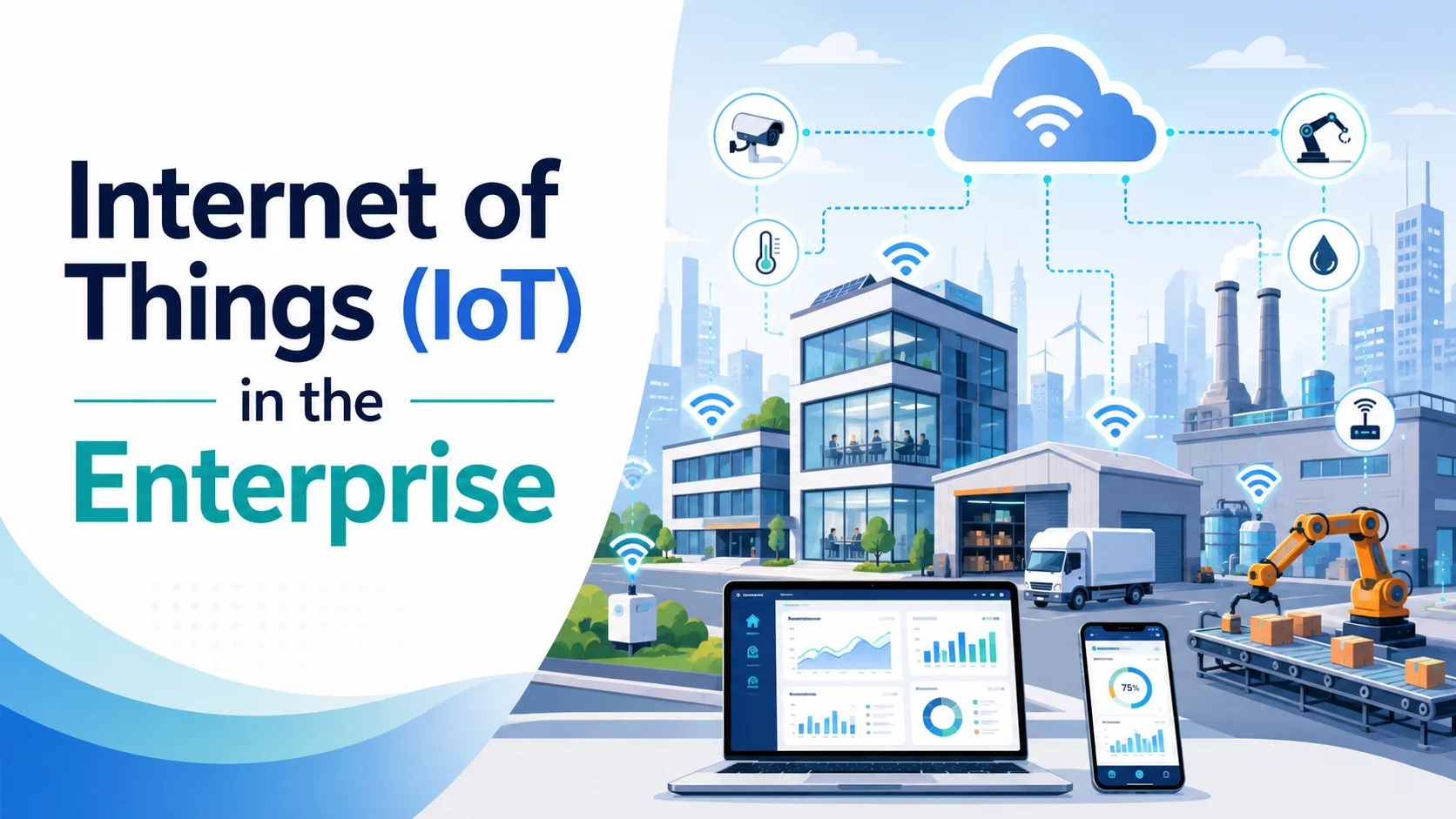
The Internet of Things (IoT) refers to connected devices, sensors, and actuators that collect, transmit, and act on data from the physical world. In enterprise settings, IoT transforms operations by enabling real-time monitoring, predictive maintenance, process automation, and data-driven decision-making.
Introduction
The Internet of Things (IoT) refers to connected devices, sensors, and actuators that collect, transmit, and act on data from the physical world. In enterprise settings, IoT transforms operations by enabling real-time monitoring, predictive maintenance, process automation, and data-driven decision-making.
With over 30 billion connected devices worldwide in 2026, enterprise IoT is no longer experimental — it is a competitive necessity in manufacturing, logistics, energy, healthcare, agriculture, and retail.
The IoT Landscape
Market Overview
| Sector | IoT Devices (2026) | Key Application |
|---|---|---|
| Manufacturing | 8B | Predictive maintenance, industrial automation |
| Transportation | 5B | Fleet tracking, logistics optimization |
| Energy & Utilities | 4B | Smart grid, meter reading |
| Healthcare | 3B | Remote patient monitoring, asset tracking |
| Retail | 2B | Inventory management, customer analytics |
| Agriculture | 1.5B | Precision farming, soil monitoring |
| Smart Buildings | 6B | HVAC control, occupancy sensing |
IoT Revenue Model
Hardware (sensors, gateways) ──── 25%
Connectivity (cellular, LPWAN) ─── 15%
IoT Platforms (AWS, Azure) ─────── 20%
Analytics & AI ─────────────────── 25%
Services (integration, consulting) ─ 15%
IoT Architecture
Four-Layer Architecture
┌─────────────────────────────────────────────────────┐
│                    Application Layer                 │
│         Dashboards, Analytics, Mobile Apps          │
├─────────────────────────────────────────────────────┤
│                   Platform Layer                     │
│    Device Management, Data Ingestion, Rules Engine  │
├─────────────────────────────────────────────────────┤
│                  Connectivity Layer                  │
│         WiFi, 5G, LoRaWAN, BLE, Zigbee, NB-IoT     │
├─────────────────────────────────────────────────────┤
│                   Device Layer                       │
│      Sensors, Actuators, Gateways, Edge Processors  │
└─────────────────────────────────────────────────────┘
1. Device Layer
Sensors collect data from the physical world:
| Sensor Type | Measures | Applications |
|---|---|---|
| Temperature | Ambient temperature | Cold chain, HVAC |
| Pressure | Fluid/gas pressure | Hydraulic systems |
| Vibration | Mechanical vibration | Predictive maintenance |
| Humidity | Moisture in air | Agriculture, storage |
| Proximity | Object distance | Parking, inventory |
| Motion | Movement detection | Security, occupancy |
| Gas | Air quality (CO2, CO, NOx) | Environmental monitoring |
| GPS | Location coordinates | Asset tracking |
| Accelerometer | Acceleration, tilt | Equipment monitoring |
Actuators perform actions in the physical world:
- Valves (open/close fluid flow).
- Relays (switch electrical circuits).
- Motors (move mechanical systems).
- Solenoids (electromechanical switching).
- Buzzers/LEDs (alerts and indicators).
2. Connectivity Layer
| Protocol | Range | Bandwidth | Power | Best For |
|---|---|---|---|---|
| WiFi 6/7 | 50m | 1-9 Gbps | Medium | High-bandwidth local |
| 5G | 500m-10km | 100-20,000 Mbps | Medium | Low latency, wide area |
| LTE-M | 1-10km | 1-5 Mbps | Low | Cellular IoT (Cat-M1) |
| NB-IoT | 1-10km | 50-250 kbps | Very low | Massive IoT, meters |
| LoRaWAN | 2-15km | 0.3-50 kbps | Very low | Long range, low data |
| BLE | 10-100m | 1-2 Mbps | Very low | Wearables, beacons |
| Zigbee | 10-100m | 250 kbps | Low | Home/building automation |
| Z-Wave | 30m | 100 kbps | Very low | Smart home |
3. Platform Layer
IoT platforms provide the middleware that connects devices to applications:
Key functions:
- Device management — Registration, configuration, firmware updates.
- Data ingestion — Receive, parse, and store telemetry data.
- Rules engine — Trigger actions based on data thresholds.
- Security — Device authentication, encryption, access control.
- Integration — APIs, webhooks, connectors to enterprise systems.
# AWS IoT Core rule example
Rule: ProcessTemperatureAlert
SQL: SELECT device_id, temperature, timestamp
     FROM 'iot/temperature'
     WHERE temperature > 85
Actions:
  - SNS: send to operations team
  - DynamoDB: log anomaly record
  - Lambda: invoke predictive maintenance
4. Application Layer
Enterprise applications that consume IoT data:
- SCADA — Supervisory control and data acquisition.
- CMMS — Computerized maintenance management systems.
- ERP — Enterprise resource planning.
- BI dashboards — Grafana, Tableau, Power BI.
- Mobile apps — Field service, operator dashboards.
Enterprise IoT Use Cases
1. Predictive Maintenance
Problem: Unplanned equipment downtime costs manufacturers $50B+ annually. Reactive maintenance is expensive and disrupts production.
Solution: IoT sensors monitor equipment health and predict failures before they occur.
# Predictive maintenance ML model (edge deployment)
import numpy as np
from sklearn.ensemble import RandomForestClassifier

# Features from IoT sensors
features = [
    'vibration_rms',      # Root mean square vibration
    'temperature',        # Bearing temperature
    'current_draw',       # Motor current
    'rpm',               # Rotations per minute
    'runtime_hours',      # Total operating time
    'zero_crossings'      # Vibration signal zero crossings
]

model = RandomForestClassifier(n_estimators=100)

def predict_failure(sensor_data):
    """Returns probability of failure within next 7 days"""
    X = np.array([[sensor_data[f] for f in features]])
    probability = model.predict_proba(X)[0][1]

    if probability > 0.8:
        alert_level = 'CRITICAL — Schedule immediate maintenance'
    elif probability > 0.5:
        alert_level = 'WARNING — Schedule maintenance within 48 hours'
    else:
        alert_level = 'NORMAL — Continue monitoring'

    return {
        'failure_probability': probability,
        'alert_level': alert_level,
        'recommended_action': get_maintenance_action(probability)
    }
Results from real deployments:
| Metric | Before IoT | After IoT |
|---|---|---|
| Unplanned downtime | 27 days/year | 5 days/year |
| Maintenance costs | $12M/year | $5M/year |
| Equipment lifespan | 8 years | 12 years |
| Mean time to repair | 12 hours | 3 hours |
2. Fleet Tracking and Logistics
Problem: Companies lose visibility of assets in transit. Fuel costs, route inefficiency, and cargo theft cost billions.
Solution: GPS + IoT telematics provide real-time fleet visibility.
┌──────────┐    ┌──────────┐    ┌──────────┐
│ Vehicle  │    │ Vehicle  │    │ Vehicle  │
│ #101     │    │ #102     │    │ #103     │
└────┬─────┘    └────┬─────┘    └────┬─────┘
     │               │               │
     └───────────────┼───────────────┘
                     │
            ┌────────▼────────┐
            │   IoT Platform  │
            │  (Azure IoT Hub)│
            └────────┬────────┘
                     │
          ┌──────────┼──────────┐
          ▼          ▼          ▼
    ┌─────────┐ ┌─────────┐ ┌─────────┐
    │ Route   │ │ Dispatch│ │ Analytics│
    │Optimizer│ │ Dashboard│ │ (Fuel   │
    │         │ │         │ │  Trends)│
    └─────────┘ └─────────┘ └─────────┘
IoT telemetry data:
{
  "vehicle_id": "TRK-1042",
  "timestamp": "2026-05-24T14:30:00Z",
  "location": {
    "lat": 40.7128,
    "lng": -74.0060
  },
  "speed": 65.3,
  "fuel_level": 72.4,
  "engine_temp": 88.2,
  "tire_pressure": [32.1, 31.8, 33.0, 32.5],
  "cargo_temp": -2.1,
  "door_status": "closed",
  "driver_id": "DRV-887"
}
Results: UPS saved 10 million gallons of fuel annually using IoT route optimization.
3. Smart Energy Management
Problem: Commercial buildings waste 30% of energy. Grid instability costs utilities billions.
Solution: IoT sensors optimize energy consumption and balance grid load.
Smart building control:
Sensors ──► Edge Gateway ──► Building Management System
  │                              │
  ├─ Occupancy                  ├─ HVAC optimization
  ├─ Temperature                ├─ Lighting control
  ├─ CO2 level                  ├─ Demand response
  ├─ Light level                ├─ Peak shaving
  └─ Power consumption          └─ Reporting
HVAC optimization algorithm:
def optimize_hvac(zone_data, occupancy, weather_forecast):
    """Determine optimal HVAC setpoints"""

    # If zone is unoccupied for 30+ minutes
    if not occupancy['present'] and occupancy['vacant_minutes'] > 30:
        setpoint = {
            'cooling': 28,  # Allow temperature to drift
            'heating': 16,
            'fan_speed': 0
        }
        return setpoint

    # Pre-cool based on weather forecast and electricity price
    if weather_forecast['peak_temp'] > 35 and electricity_price > 0.15:
        return {
            'cooling': 22,  # Pre-cool before peak
            'heating': 'off',
            'fan_speed': 'high',
            'schedule': 'pre-cool_before_peak'
        }

    # Normal occupancy mode
    return calculate_comfort_setpoint(zone_data)
Results:
- 20-40% reduction in energy costs.
- 30% reduction in peak demand charges.
- LEED certification compliance.
4. Healthcare IoT
Remote patient monitoring (RPM):
Patient at home:
  ┌─ Blood pressure cuff
  ├─ Continuous glucose monitor
  ├─ Pulse oximeter
  ├─ Smart scale
  └─ Medication dispenser
         │
         ▼ (BLE/5G)
   ┌───────────┐
   │  Gateway   │
   │ (phone/app)│
   └─────┬─────┘
         │
         ▼ (LTE/WiFi)
   ┌──────────────┐
   │  Cloud        │
   │  Platform     │
   └──────┬───────┘
          │
   ┌──────┴──────┐
   ▼             ▼
Alerts      EHR Integration
(to nurse)  (Epic, Cerner)
Alerting rules:
ALERT_RULES = {
    'critical_bp': {
        'condition': 'systolic > 180 or diastolic > 120',
        'action': 'immediate_alert_nurse',
        'priority': 'CRITICAL'
    },
    'glucose_trend': {
        'condition': 'glucose trending > 20% drop over 2 hours',
        'action': 'alert_caregiver',
        'priority': 'HIGH'
    },
    'medication_missed': {
        'condition': 'no medication dispensed in 2 hours past scheduled',
        'action': 'reminder_push + alert_family',
        'priority': 'MEDIUM'
    }
}
5. Agriculture (Smart Farming)
| IoT Application | Sensors Used | Impact |
|---|---|---|
| Soil monitoring | Moisture, pH, NPK nutrients | 30% water savings, higher yields |
| Weather stations | Temperature, humidity, wind, rain | Optimal planting/harvest timing |
| Livestock tracking | GPS, temperature, activity | Health monitoring, pasture management |
| Drone imaging | Multi-spectral cameras | Crop health assessment |
| Automated irrigation | Flow meters, valve actuators | Targeted water delivery |
IoT Security
The Challenge
IoT devices introduce unique security risks:
| Risk | Why IoT Is Vulnerable | Mitigation |
|---|---|---|
| Physical access | Devices in uncontrolled environments | Tamper-proof enclosures, secure boot |
| Limited resources | No CPU for encryption | Hardware crypto accelerators |
| No update mechanism | Devices deployed and forgotten | OTA update infrastructure |
| Default credentials | Factory-set passwords | Mandatory password change on first login |
| Heterogeneous protocols | Zigbee, BLE, LoRaWAN all have different security models | Defense in depth at gateway |
| Data in transit | Wireless signals can be intercepted | TLS/mTLS, application-layer encryption |
IoT Security Framework
iot_security:
  device:
    - secure_boot: enabled
    - hardware_root_of_trust: TPM 2.0
    - firmware_signing: required
    - unique_identity: X.509 certificate per device

  communication:
    - transport_encryption: TLS 1.3
    - mutual_authentication: mTLS
    - certificate_revocation: OCSP stapling

  platform:
    - device_authentication: certificate-based
    - data_encryption_at_rest: AES-256
    - access_control: IAM roles
    - audit_logging: all API calls

  lifecycle:
    - provisioning: zero-touch enrollment
    - monitoring: anomaly detection
    - updates: signed OTA, staged rollout
    - decommissioning: certificate revocation, secure wipe
IoT Platform Comparison
| Feature | AWS IoT Core | Azure IoT Hub | GCP IoT Core |
|---|---|---|---|
| Device SDKs | C, Python, JS, Java, Embedded C | C, C#, Python, Java, JS | Python, C, Java |
| Protocols | MQTT, HTTP, WebSocket, LoRaWAN | MQTT, AMQP, HTTP, WebSocket | MQTT, HTTP |
| Device shadow | Yes (device state) | Yes (device twin) | Yes (state) |
| Rules engine | SQL-based | Azure Stream Analytics | Cloud Pub/Sub |
| Edge computing | Greengrass | IoT Edge | Edge TPU |
| Fleet management | Device Defender | Device Management | Device Manager |
| Security | X.509, IAM, Cognito | X.509, SAS tokens, DPS | JWT, IAM |
Implementation Considerations
Data Volume Management
A single factory with 1,000 sensors sending data every 5 seconds:
1,000 devices × 1 KB/reading × (86400/5) readings/day
= 17.28 GB/day raw data
= ~6.3 TB/year
Strategies:
- Edge filtering — Only send alerts or aggregated data to cloud.
- Data compression — Compress telemetry before transmission.
- Tiered storage — Hot (1 day), warm (30 days), cold (1+ years).
- Retention policies — Delete raw data after aggregation.
Edge vs. Cloud Processing
| Decision Factor | Process at Edge | Process in Cloud |
|---|---|---|
| Latency requirement | <10ms | >100ms allowed |
| Bandwidth available | Limited | Sufficient |
| Data volume | High | Low/medium |
| Decision criticality | Safety-critical | Analytical |
| Connectivity | Intermittent | Always available |
| Model complexity | Simple models | Complex ML |
Conclusion
Enterprise IoT delivers measurable business value across industries:
- Manufacturing — 30-50% reduction in unplanned downtime.
- Logistics — 15-20% fuel savings, real-time asset visibility.
- Energy — 20-40% reduction in building energy costs.
- Healthcare — 50% reduction in hospital readmissions via RPM.
- Agriculture — 30% water savings, 20% yield increase.
Getting Started
- Identify the problem — What operational pain point needs solving?
- Start small — 10 devices, one factory, one use case.
- Prove ROI — Measure before/after metrics.
- Scale gradually — Expand to more devices and locations.
- Security first — Implement security from day one, not as an afterthought.
- Plan for data — IoT generates massive data. Plan storage, processing, and analysis.
IoT is not about connecting devices — it is about connecting devices to create business value. Start with the business problem, choose the right technology stack, and iterate based on real-world results.
Featured Articles
The 10 Largest Frontend Performance Challenges in 2026 (And How to Fix Them)

Should I Use React or Next.js? Complete Comparison Guide 2026

Build an Offline-First SaaS with Laravel & React: Complete PWA Tutorial 2026
Comments
0 commentsNo approved comments are visible yet. New community replies may wait for moderation.