Graph Databases: Modeling Connected Data
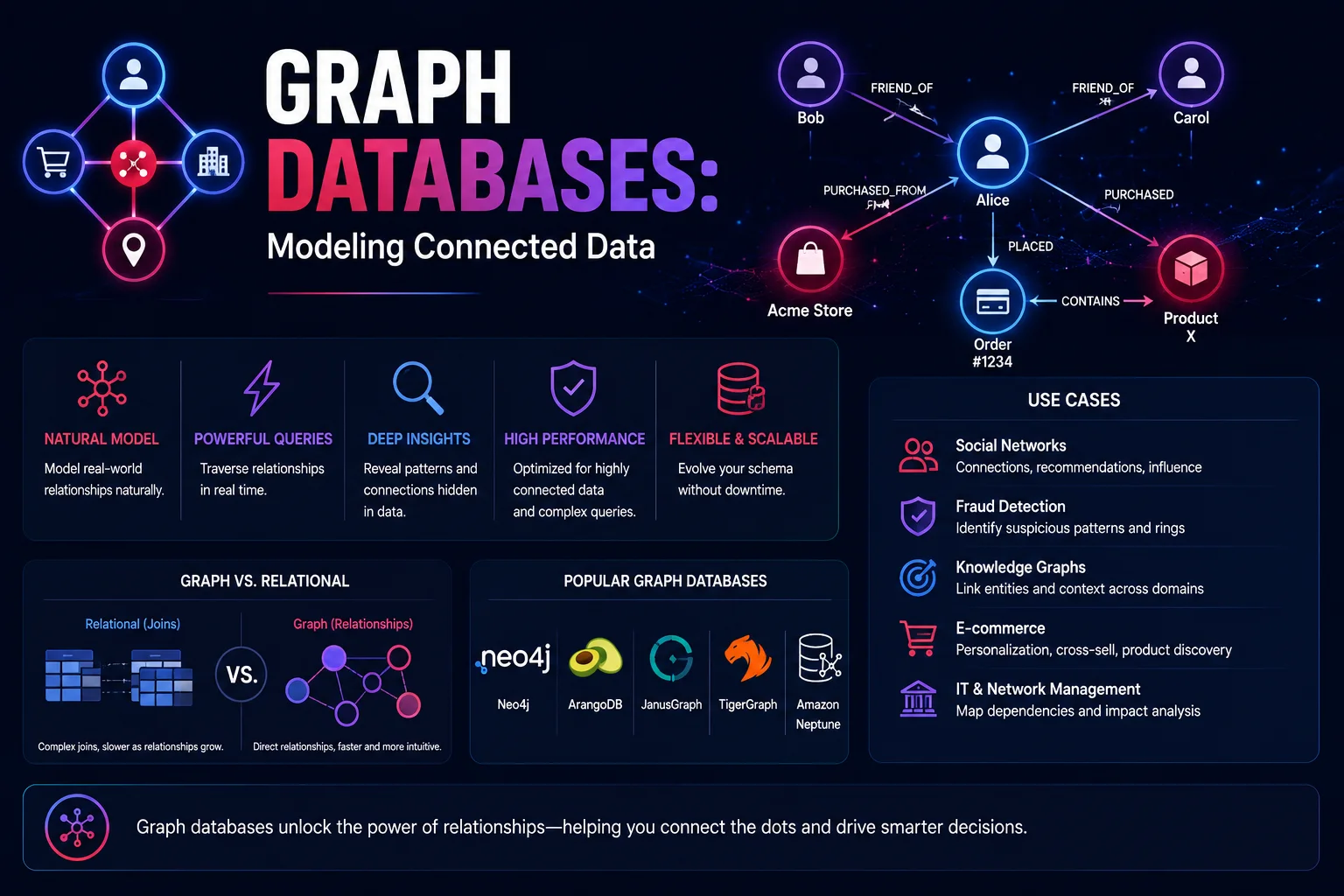
Graph databases are purpose-built for storing and querying highly connected data. While relational databases excel at tabular data with known relationships, graph databases excel when relationships are as important as the data itself — social networks, recommendation engines, fraud detection, knowledge graphs, and supply chains.
Introduction
Graph databases are purpose-built for storing and querying highly connected data. While relational databases excel at tabular data with known relationships, graph databases excel when relationships are as important as the data itself — social networks, recommendation engines, fraud detection, knowledge graphs, and supply chains.
The fundamental insight: in many domains, the connections between entities ARE the data, and graph databases make those connections a first-class citizen.
Graph Database Concepts
Property Graph Model
       ┌──────────────────┐
       │   Person         │
       │  name: "Alice"  │
       │  age: 30        │
       └────────┬─────────┘
                │
       ┌────────▼─────────┐
       │   KNOWS           │
       │  since: 2020      │
       │  type: "friend"   │
       └────────┬─────────┘
                │
       ┌────────▼─────────┐
       │   Person         │
       │  name: "Bob"    │
       │  age: 32         │
       └──────────────────┘
Three core components:
| Component | Description | Example |
|---|---|---|
| Node (Vertex) | An entity in the graph | Person, Company, Product |
| Edge (Relationship) | A connection between two nodes | KNOWS, WORKS_AT, PURCHASED |
| Property | Attributes on nodes or edges | name: "Alice", since: 2020 |
Relational vs. Graph
Querying relationships in SQL:
-- Find friends of friends who work at Google
SELECT DISTINCT p3.name
FROM persons p1
JOIN friendships f1 ON p1.id = f1.person_id
JOIN persons p2 ON f1.friend_id = p2.id
JOIN friendships f2 ON p2.id = f2.person_id
JOIN persons p3 ON f2.friend_id = p3.id
JOIN employment e ON p3.id = e.person_id
JOIN companies c ON e.company_id = c.id
WHERE p1.name = 'Alice'
  AND c.name = 'Google';
Same query in Cypher (Neo4j):
MATCH (alice:Person {name: "Alice"})
      -[:KNOWS*2]->
      (friend_of_friend:Person)
MATCH (friend_of_friend)-[:WORKS_AT]->(google:Company {name: "Google"})
RETURN DISTINCT friend_of_friend.name
Key difference: SQL juggles multiple JOINs. Graph traversals match patterns naturally.
Graph Query Languages
Cypher (Neo4j) — Declarative Pattern Matching
// Create nodes and relationships
CREATE (alice:Person {name: "Alice", age: 30})
CREATE (bob:Person {name: "Bob", age: 32})
CREATE (alice)-[:KNOWS {since: 2020}]->(bob)

// Find friends of friends who bought products in the last month
MATCH (user:Person {id: $userId})
      -[:KNOWS]->
      (friend:Person)
      -[:PURCHASED]->
      (product:Product)
WHERE product.purchased_at > datetime() - duration('P1M')
RETURN product.name, count(*) as purchase_count
ORDER BY purchase_count DESC
LIMIT 10

// Shortest path between two people
MATCH p = shortestPath(
  (alice:Person {name: "Alice"})-[:KNOWS*]-(bob:Person {name: "Bob"})
)
RETURN length(p) as degrees_of_separation,
       [node IN nodes(p) | node.name] as path
Gremlin (Apache TinkerPop) — Imperative Graph Traversal
// Same query in Gremlin
g.V().has('Person', 'name', 'Alice')
  .repeat(out('KNOWS')).times(2)
  .out('WORKS_AT')
  .has('Company', 'name', 'Google')
  .values('name')
  .dedup()
SPARQL (RDF) — Semantic Web
PREFIX foaf: <http://xmlns.com/foaf/0.1/>
PREFIX org: <http://www.w3.org/ns/org#>

SELECT ?name WHERE {
  ?alice foaf:name "Alice" ;
         foaf:knows ?friend .
  ?friend foaf:knows ?friend_of_friend .
  ?friend_of_friend org:memberOf ?company .
  ?company org:legalName "Google" .
  ?friend_of_friend foaf:name ?name .
}
Graph Database Comparison
| Feature | Neo4j | Amazon Neptune | ArangoDB | JanusGraph | Dgraph |
|---|---|---|---|---|---|
| Query language | Cypher | Gremlin/SPARQL | AQL | Gremlin | GraphQL+ |
| Storage | Native graph | RDF/Property | Multi-model | Cassandra/HBase | Badger |
| Clustering | Enterprise | Managed | Yes | Yes | Yes |
| ACID | Yes | Yes | Yes | Per-storage | Yes |
| Free tier | Community (1 node) | Pay-as-you-go | Open-source | Open-source | Open-source |
| Best for | Enterprise graphs | AWS ecosystem | Multi-model | Big data graphs | High performance |
| Vector search | ✅ (5.x+) | ❌ | ✅ | ❌ | ❌ |
Use Cases
1. Social Networks and Recommendations
(User:Alice)-[:KNOWS]->(User:Bob)
(User:Alice)-[:LIKES]->(Movie:Inception)
(User:Bob)-[:LIKES]->(Movie:Inception)
(User:Charlie)-[:KNOWS]->(User:Alice)
Recommendation query — "Movies liked by friends of friends":
MATCH (me:User {id: $userId})
      -[:KNOWS*1..2]-
      (other:User)
      -[:LIKES]->
      (movie:Movie)
WHERE NOT EXISTS {
  (me)-[:LIKES]->(movie)
  OR (me)-[:DISLIKES]->(movie)
}
RETURN movie.title, count(DISTINCT other) as friend_count,
       avg(other.rating) as avg_rating
ORDER BY friend_count DESC, avg_rating DESC
LIMIT 20
2. Fraud Detection
Fraud rings exhibit complex, non-obvious patterns. Graph queries detect them efficiently:
// Detect potential fraud rings:
// Multiple accounts sharing same device, IP, or phone
MATCH (account:Account)
      -[:USED_DEVICE]->(device:Device)<-[:USED_DEVICE]-
      (other:Account),
      (account)-[:USED_IP]->(ip:IPAddress)<-[:USED_IP]-
      (other)
WHERE account.id <> other.id
  AND account.created_at > datetime() - duration('P7D')
RETURN account.id, other.id, device.device_id, ip.address,
       count(*) as connection_count
ORDER BY connection_count DESC
LIMIT 100
Fraud detection statistics:
| Metric | Before Graph | After Graph |
|---|---|---|
| Detection rate | 65% | 93% |
| False positive rate | 8% | 2% |
| Investigation time per case | 45 min | 5 min |
3. Knowledge Graphs
Knowledge graphs connect structured and unstructured data into a unified web of meaning:
// Create a knowledge graph from documents
LOAD CSV WITH HEADERS FROM 'file:///entities.csv' AS row
CREATE (e:Entity {
  id: row.id,
  name: row.name,
  type: row.type,
  description: row.description
});

LOAD CSV WITH HEADERS FROM 'file:///relationships.csv' AS row
MATCH (a:Entity {id: row.source_id})
MATCH (b:Entity {id: row.target_id})
CALL apoc.create.relationship(a, row.relationship_type, {
  source_document: row.document,
  confidence: toFloat(row.confidence)
}) YIELD rel
RETURN count(*);

// Query: "How does Product X relate to Regulation Y?"
MATCH path = shortestPath(
  (product:Entity {name: "Product X"})
  -[:AFFECTS|REGULATES|DEPENDS_ON|MANUFACTURED_BY*]-
  (regulation:Entity {name: "Regulation Y"})
)
RETURN [node IN nodes(path) | {name: node.name, type: node.type}],
       [rel IN relationships(path) | type(rel)]
4. Supply Chain
// Find all suppliers that feed into a critical component
MATCH (component:Part {name: "Critical Microchip"})
      <-[:PRODUCES]-
      (:Factory)
      -[:SOURCES_FROM]->
      (supplier:Supplier)
      -[:SUPPLIED_BY]->
      (sub_supplier:Supplier)
WHERE sub_supplier.location IN ["Region_A", "Region_B"]
RETURN component.name, supplier.name, sub_supplier.name,
       sub_supplier.location

// Impact analysis: "If Supplier X fails, which products are affected?"
MATCH (failing:Supplier {id: $supplierId})
      <-[:SUPPLIED_BY]-*
      (factory:Factory)
      -[:PRODUCES]->
      (product:Product)
RETURN product.name, product.revenue,
       count(DISTINCT factory) as factories_affected
ORDER BY product.revenue DESC
Graph Database Internals
Index-Free Adjacency
The fundamental performance advantage of native graph databases: each node directly points to its connected neighbors. No index lookups needed for traversals.
Relational Database:                         Graph Database:
                                            ┌────────┐
Find friends:                              │ Alice  │──┐
1. Index lookup on person_id ──┐            │        │  │
2. Index lookup on friend_id ──┤            └────────┘  │
3. Join results              ──┤               │        │
4. Fetch friend data         ──┤            ┌──▼─────┐  │
                               │            │ Bob    │◄─┘
O(log N) per hop               │            │        │
                               │            └────────┘
                               │
For 6 degrees of separation:  │  O(1) per traversal hop
O(log N × 6) = O(log N)      │  O(6) = O(1)
                               │
                               │  For 6 hops: 6 pointer dereferences
Graph Partitioning
For distributed graph databases, partitioning is challenging:
| Strategy | Description | Problem |
|---|---|---|
| Edge-cut | Split by vertex, edges cross partitions | Many cross-partition traversals |
| Vertex-cut | Split by edge, vertex replicated | Consistency overhead |
| Hash partitioning | Hash vertices to partitions | Random — poor locality |
| Range partitioning | Partition by property value | Skew if data is not uniform |
Advanced Graph Patterns
Temporal Graphs (Time-Travel Queries)
// Property graph with versioned edges
MATCH (employee:Employee {id: $empId})
      -[assignment:ASSIGNED_TO]->(project:Project)
WHERE assignment.from_date <= date("2026-01-15")
  AND (assignment.to_date IS NULL OR assignment.to_date >= date("2026-01-15"))
RETURN employee.name, project.name, assignment.role

// What was the org structure on Jan 1, 2025?
MATCH (manager:Employee)
      -[reports:MANAGES]->(report:Employee)
WHERE reports.effective_from <= date("2025-01-01")
  AND (reports.effective_to IS NULL OR reports.effective_to > date("2025-01-01"))
RETURN manager.name, collect(report.name) as reports
Graph Algorithms (Neo4j GDS)
from neo4j import GraphDatabase
from graphdatascience import GraphDataScience

gds = GraphDataScience("bolt://localhost:7687", auth=("neo4j", "password"))

# Create in-memory graph
G, result = gds.graph.project(
    "myGraph",
    ["Person", "Company"],
    ["KNOWS", "WORKS_AT"]
)

# PageRank — find influential people
pagerank = gds.pageRank.stream(G)
influencers = pagerank.sort_values('score', ascending=False).head(10)

# Community detection (Louvain) — find clusters
communities = gds.louvain.stream(G)
Graph + Vector Search (Hybrid)
Modern graph databases (Neo4j 5.x+) support both graph and vector search:
// Find similar products using vector embeddings,
// then traverse the recommendation graph
CALL db.index.vector.queryNodes(
  'product-embeddings',
  10,
  $query_embedding
) YIELD node AS similar_product, score

MATCH (similar_product)-[:ALSO_BOUGHT]->(recommended:Product)
WHERE recommended.rating > 4.0
RETURN recommended.name, recommended.price, score
ORDER BY score DESC, recommended.rating DESC
LIMIT 20
Graph Database Anti-Patterns
| Anti-Pattern | Why It Hurts | Better Approach |
|---|---|---|
| Global operations | MATCH (n) WHERE n.property scans all nodes |
Add index: CREATE INDEX FOR (n:Label) ON (n.property) |
| Deep unlimited traversals | MATCH (a)-[*]->(b) without limit |
Specify depth: [*1..5] |
| Supernodes | One node with millions of edges | Break into intermediate nodes, use time-boundaries |
| Missing direction | Bidirectional edges cause double traversal | Define clear direction and traverse efficiently |
| Over-normalization | Creating nodes for simple attributes | Use node properties instead |
When to Use a Graph Database
Use Graph When:
- Relationships are first-class — the connections ARE the data.
- Traversal depth is variable — 2-hop vs. 6-hop queries change dynamically.
- Schema evolves frequently — adding new relationship types on the fly.
- Pattern matching is the query pattern — "find paths that look like X."
- Complex join chains — 5+ JOINs in SQL suggest a graph might be better.
Don't Use Graph When:
- Data is purely tabular — sales records, transaction logs.
- Aggregate-heavy workloads — "total revenue by region" (SQL/column store is better).
- Simple CRUD by ID — "find user by email" (relational DB is fine).
- High-volume point queries — millions of simple lookups per second.
Conclusion
Graph databases excel where relationships are complex, variable, and central to the domain. They are not a replacement for relational databases — they are a complementary tool for specific problem spaces.
- Social and recommendation systems — traverse friend-of-friend graphs naturally.
- Fraud detection — find non-obvious connections in financial networks.
- Knowledge graphs — connect data from diverse sources into a unified model.
- Supply chain and logistics — model complex multi-tier relationships.
- Network and IT operations — dependency graphs, root cause analysis.
Best practice: Start with Neo4j (most mature ecosystem), use Cypher for queries, and combine with vector search for AI-powered graph applications. Keep traversal depths bounded, index labeled properties, and monitor supernode growth.
Featured Articles
The 10 Largest Frontend Performance Challenges in 2026 (And How to Fix Them)

Should I Use React or Next.js? Complete Comparison Guide 2026

Build an Offline-First SaaS with Laravel & React: Complete PWA Tutorial 2026
Comments
0 commentsNo approved comments are visible yet. New community replies may wait for moderation.