Cybersecurity Best Practices
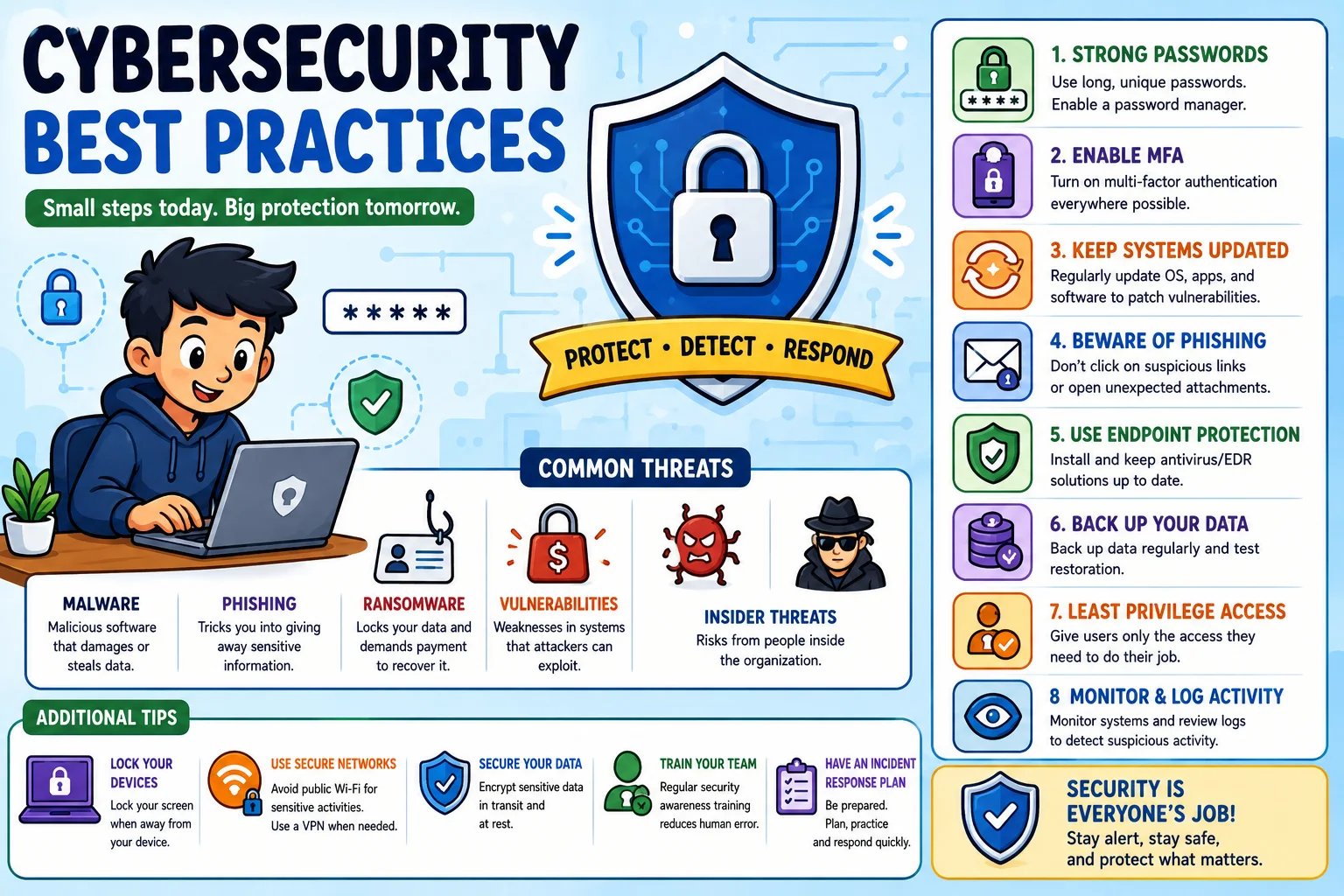
Cybersecurity threats continue to evolve in sophistication and frequency. Understanding the adversary is the first step in building effective defenses.
The Threat Landscape in 2026
Cybersecurity threats continue to evolve in sophistication and frequency. Understanding the adversary is the first step in building effective defenses.
Current Threat Statistics
- Ransomware — A ransomware attack occurs every 11 seconds. Average ransom demand: $1.5M.
- Phishing — 90% of data breaches begin with a phishing email.
- Zero-day exploits — 50+ zero-day vulnerabilities discovered and exploited in the wild annually.
- Insider threats — 34% of breaches involve internal actors (malicious or accidental).
- Supply chain attacks — SolarWinds, Log4j, and MOVEit incidents demonstrate cascading risk.
- AI-powered attacks — Generative AI creates convincing phishing emails, deepfake audio/video for social engineering, and automated vulnerability discovery.
Common Attack Vectors
| Attack Vector | Description | Mitigation |
|---|---|---|
| Phishing/Spear-phishing | Deceptive emails tricking users into revealing credentials or installing malware | Security awareness training, email filtering, MFA |
| Ransomware | Malware encrypts files, demands payment for decryption | Backups, EDR, network segmentation |
| DDoS | Overwhelm servers with traffic to cause downtime | CDN, rate limiting, DDoS protection services |
| SQL Injection | Malicious SQL queries through input fields | Parameterized queries, input validation, WAF |
| Cross-Site Scripting (XSS) | Injecting malicious scripts into web pages | CSP headers, output encoding, input sanitization |
| Man-in-the-Middle (MITM) | Intercepting communication between two parties | TLS 1.3, certificate pinning, VPN |
| Credential Stuffing | Using leaked credentials to access accounts | MFA, passwordless auth, breach monitoring |
| Zero-Day Exploit | Attacking unknown vulnerabilities before patches exist | Defense in depth, EDR, anomaly detection |
1. Zero Trust Architecture
The traditional perimeter-based security model (castle-and-moat) assumes everything inside the corporate network is trusted. With remote work, cloud services, and mobile devices, this assumption no longer holds.
Zero Trust Principles
- Never trust, always verify — Every access request must be authenticated, authorized, and encrypted regardless of origin.
- Least privilege access — Grant the minimum permissions needed for the minimum time required.
- Assume breach — Design systems assuming an attacker is already present. Segment aggressively and monitor continuously.
Implementation Framework
                    ┌──────────────────────┐
                    │    Policy Engine      │
                    │ (IDP + PDP + PEP)     │
                    └──────────┬───────────┘
                               │
  User ──► Device ──► Network ─┼──► Application ──► Data
                               │
                    ┌──────────▼───────────┐
                    │  Continuous Monitoring│
                    │ (SIEM, UEBA, SOAR)    │
                    └──────────────────────┘
NIST Zero Trust Maturity Model
| Maturity Level | Characteristics |
|---|---|
| Traditional | Static perimeter, VPN-based access, flat network |
| Initial | MFA implemented, basic network segmentation |
| Advanced | Micro-segmentation, ZTNA replaces VPN, device trust evaluation |
| Optimal | Fully automated policy enforcement, real-time risk scoring, AI-driven response |
2. Strong Authentication
Passwords alone are insufficient. Even complex passwords are routinely stolen through phishing, credential stuffing, or database breaches.
Multi-Factor Authentication (MFA)
| Factor Type | Examples | Security Level |
|---|---|---|
| Something you know | Password, PIN | Low |
| Something you have | Phone (TOTP), hardware key, smart card | Medium |
| Something you are | Fingerprint, face ID, voice | High |
| Somewhere you are | Geolocation, IP range | Contextual |
| Something you do | Typing pattern, mouse movement | Behavioral |
MFA implementation priority:
- All external-facing systems — Email, VPN, SaaS applications.
- Privileged accounts — Admin access to critical systems.
- All users — Even internal users should use MFA.
Passwordless Authentication
Passwordless eliminates the most vulnerable authentication factor. Standards:
- WebAuthn — W3C standard for public key cryptography-based authentication.
- Passkeys — Platform-specific implementation (Apple, Google, Microsoft).
- FIDO2 — Complete passwordless framework.
// WebAuthn registration example
const credential = await navigator.credentials.create({
  publicKey: {
    challenge: new Uint8Array([...]),
    rp: { name: "Example Corp", id: "example.com" },
    user: {
      id: new Uint8Array([...]),
      name: "user@example.com",
      displayName: "User"
    },
    pubKeyCredParams: [{ alg: -7, type: "public-key" }]
  }
});
Single Sign-On (SSO)
SSO centralizes authentication, reducing password fatigue and enabling centralized security controls:
- SAML 2.0 — Browser-based SSO, common in enterprise.
- OAuth 2.0 + OpenID Connect — Modern API-friendly SSO.
- LDAP / Active Directory — Traditional on-premises SSO.
3. Regular Patching and Updates
Unpatched vulnerabilities are the entry point for the majority of breaches. The Equifax breach (2017), which exposed 147M records, was caused by an unpatched Apache Struts vulnerability.
Patch Management Process
Discovery → Assessment → Testing → Deployment → Verification
- Discovery — Use vulnerability scanners (Nessus, Qualys, OpenVAS) to identify missing patches.
- Assessment — Prioritize based on CVSS score, exploitability, and asset criticality.
- Testing — Apply patches to staging/test environments first.
- Deployment — Roll out patches in waves (canary → pilot → full).
- Verification — Run scans to confirm patches were applied successfully.
Critical Patch Timelines
| Severity | CVSS Score | Patch Window |
|---|---|---|
| Critical | 9.0-10.0 | 48 hours |
| High | 7.0-8.9 | 7 days |
| Medium | 4.0-6.9 | 30 days |
| Low | 0.1-3.9 | Next scheduled cycle |
Automation Tools
- WSUS — Windows Server Update Services.
- Red Hat Satellite — Linux patch management.
- Automox — Cloud-native patch orchestration.
- ManageEngine Patch Connect Plus — Third-party patching.
4. Network Security
Network Segmentation
Divide the network into isolated zones to contain breaches:
[Internet]
    │
┌───▼─────────────────────┐
│     DMZ                 │  Web servers, VPN gateways
└─────────────────────────┘
    │
┌───▼─────────────────────┐
│     Internal Zone       │  User workstations, printers
└─────────────────────────┘
    │
┌───▼─────────────────────┐
│     Restricted Zone     │  Databases, source control, secrets
└─────────────────────────┘
    │
┌───▼─────────────────────┐
│     OT / ICS Zone       │  Industrial control systems
└─────────────────────────┘
Firewalls
| Type | Layer | Example |
|---|---|---|
| Packet filter | 3-4 | iptables, ACLs |
| Stateful | 3-4 | pfSense, Windows Firewall |
| Application (WAF) | 7 | Cloudflare, AWS WAF, ModSecurity |
| Next-Gen (NGFW) | 3-7 | Palo Alto, Fortinet, Check Point |
Intrusion Detection/Prevention
- Snort — Open-source signature-based IDS/IPS.
- Suricata — Multi-threaded, supports hardware acceleration.
- Zeek (Bro) — Network analysis framework for anomaly detection.
IDS/IPS Rules Example (Snort)
# Detect SQL injection attempts
alert tcp $EXTERNAL_NET any -> $HTTP_SERVERS $HTTP_PORTS (
  msg:"SQL Injection - UNION SELECT";
  content:"UNION"; nocase;
  content:"SELECT"; nocase; distance:0;
  sid:1000001; rev:1;
)
5. Endpoint Protection
Endpoints (laptops, servers, mobile devices) are the most common target for initial compromise.
Endpoint Detection and Response (EDR)
EDR goes beyond traditional antivirus by monitoring behavioral patterns:
| Feature | Traditional AV | EDR |
|---|---|---|
| Detection method | Signatures | Behavioral + ML |
| Response | Quarantine or delete | Isolate, investigate, remediate |
| Visibility | File system | Processes, registry, network, memory |
| Forensics | Limited | Full timeline of events |
| Threat hunting | No | Yes |
Top EDR solutions: CrowdStrike Falcon, SentinelOne, Microsoft Defender for Endpoint, Palo Alto Cortex XDR.
Application Control
- Allowlisting — Only approved applications can execute.
- Microsoft AppLocker — Windows application control.
- Google Santa — macOS application allowlisting.
- Linux Security Modules — AppArmor, SELinux.
6. Data Protection
Encryption
At rest:
- AES-256 — Industry standard for data encryption.
- Full Disk Encryption — BitLocker (Windows), FileVault (macOS), LUKS (Linux).
- Database Encryption — Transparent Data Encryption (TDE), column-level encryption.
- Cloud Storage — Server-side encryption (SSE-S3, SSE-KMS), client-side encryption.
In transit:
- TLS 1.3 — Current standard for transport encryption.
- mTLS — Mutual TLS for service-to-service authentication.
- SSH — Secure remote access.
- IPsec — Network-level encryption for VPNs.
Backup Strategy — The 3-2-1 Rule
| Component | Requirement | Example |
|---|---|---|
| 3 copies | Original + 2 backups | Production + local backup + cloud backup |
| 2 media types | Different storage technologies | SSD + Tape or HDD + Cloud |
| 1 offsite | Separate physical location | Cloud region or different data center |
Data Loss Prevention (DLP)
DLP tools monitor and control sensitive data movement:
- Network DLP — Scans outbound traffic for credit cards, SSN, IP.
- Endpoint DLP — Prevents copying sensitive files to USB drives.
- Cloud DLP — Scans SaaS applications for data exposure.
7. Security Awareness Training
Technology alone cannot prevent breaches — humans are both the weakest link and the first line of defense.
Training Program Components
- Initial onboarding — Security basics for all new hires.
- Quarterly training — Phishing simulations, updated threat briefings.
- Role-specific training — Developers (secure coding), executives (fraud protection), IT staff (incident response).
- Phishing simulations — Send simulated phishing emails and track click rates.
Key Training Topics
- Recognizing phishing emails (urgency, poor grammar, mismatched URLs).
- Password hygiene and using password managers.
- Safe browsing habits.
- Physical security (badge access, clean desk).
- Incident reporting procedures.
- Social engineering awareness (pretexting, baiting, tailgating).
Incident Response Plan
A well-defined incident response plan minimizes damage and recovery time.
The 6-Stage IR Framework (NIST)
| Phase | Description | Key Actions |
|---|---|---|
| Preparation | Build capability before incidents occur | Document playbooks, assemble a CSIRT, acquire tools, conduct tabletop exercises |
| Detection | Identify potential incidents | Monitor SIEM alerts, analyze suspicious emails, review IDS alerts, user reports |
| Containment | Stop the incident from spreading | Isolate affected systems, block malicious IPs, disable compromised accounts, take disk images |
| Eradication | Remove the threat | Remove malware, patch vulnerabilities, reset credentials, rebuild systems from clean images |
| Recovery | Restore normal operations | Restore from backups, monitor for reinfection, gradually return systems to production |
| Lessons Learned | Improve for next time | Conduct post-mortem within 2 weeks, update playbooks, implement preventive measures |
Incident Severity Levels
| Level | Description | Response Time |
|---|---|---|
| SEV-1 | Critical (data breach, ransomware, service outage) | Immediate — 24/7 response |
| SEV-2 | High (targeted attack, malware outbreak) | Within 1 hour |
| SEV-3 | Medium (phishing campaign, single infected device) | Within 4 hours |
| SEV-4 | Low (policy violation, low-risk scan) | Next business day |
Compliance Frameworks
| Framework | Focus | Applicable To |
|---|---|---|
| ISO 27001 | Information security management | All organizations |
| SOC 2 | Service organization controls | SaaS companies |
| PCI DSS | Payment card data security | E-commerce, payment processors |
| HIPAA | Healthcare data privacy | Healthcare, insurance |
| GDPR | Personal data protection | Organizations handling EU citizen data |
| NIST CSF | Cybersecurity framework | Critical infrastructure, US federal agencies |
| FedRAMP | Cloud service provider security | Cloud vendors working with US government |
Conclusion
Cybersecurity is not a destination — it is a continuous journey. The most effective approach combines:
- Technology — EDR, firewalls, encryption, SIEM.
- Process — Patch management, incident response, vulnerability management.
- People — Security awareness, training, culture of security.
Start with the fundamentals: enable MFA, patch critical vulnerabilities, implement backups, and train your users. From that foundation, build toward zero trust architecture, advanced threat detection, and automated incident response.
Featured Articles

The 10 Largest Frontend Performance Challenges in 2026 (And How to Fix Them)

Should I Use React or Next.js? Complete Comparison Guide 2026

Build an Offline-First SaaS with Laravel & React: Complete PWA Tutorial 2026
Comments
0 commentsNo approved comments are visible yet. New community replies may wait for moderation.