Blockchain Beyond Cryptocurrency
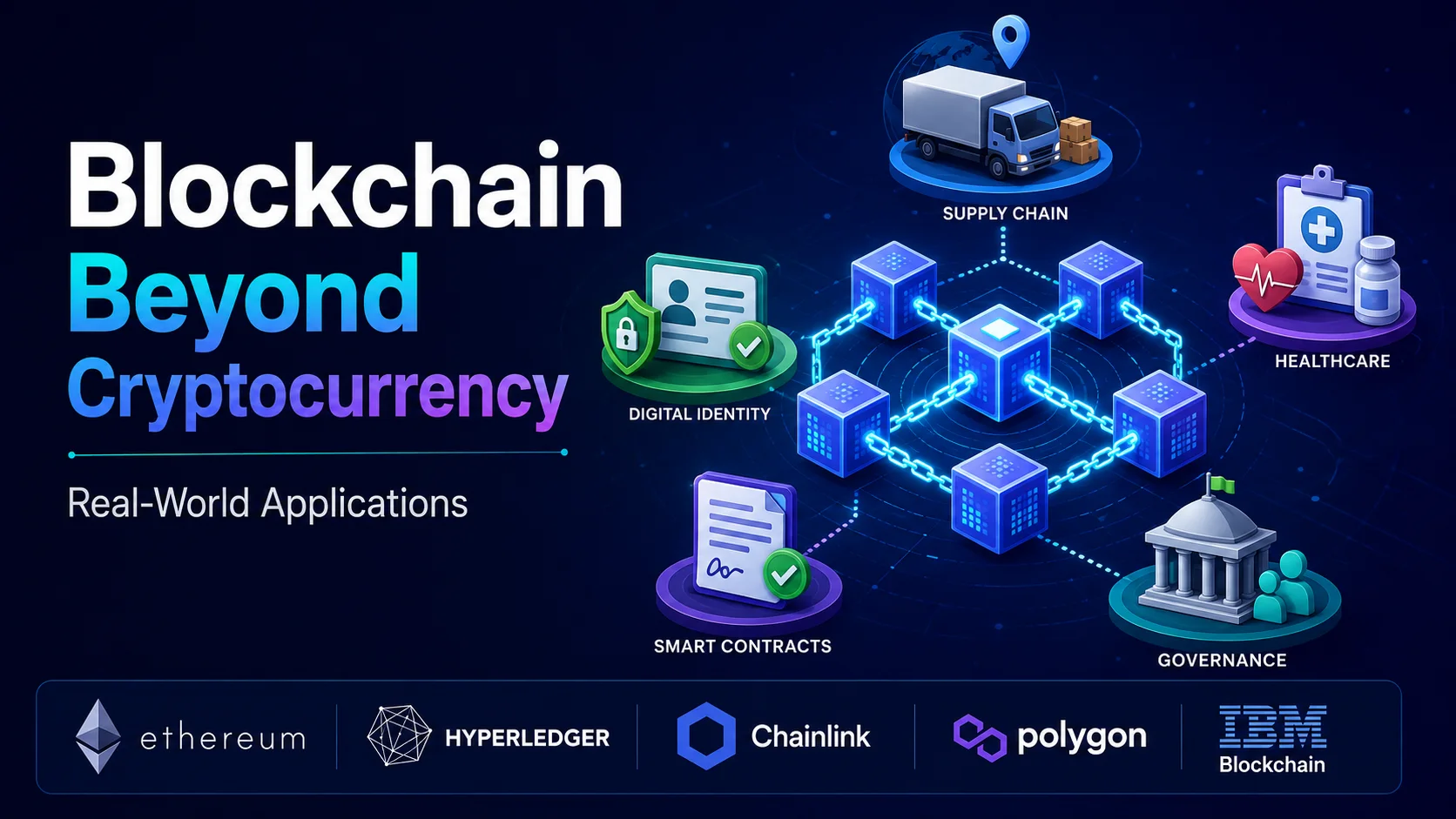
Blockchain is a distributed, immutable ledger that records transactions across a network of computers. Each block contains a cryptographic hash of the previous block, creating a chain that cannot be altered retroactively without consensus from the network.
Introduction
Blockchain is a distributed, immutable ledger that records transactions across a network of computers. Each block contains a cryptographic hash of the previous block, creating a chain that cannot be altered retroactively without consensus from the network.
While blockchain gained mainstream attention through cryptocurrencies like Bitcoin and Ethereum, its potential extends far beyond digital money. This article explores real-world enterprise applications of blockchain technology — where it adds value, where it does not, and how organizations are implementing it today.
How Blockchain Works
Core Concepts
- Distributed Ledger — Every participant has a copy of the ledger. No central authority.
- Immutability — Once recorded, data cannot be altered without network consensus.
- Consensus — Participants agree on the state of the ledger through algorithms like Proof-of-Work, Proof-of-Stake, or Raft.
- Smart Contracts — Self-executing code on the blockchain that automatically enforces agreements.
- Cryptography — Public/private key cryptography ensures security and identity.
Blockchain Structure
Block 1 (Genesis)          Block 2                  Block 3
┌─────────────────┐       ┌─────────────────┐       ┌─────────────────┐
│ Block Header     │       │ Block Header     │       │ Block Header     │
│ - Previous Hash: 0 │─────│ - Previous Hash: │──────│ - Previous Hash: │
│ - Timestamp     │       │   a3f2...         │       │   b7c1...         │
│ - Nonce         │       │ - Timestamp     │       │ - Timestamp     │
│ - Merkle Root   │       │ - Nonce         │       │ - Nonce         │
├─────────────────┤       ├─────────────────┤       ├─────────────────┤
│ Transactions    │       │ Transactions    │       │ Transactions    │
│ [Tx1] [Tx2]     │       │ [Tx3] [Tx4]     │       │ [Tx5] [Tx6]     │
└─────────────────┘       └─────────────────┘       └─────────────────┘
Blockchain Types
| Type | Access | Consensus | Performance | Example |
|---|---|---|---|---|
| Public (Permissionless) | Anyone can read/write | PoW, PoS | Low (7-100 TPS) | Bitcoin, Ethereum |
| Private (Permissioned) | Authorized participants only | Raft, PBFT | High (1000+ TPS) | Hyperledger Fabric |
| Consortium | Multiple organizations | Multi-party consensus | Medium | R3 Corda, B3i |
| Hybrid | Mixed public/private | Customizable | Variable | Dragonchain |
Public vs. Private Blockchain
| Aspect | Public | Private |
|---|---|---|
| Trust model | Trustless (no one trusted) | Trusted participants |
| Transparency | Fully transparent | Selective visibility |
| Speed | Slow (7-100 TPS) | Fast (1000+ TPS) |
| Cost | High (gas fees) | Low (no mining) |
| Governance | Decentralized | Centralized/consortium |
| Regulation | Unregulated | Compliant by design |
Key insight for enterprises: Permissioned blockchains (Hyperledger Fabric, Corda) are almost always the right choice for business applications. Public blockchains are rarely suitable due to speed, cost, and privacy limitations.
Enterprise Use Cases
1. Supply Chain and Traceability
Problem: Supply chains are complex, opaque, and prone to fraud. Counterfeiting costs global businesses $500B+ annually.
Solution: Blockchain provides an immutable record of every step in the supply chain — from raw materials to finished product.
Example — IBM Food Trust:
Farm → Distributor → Processor → Retailer → Consumer
  │         │            │          │          │
  └─────────┴──── Blockchain ───────┴──────────┘

  Each participant records:
  - Origin and harvest date
  - Temperature during transport
  - Processing and packaging
  - Distribution and delivery
// Solidity smart contract for supply chain tracking
pragma solidity ^0.8.0;

contract SupplyChain {
    enum State { Produced, Shipped, InTransit, Delivered, Received }

    struct Product {
        uint id;
        string name;
        address producer;
        State state;
        uint timestamp;
    }

    mapping(uint => Product) public products;
    mapping(uint => address[]) public custodyChain;

    event ProductStateChanged(uint productId, State newState, address updatedBy);

    function produceProduct(uint _id, string memory _name) public {
        products[_id] = Product(_id, _name, msg.sender, State.Produced, block.timestamp);
        custodyChain[_id].push(msg.sender);
        emit ProductStateChanged(_id, State.Produced, msg.sender);
    }

    function updateState(uint _productId, State _newState) public {
        require(products[_productId].state < _newState, "State must advance");
        products[_productId].state = _newState;
        products[_productId].timestamp = block.timestamp;
        custodyChain[_productId].push(msg.sender);
        emit ProductStateChanged(_productId, _newState, msg.sender);
    }

    function getCustodyHistory(uint _productId) public view returns (address[] memory) {
        return custodyChain[_productId];
    }
}
Real-world impact:
- Walmart — Reduced trace time for mangoes from 7 days to 2.2 seconds.
- De Beers — Tracks diamonds from mine to retail, ensuring conflict-free sourcing.
- Maersk (TradeLens) — Digitized shipping documentation, reduced transit time by 40%.
2. Healthcare
Problem: Patient data is fragmented across providers, insecure, and not easily portable.
Solution: Blockchain creates a unified, patient-controlled health record system.
Patient ──► Hospital ──► Lab ──► Pharmacy ──► Insurance
   │          │          │        │             │
   └──────────┴──────────┴────────┴─────────────┘
                    │
          ┌─────────▼─────────┐
          │  Blockchain       │
          │  Health Record    │
          │                   │
          │  Patient controls │
          │  access via keys  │
          └───────────────────┘
Key benefits:
- Patient-controlled access (who sees what data).
- Immutable audit trail of all access.
- Interoperability between providers.
- Secure sharing for research (with consent).
3. Digital Identity
Problem: Digital identities are fragmented, insecure, and controlled by third parties (Google, Facebook, government databases).
Solution: Self-sovereign identity (SSI) gives users control over their own identity data.
// Decentralized Identifier (DID) document
{
  "@context": "https://www.w3.org/ns/did/v1",
  "id": "did:example:123456789abcdef",
  "verificationMethod": [{
    "id": "did:example:123456789abcdef#keys-1",
    "type": "Ed25519VerificationKey2020",
    "controller": "did:example:123456789abcdef",
    "publicKeyMultibase": "zH3C2AVvLMv6gmMNam3uVAjZpfkcJCwDwnZn6z3wXmqPV"
  }],
  "authentication": ["did:example:123456789abcdef#keys-1"],
  "service": [{
    "id": "did:example:123456789abcdef#vcs",
    "type": "VerifiableCredentialService",
    "serviceEndpoint": "https://example.com/credentials"
  }]
}
Applications:
- Digital passports — W3C verifiable credentials for border control.
- Educational credentials — MIT issues diplomas on blockchain.
- KYC/AML compliance — Share verified identity without exposing raw data.
- Employee onboarding — Verify work history without contacting previous employers.
4. Real Estate
Problem: Property transactions are slow, paper-heavy, and fraud-prone. Title disputes cost billions annually.
Solution: Blockchain records property titles, automates escrow, and enables fractional ownership.
Smart contract escrow:
contract RealEstateEscrow {
    address buyer;
    address seller;
    address inspector;
    address lender;
    uint256 purchasePrice;
    bool inspectionPassed;
    bool financingApproved;

    constructor(address _seller, uint256 _price) {
        buyer = msg.sender;
        seller = _seller;
        purchasePrice = _price;
    }

    function approveInspection() public {
        require(msg.sender == inspector);
        inspectionPassed = true;
    }

    function finalizeSale() public {
        require(inspectionPassed, "Inspection failed");
        require(address(this).balance >= purchasePrice, "Insufficient funds");
        payable(seller).transfer(purchasePrice);
    }
}
5. Intellectual Property and Royalties
Problem: Creators lose control of their work once published. Royalty tracking is opaque and slow.
Solution: NFTs and smart contracts automate royalty distribution.
// NFT with automated royalties (ERC-2981)
contract MusicNFT is ERC721, ERC2981 {
    uint256 public royaltyFee = 500; // 5% (basis points)

    function _beforeTokenTransfer(
        address from, address to, uint256 tokenId, uint256 batchSize
    ) internal override(ERC721, ERC2981) {
        super._beforeTokenTransfer(from, to, tokenId, batchSize);
    }

    function supportsInterface(bytes4 interfaceId)
        public view override(ERC721, ERC2981) returns (bool)
    {
        return super.supportsInterface(interfaceId);
    }

    // Royalty info is enforced at marketplace level
    function royaltyInfo(uint256 tokenId, uint256 salePrice)
        external view returns (address, uint256)
    {
        return (creatorOf[tokenId], (salePrice * royaltyFee) / 10000);
    }
}
Smart Contracts — Deeper Dive
What Are Smart Contracts?
Self-executing contracts with the terms of the agreement directly written into code. They run on the blockchain, making them transparent, immutable, and trustless.
Simple Smart Contract
// SPDX-License-Identifier: MIT
pragma solidity ^0.8.20;

contract Voting {
    struct Proposal {
        string description;
        uint voteCount;
    }

    mapping(address => bool) public hasVoted;
    Proposal[] public proposals;
    address public chairperson;

    constructor() {
        chairperson = msg.sender;
    }

    function addProposal(string memory description) public {
        require(msg.sender == chairperson, "Only chairperson can add proposals");
        proposals.push(Proposal(description, 0));
    }

    function vote(uint proposalIndex) public {
        require(!hasVoted[msg.sender], "Already voted");
        require(proposalIndex < proposals.length, "Invalid proposal");

        hasVoted[msg.sender] = true;
        proposals[proposalIndex].voteCount++;
    }

    function winningProposal() public view returns (uint winningIndex) {
        uint winningVoteCount = 0;
        for (uint i = 0; i < proposals.length; i++) {
            if (proposals[i].voteCount > winningVoteCount) {
                winningVoteCount = proposals[i].voteCount;
                winningIndex = i;
            }
        }
    }
}
Smart contracts are deterministic — given the same input, they always produce the same output. They cannot access external data directly (APIs, databases) without an oracle.
Oracles — Bridging Blockchain and Real-World Data
// Chainlink oracle for price data
import "@chainlink/contracts/src/v0.8/interfaces/AggregatorV3Interface.sol";

contract PriceConsumer {
    AggregatorV3Interface internal priceFeed;

    constructor() {
        // ETH/USD price feed on Ethereum mainnet
        priceFeed = AggregatorV3Interface(0x5f4eC3Df9cbd43714FE2740f5E3616155c5b8419);
    }

    function getLatestPrice() public view returns (int) {
        (, int price, , , ) = priceFeed.latestRoundData();
        return price; // 8 decimals (e.g., 2000.12345678 = $2000.12)
    }
}
Consensus Mechanisms
| Algorithm | Energy | Speed | Decentralization | Used By |
|---|---|---|---|---|
| Proof of Work (PoW) | Very high | Slow | High | Bitcoin |
| Proof of Stake (PoS) | Low | Medium | High | Ethereum 2.0 |
| Delegated PoS | Low | Fast | Medium | EOS, TRON |
| Practical Byzantine Fault Tolerance (PBFT) | Low | Fast | Low | Hyperledger Fabric |
| Raft | Low | Very fast | Low | Private chains |
| Proof of Authority (PoA) | Low | Fast | Low | Consortium chains |
Challenges and Limitations
1. Scalability
| Blockchain | Transactions Per Second | Comparison |
|---|---|---|
| Bitcoin | 7 TPS | ❌ Visa: 24,000 TPS |
| Ethereum | 15-30 TPS | ❌ Visa: 24,000 TPS |
| Solana | 2,000-3,000 TPS | ✅ Near Visa level |
| Hyperledger Fabric | 1,000-10,000 TPS | ✅ Enterprise grade |
Scaling solutions:
- Layer 2 — Rollups (Optimistic, ZK), Lightning Network.
- Sharding — Split blockchain into parallel shards (Ethereum 2.0).
- Sidechains — Separate chains that connect to main chain.
2. Energy Consumption
| Network | Annual Energy | Equivalent To |
|---|---|---|
| Bitcoin PoW | ~150 TWh | Argentina |
| Ethereum (pre-merge) | ~100 TWh | Netherlands |
| Ethereum (post-merge PoS) | ~0.01 TWh | ~2,000 US homes |
| Hyperledger Fabric | ~negligible | Office computers |
Key point: Permissioned blockchains (suitable for enterprise) use negligible energy. PoW is only required for permissionless, trustless networks.
3. Regulatory Uncertainty
| Jurisdiction | Stance |
|---|---|
| EU | MiCA (Markets in Crypto-Assets) regulation adopted 2024 |
| US | Evolving — SEC/CFTC jurisdiction unresolved |
| UK | Crypto assets regulated as financial instruments |
| Singapore | Clear regulatory framework for DLT |
| China | Crypto banned, but blockchain technology encouraged |
4. Integration with Legacy Systems
Most enterprises have existing ERP, CRM, and database systems. Connecting blockchain to these systems requires:
- Middleware — Blockchain adapters and APIs.
- Data synchronization — Keep blockchain and off-chain data consistent.
- Workflow integration — Map smart contracts to business processes.
5. Interoperability
Different blockchains do not natively communicate. Solutions:
- Cross-chain bridges — Connect separate blockchains.
- Polkadot — Parachains connected to relay chain.
- Cosmos IBC — Inter-blockchain communication protocol.
When to Use Blockchain (and When Not To)
Use Blockchain When:
- Multiple parties who do not fully trust each other need to share data.
- You need an immutable, auditable record of transactions.
- You need to automate agreements with smart contracts.
- You need to remove a central intermediary.
- Data integrity and provenance are critical.
Don't Use Blockchain When:
- A centralized database works fine (most use cases).
- You need high throughput (>10,000 TPS).
- Data privacy requires hiding transactions from all participants.
- You have a single trusted party who can maintain the database.
- Regulatory requirements conflict with public/immutable ledgers.
Conclusion
Blockchain is a tool, not a solution. It adds value specifically when multiple untrusted parties need to share data with integrity guarantees. For most business problems, a traditional database is simpler, faster, and cheaper.
When blockchain is the right choice:
- Supply chain traceability across multiple organizations.
- Digital identity where users control their own data.
- Smart contracts for automated, trustless agreements.
- Immutable audit trails for regulatory compliance.
- Tokenization of assets for fractional ownership.
Due diligence checklist:
- Do multiple parties need to share data? If no — skip blockchain.
- Do the parties not fully trust each other? If no — centralized DB works.
- Is immutability important? If no — skip blockchain.
- Are smart contracts beneficial? If no — a shared ledger may suffice.
- Can you use a permissioned blockchain? If public is required, consider regulatory and cost implications.
Blockchain is not a silver bullet — but for the right problems, it is a transformative technology.
Featured Articles
The 10 Largest Frontend Performance Challenges in 2026 (And How to Fix Them)
Should I Use React or Next.js? Complete Comparison Guide 2026
Build an Offline-First SaaS with Laravel & React: Complete PWA Tutorial 2026
Comments
0 commentsNo approved comments are visible yet. New community replies may wait for moderation.