KI-Agenten und autonome Systeme: Architektur, Muster und Anwendungen
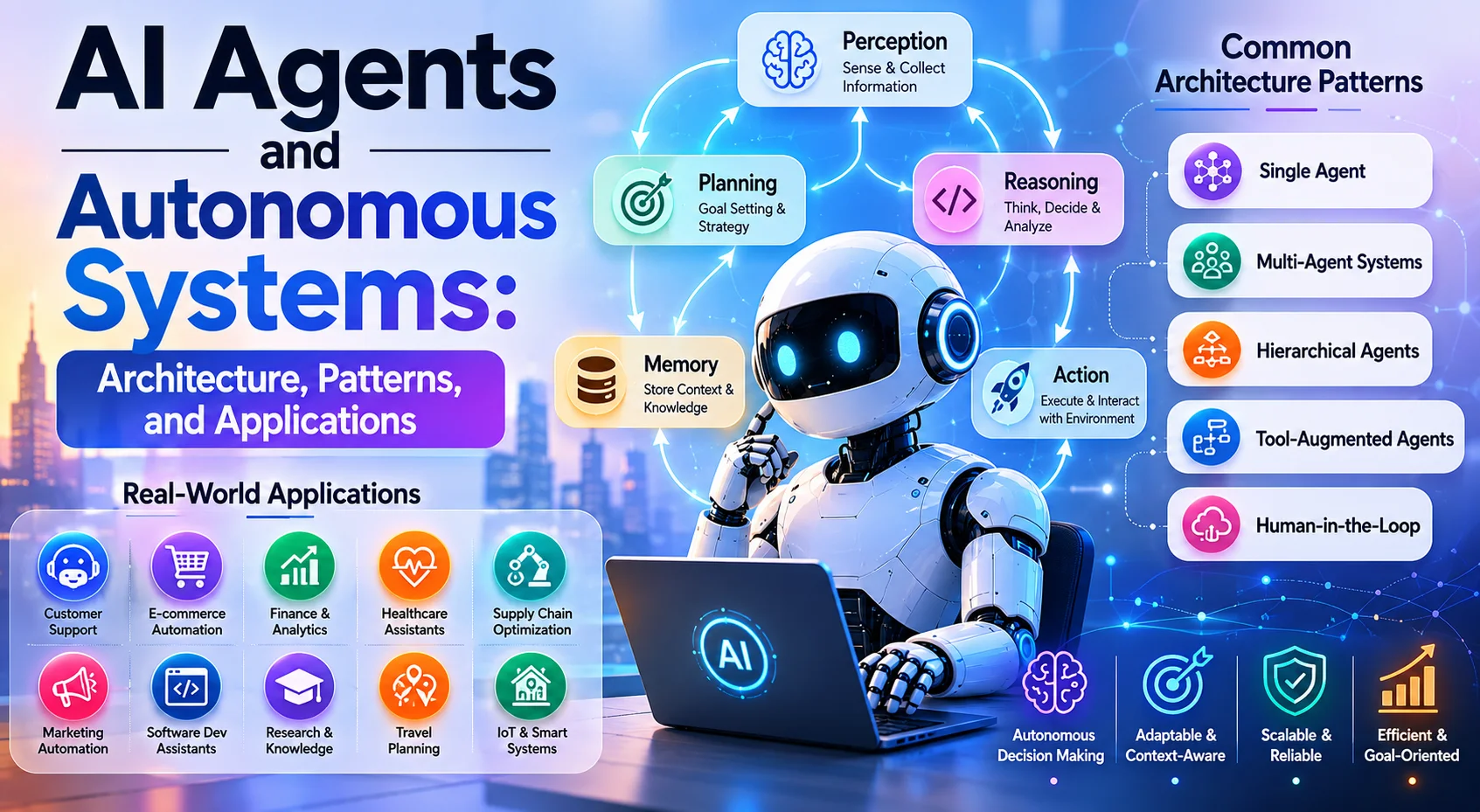
KI-Agenten sind autonome Softwaresysteme, die ihre Umgebung wahrnehmen, über Ziele nachdenken, Maßnahmen ergreifen und aus Ergebnissen lernen. Im Gegensatz zu herkömmlichen LLM-Anwendungen, die auf eine einzige Eingabeaufforderung reagieren, arbeiten Agenten in Schleifen – sie beobachten, denken, handeln und beobachten erneut –, bis ein Ziel erreicht ist.
Einführung
KI-Agenten sind autonome Softwaresysteme, die ihre Umgebung wahrnehmen, über Ziele nachdenken, Maßnahmen ergreifen und aus Ergebnissen lernen. Im Gegensatz zu herkömmlichen LLM-Anwendungen, die auf eine einzige Eingabeaufforderung reagieren, arbeiten Agenten in Schleifen – sie beobachten, denken, handeln und beobachten erneut –, bis ein Ziel erreicht ist.
Im Jahr 2026 stellen KI-Agenten die Grenze der angewandten KI dar. Sie automatisieren komplexe mehrstufige Arbeitsabläufe, interagieren mit externen Tools und APIs, arbeiten mit anderen Agenten zusammen und treffen Entscheidungen in dynamischen Umgebungen.
Was zeichnet einen KI-Agenten aus?
Kernkomponenten
                   ┌──────────────────┐
                   │   Environment    │
                   │ (APIs, files,    │
                   │  databases, web) │
                   └────────┬─────────┘
                            │
Perception (observe)        │        Action (effect)
    ┌───────────────────────┼───────────────────────┐
    │                       │                       │
    ▼                       │                       ▼
┌─────────────────┐         │              ┌─────────────────┐
│   Sensors       │         │              │   Tools         │
│ (read input)    │         │              │ (call APIs,     │
│                 │         │              │  write files)   │
└────────┬────────┘         │              └────────▲────────┘
         │                 │                        │
         │          ┌──────▼──────────────────────┐ │
         └─────────►│       Reasoner (LLM)        ├─┘
                    │   (plan, decide, reflect)   │
                    └─────────────────────────────┘
                              │
                              ▼
                    ┌──────────────────┐
                    │   Memory         │
                    │ (history, state, │
                    │  learnings)      │
                    └──────────────────┘
| Komponente | Beschreibung | Beispiel |
|---|---|---|
| Umwelt | Die Außenwelt, mit der der Agent interagiert | Web, Dateisystem, API, Datenbank |
| Sensoren | Wie der Agent die Umgebung wahrnimmt | Datei lesen, HTTP-Antwort, Benutzereingabe |
| Vernünftiger | Der LLM, der plant und entscheidet | GPT-4, Claude, Open-Source-Modell |
| Werkzeuge | Aktionen, die der Agent ausführen kann | Suche, Rechner, Codeausführung |
| Speicher | Kurzfristig (Konversation) + langfristig (Vektor-DB) | Chatverlauf, gelernte Fakten |
| Planung | Ziele in Schritte aufteilen | ReAct, Plan-and-Lose, Tree-of-Thought |
Agentenarchitekturen
1. ReAct (Begründung + Handeln)
Das beliebteste Agentenmuster – verschachtelt Argumentationsspuren mit Aktionen:
User: "Book a flight to Paris next Tuesday for under $500"

Thought: I need to search for flights to Paris next Tuesday.
Action: search_flights(destination="Paris", date="2026-05-26")
Observation: Found flights: $450 (direct), $380 (1 stop), $520 (direct)

Thought: The $450 direct flight is under budget. I need to check if
         the user has preferences for time.
Action: ask_user("Would you like the 7:00 AM direct for $450 or
                  the 11:00 AM direct for $520?")
Observation: User prefers morning.

Thought: Booking the 7:00 AM direct flight.
Action: book_flight(flight_id="AF1234", user_id="user_42")
Observation: Booking confirmed. Reference: BK-98765.

Thought: The task is complete. Let me summarize.
Response: I booked flight AF1234 to Paris on May 26 at 7:00 AM.
          Total: $450. Booking reference: BK-98765.
class ReActAgent:
    def __init__(self, llm, tools: list[Tool]):
        self.llm = llm
        self.tools = {t.name: t for t in tools}
        self.max_steps = 20

    def run(self, task: str) -> str:
        messages = [
            {"role": "system", "content": SYSTEM_PROMPT},
            {"role": "user", "content": task},
        ]

        for step in range(self.max_steps):
            # Reasoning step
            response = self.llm.invoke(messages)
            thought = response.content

            # Check if final answer
            if "FINAL ANSWER:" in thought:
                return thought.split("FINAL ANSWER:")[-1].strip()

            # Parse action
            action = self._parse_action(thought)
            if not action:
                continue

            # Execute action
            tool = self.tools.get(action['name'])
            if not tool:
                observation = f"Error: Unknown tool '{action['name']}'"
            else:
                try:
                    observation = tool.execute(**action['args'])
                except Exception as e:
                    observation = f"Error: {str(e)}"

            # Add to conversation
            messages.append({
                "role": "assistant",
                "content": thought
            })
            messages.append({
                "role": "user",
                "content": f"Observation: {observation}"
            })

        return "Max steps reached without completing task."
2. Planen und lösen (Zerlegung)
User: "Create a monthly sales report with charts"

Plan:
1. Query database for last month's sales data
2. Clean and aggregate data by product category
3. Create bar chart of sales by category
4. Create line chart of daily sales trend
5. Generate PDF report with charts and summary

Step 1: query_database("SELECT ... WHERE month = '2026-04'")
✓ Done: 15,243 records returned

Step 2: aggregate_by_category(data)
✓ Done: 8 categories aggregated

...
3. Multiagentensysteme
Spezialisierte Agenten arbeiten bei komplexen Aufgaben zusammen:
                    ┌─────────────────────────┐
                    │   Orchestrator Agent     │
                    │ (decomposes tasks,       │
                    │  coordinates agents)     │
                    └────┬──────┬──────┬───────┘
                         │      │      │
              ┌──────────┤      │      ├──────────┐
              │          │      │      │          │
         ┌────▼────┐ ┌──▼──┐ ┌─▼───┐ ┌▼────────┐
         │Research │ │Code │ │Test │ │Document │
         │ Agent   │ │Agent│ │Agent│ │ Agent   │
         │(search, │ │(code│ │(test│ │(docs,   │
         │ analyze)│ │ gen)│ │ gen)│ │ reports)│
         └─────────┘ └─────┘ └─────┘ └─────────┘
Beispiel: Softwareentwicklung mit mehreren Agenten:
# Agent roles
agents = {
    'product_manager': Agent(
        role="Defines requirements and acceptance criteria",
        tools=[search_knowledge_base, ask_user]
    ),
    'architect': Agent(
        role="Designs system architecture and data flow",
        tools=[draw_diagram, search_documentation]
    ),
    'developer': Agent(
        role="Writes and reviews code",
        tools=[write_file, read_file, execute_code]
    ),
    'qa_engineer': Agent(
        role="Writes tests and validates functionality",
        tools=[run_tests, check_coverage, report_bugs]
    ),
}

# Orchestrator coordinates the workflow
orchestrator = Orchestrator(agents)
result = orchestrator.execute(
    "Build a REST API for user authentication"
)
Tools und Funktionsaufrufe
Werkzeuge definieren
from pydantic import BaseModel, Field

class SearchTool(Tool):
    name = "web_search"
    description = "Search the web for current information"

    class Parameters(BaseModel):
        query: str = Field(description="The search query")

    def execute(self, query: str) -> str:
        response = requests.get(
            "https://api.search.example.com",
            params={"q": query}
        )
        return response.text

class CalculatorTool(Tool):
    name = "calculator"
    description = "Perform mathematical calculations"

    class Parameters(BaseModel):
        expression: str = Field(
            description="Mathematical expression to evaluate"
        )

    def execute(self, expression: str) -> str:
        try:
            # Safe evaluation
            result = self._safe_eval(expression)
            return str(result)
        except Exception as e:
            return f"Error: {e}"

class DatabaseQueryTool(Tool):
    name = "query_database"
    description = "Query the sales database"

    class Parameters(BaseModel):
        sql: str = Field(description="SQL query to execute")

    def execute(self, sql: str) -> str:
        # Validate SQL (read-only queries only)
        if not sql.strip().upper().startswith("SELECT"):
            return "Error: Only SELECT queries are allowed"
        result = db.execute(sql)
        return json.dumps(result, default=str)
Werkzeugregistrierung
class Agent:
    def __init__(self, llm, tools: list[Tool]):
        self.llm = llm
        self.tool_registry = {
            t.name: t for t in tools
        }

        # Create function descriptions for LLM
        self.functions = [
            {
                "type": "function",
                "function": {
                    "name": t.name,
                    "description": t.description,
                    "parameters": t.Parameters.model_json_schema()
                }
            }
            for t in tools
        ]

    def think_and_act(self, prompt: str) -> str:
        response = self.llm.invoke(
            messages=[{"role": "user", "content": prompt}],
            tools=self.functions
        )

        # If LLM wants to call a tool
        if response.tool_calls:
            for call in response.tool_calls:
                tool = self.tool_registry[call.function.name]
                args = json.loads(call.function.arguments)
                result = tool.execute(**args)
                # Feed result back to LLM...
Speichersysteme
Kurzzeitgedächtnis (Konversationskontext)
class ConversationMemory:
    def __init__(self, max_tokens: int = 4000):
        self.messages = []
        self.max_tokens = max_tokens

    def add(self, role: str, content: str):
        self.messages.append({"role": role, "content": content})
        self._trim()

    def _trim(self):
        total = sum(len(m['content']) for m in self.messages)
        while total > self.max_tokens and len(self.messages) > 2:
            self.messages.pop(1)  # Keep system prompt
            total = sum(len(m['content']) for m in self.messages)
Langzeitgedächtnis (Vector Store)
class LongTermMemory:
    def __init__(self, vector_store):
        self.store = vector_store

    def remember(self, fact: str, metadata: dict = None):
        """Store important facts for future reference"""
        embedding = embed_text(fact)
        self.store.insert(embedding, payload={
            'fact': fact,
            **metadata,
            'timestamp': datetime.now().isoformat()
        })

    def recall(self, query: str, k: int = 5) -> list[str]:
        """Retrieve relevant past facts"""
        query_vector = embed_text(query)
        results = self.store.search(query_vector, k=k)
        return [r.payload['fact'] for r in results]

    def consolidate(self):
        """Summarize and compress old memories"""
        old_memories = self.store.get_older_than(days=30)
        summary = summarize_texts([m.payload['fact'] for m in old_memories])
        self.remember(f"Summary of past activities: {summary}",
                       metadata={'type': 'summary'})
        self.store.delete(old_memories)
Agentenplanungsstrategien
Baum der Gedanken
Erkunden Sie mehrere Argumentationspfade gleichzeitig:
Question: "What is the best cloud provider for our startup?"

Branch 1: Cost comparison
  ├─ AWS: $X/month
  └─ GCP: $Y/month (cheaper, but fewer services)

Branch 2: Required services
  ├─ Need managed Kubernetes → all support
  └─ Need specific AI/ML → GCP has TPUs

Branch 3: Team expertise
  ├─ Team knows AWS → faster ramp-up
  └─ learning GCP → 2-3 month delay

Evaluation:
  Path AWS: high team skill, moderate cost → score 8/10
  Path GCP: lower cost, TPUs, but learning curve → score 7/10
Selbstreflexion und Verbesserung
class ReflectiveAgent(Agent):
    def __init__(self, *args, **kwargs):
        super().__init__(*args, **kwargs)
        self.mistakes = []

    def reflect_on_failure(self, task: str, action: str, error: str):
        """Learn from mistakes"""
        reflection = self.llm.invoke(f"""
        Task: {task}
        Action taken: {action}
        Error: {error}

        Why did this fail? What should I do differently next time?
        """)
        self.mistakes.append(reflection.content)

    def plan(self, task: str) -> str:
        # Consider past mistakes when planning
        if self.mistakes:
            lessons = "\n".join([f"- {m}" for m in self.mistakes[-5:]])
            return self.llm.invoke(f"""
            Task: {task}
            Lessons from past mistakes:
            {lessons}
            Plan your approach carefully.
            """)
        return super().plan(task)
Anwendungsfälle
1. Automatisierter Kundensupport
Customer: "My order hasn't arrived and it's been 2 weeks"

Agent tasks:
1. Query order database for status
2. Check tracking API for shipment location
3. If delayed: contact shipping carrier
4. If lost: initiate refund process
5. If delivered: verify with customer

Tools needed: order_lookup, tracking_api, email_send, refund_system
2. Codegenerierung und Debugging
Developer: "Fix the login bug — users get 401 errors after password reset"

Agent workflow:
1. Search codebase for password reset implementation
2. Identify token validation logic
3. Write a unit test reproducing the bug
4. Fix the issue
5. Run existing tests to verify no regression
6. Create PR with description
3. Forschungsassistent
class ResearchAgent:
    async def research(self, topic: str) -> Report:
        # Parallel exploration
        subtopics = self.decompose(topic)
        tasks = [self.explore_subtopic(st) for st in subtopics]
        findings = await asyncio.gather(*tasks)

        # Synthesize
        report = self.synthesize(findings)
        return report

    async def explore_subtopic(self, subtopic: str) -> Finding:
        search_results = await web_search(subtopic)
        summaries = await asyncio.gather(*[
            summarize_page(url) for url in search_results[:5]
        ])
        return Finding(subtopic=subtopic, summaries=summaries)
Herausforderungen und Risiken
1. Halluzination in Handlungen
Der Agent kann getrost falsche Maßnahmen ergreifen:
Thought: The user asked to delete expired records.
Action: DELETE FROM users  -- (Oops, no WHERE clause!)
Schadensbegrenzung:
- Überprüfen Sie stets destruktive Handlungen.
- Für irreversible Vorgänge ist eine Bestätigung erforderlich.
- Verwenden Sie zum Testen den Modus „Trockenlauf“.
2. Schleifenerkennung
Agenten können in Endlosschleifen stecken bleiben:
class LoopDetector:
    def __init__(self, max_repeated_actions: int = 3):
        self.action_history = []
        self.max_repeated = max_repeated_actions

    def check(self, action: str, observation: str) -> bool:
        self.action_history.append({
            'action': action,
            'observation': observation
        })

        # Check for repeated patterns
        recent = self.action_history[-5:]
        if len(recent) >= 3:
            patterns = [a['action'] for a in recent]
            if len(set(patterns)) <= 2:
                print("Loop detected!")
                return True
        return False
3. Kostenmanagement
Jeder Agentenschritt kostet Geld (LLM-Aufrufe + API-Aufrufe):
agent_cost_estimation:
  per_step:
    llm_call:  "$0.01"    # GPT-4o
    tool_call: "$0.001"   # Average API call
    search:    "$0.00"    # Web search

  typical_session:
    steps: 10-30
    total: "$0.10 - $0.50"

  complex_research:
    steps: 50-200
    total: "$0.50 - $5.00"
Agent-Frameworks
| Rahmen | Sprache | Funktionen |
|---|---|---|
| LangChain | Python | Das beliebteste und umfassendste Tool-Ökosystem |
| AutoGen | Python | Gespräche mit mehreren Agenten, Microsoft |
| CrewAI | Python | Rollenbasierte Agententeams |
| Semantischer Kern | C#/Python | Microsoft AI-Orchestrierung |
| Vercel AI SDK | TypeScript | RSC, Streaming, Tools für Web-Apps |
| LlamaIndex | Python | RAG + Agent, datenzentriert |
| OpenAI Assistants API | API | Verwaltet, Code-Interpreter, Dateisuche |
Fazit
KI-Agenten stellen die nächste Weiterentwicklung von LLM-Anwendungen dar – von Fragen und Antworten in einer einzigen Runde bis hin zur autonomen, mehrstufigen Aufgabenerledigung.
| Ebene | Typ | Beispiel |
|---|---|---|
| Stufe 1 | Einfacher Chatbot | Fragen und Antworten mit RAG |
| Stufe 2 | Tool-verwendender Agent | Kundenbetreuung mit Ticketerstellung |
| Stufe 3 | Mehrstufig mit Planung | Wissenschaftlicher Mitarbeiter, Codegenerierung |
| Stufe 4 | Multiagentensysteme | Softwareentwicklungsteam aus Agenten |
| Stufe 5 | Autonomes Lernen | Sich selbst verbessern, sich im Laufe der Zeit anpassen |
Wichtige Erkenntnisse:
- Beginnen Sie mit einfachem ReAct – Die meisten Probleme erfordern keine komplexen Architekturen.
- Werkzeuge sorgfältig entwerfen – Die Werkzeugqualität bestimmt die Agentenqualität.
- Leitplanken implementieren – Schleifenerkennung, Kostengrenzen, Bestätigungstore.
- Alles überwachen und protokollieren – Das Agentenverhalten ist schwieriger zu debuggen als herkömmlicher Code.
- Human-in-the-Loop – Bitten Sie den Agenten bei kritischen Entscheidungen um eine Bestätigung.
Die effektivsten Agentensysteme im Jahr 2026 vereinen Autonomie mit Sicherheit – sie geben dem Agenten Handlungsspielraum und behalten gleichzeitig die menschliche Kontrolle über Folgeentscheidungen.
Empfohlene Artikel
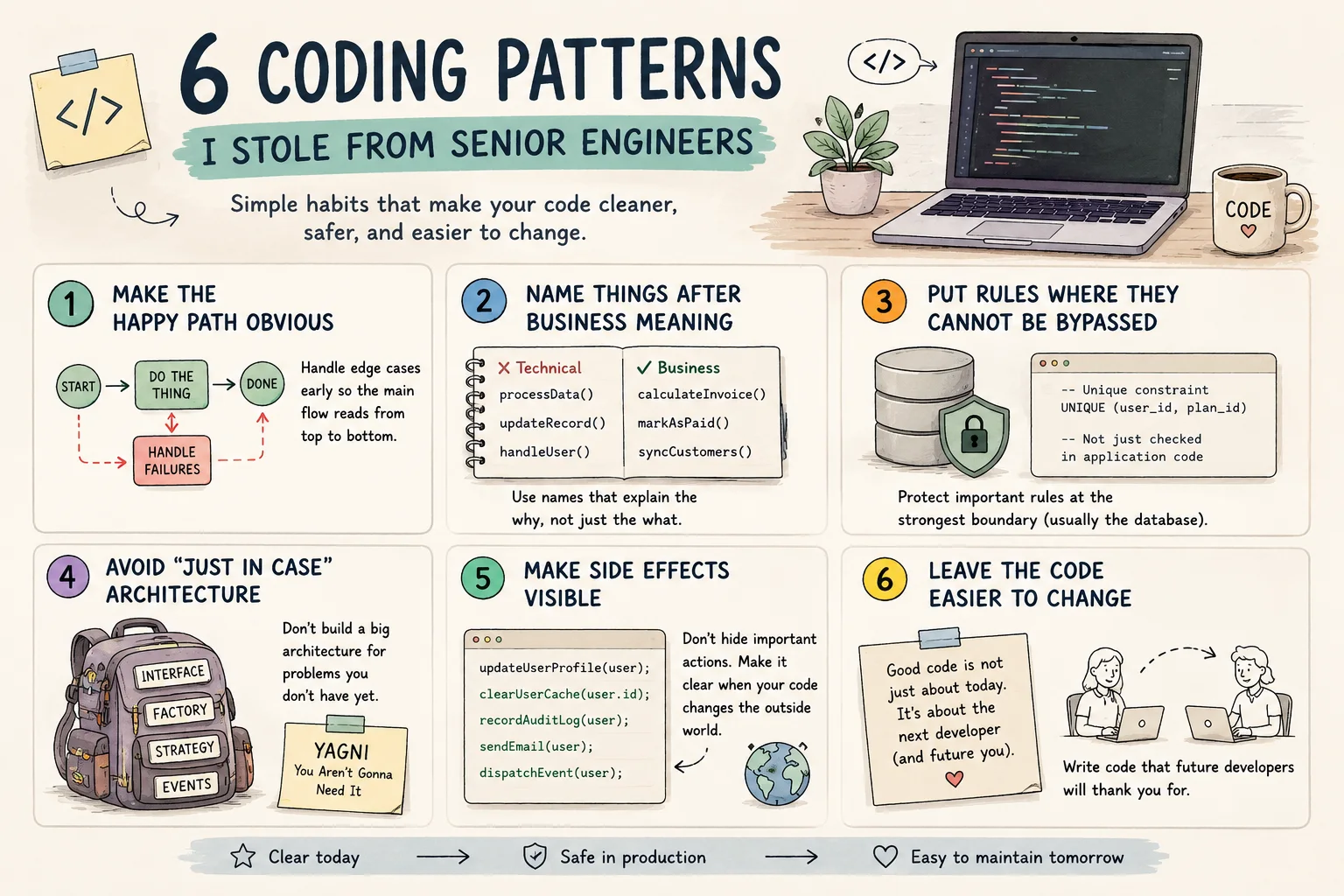
6 Coding-Patterns, die ich von Senior Engineers gelernt habe

Einen privaten KI-Assistenten für Notizen bauen
Mache aus Markdown-Notizen einen durchsuchbaren Assistenten, ohne private Entwürfe offenzulegen.

Rechnungsdaten mit OCR automatisiert auslesen
Baue eine Pipeline, die Rechnungen liest, Felder extrahiert und unsichere Werte markiert.
Kommentare
0 KommentareNoch keine freigegebenen Kommentare sichtbar. Neue Antworten können moderiert werden.