وكلاء الذكاء الاصطناعي والأنظمة المستقلة: الهندسة المعمارية والأنماط والتطبيقات
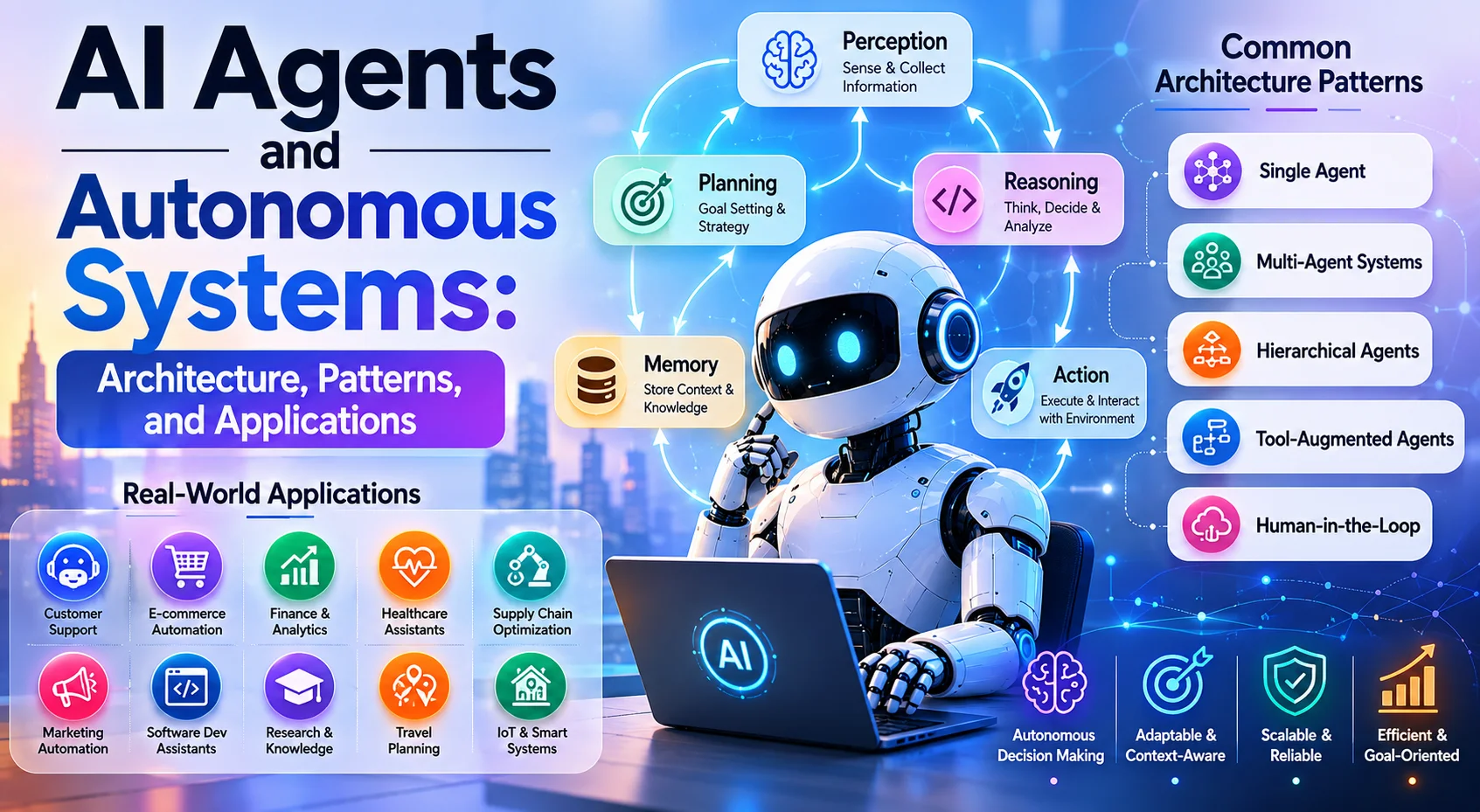
وكلاء الذكاء الاصطناعي عبارة عن أنظمة برمجية مستقلة تدرك بيئتها وتفكر في الأهداف وتتخذ الإجراءات وتتعلم من النتائج. على عكس تطبيقات LLM التقليدية التي تستجيب لموجه واحد، يعمل الوكلاء في حلقات - المراقبة والتفكير والتصرف والملاحظة مرة أخرى - حتى يتم تحقيق الهدف.
مقدمة
وكلاء الذكاء الاصطناعي عبارة عن أنظمة برمجية مستقلة تدرك بيئتها وتفكر في الأهداف وتتخذ الإجراءات وتتعلم من النتائج. على عكس تطبيقات LLM التقليدية التي تستجيب لموجه واحد، يعمل الوكلاء في حلقات - المراقبة والتفكير والتصرف والملاحظة مرة أخرى - حتى يتم تحقيق الهدف.
في عام 2026، سيمثل عملاء الذكاء الاصطناعي حدود الذكاء الاصطناعي التطبيقي. إنهم يقومون بأتمتة سير العمل المعقد متعدد الخطوات، ويتفاعلون مع الأدوات الخارجية وواجهات برمجة التطبيقات، ويتعاونون مع الوكلاء الآخرين، ويتخذون القرارات في بيئات ديناميكية.
ما الذي يجعل وكيل الذكاء الاصطناعي؟
المكونات الأساسية
                   ┌──────────────────┐
                   │   Environment    │
                   │ (APIs, files,    │
                   │  databases, web) │
                   └────────┬─────────┘
                            │
Perception (observe)        │        Action (effect)
    ┌───────────────────────┼───────────────────────┐
    │                       │                       │
    ▼                       │                       ▼
┌─────────────────┐         │              ┌─────────────────┐
│   Sensors       │         │              │   Tools         │
│ (read input)    │         │              │ (call APIs,     │
│                 │         │              │  write files)   │
└────────┬────────┘         │              └────────▲────────┘
         │                 │                        │
         │          ┌──────▼──────────────────────┐ │
         └─────────►│       Reasoner (LLM)        ├─┘
                    │   (plan, decide, reflect)   │
                    └─────────────────────────────┘
                              │
                              ▼
                    ┌──────────────────┐
                    │   Memory         │
                    │ (history, state, │
                    │  learnings)      │
                    └──────────────────┘
| مكون | الوصف | مثال |
|---|---|---|
| البيئة | العالم الخارجي الذي يتفاعل معه الوكيل | الويب، نظام الملفات، API، قاعدة البيانات |
| أجهزة الاستشعار | كيف يدرك الوكيل البيئة | قراءة الملف، استجابة HTTP، إدخال المستخدم |
| السبب | LLM الذي يخطط ويقرر | جي بي تي-4، كلود، نموذج مفتوح المصدر |
| الأدوات | الإجراءات التي يمكن للوكيل اتخاذها | البحث، الآلة الحاسبة، تنفيذ التعليمات البرمجية |
| الذاكرة | المدى القصير (المحادثة) + المدى الطويل (ناقل DB) | تاريخ الدردشة، والحقائق المستفادة |
| التخطيط | تقسيم الأهداف إلى خطوات | التفاعل، التخطيط والحل، شجرة الفكر |
معماريات الوكيل
1. رد الفعل (الاستدلال + التصرف)
نمط الوكيل الأكثر شيوعًا - يتداخل مع آثار المنطق مع الإجراءات:
User: "Book a flight to Paris next Tuesday for under $500"

Thought: I need to search for flights to Paris next Tuesday.
Action: search_flights(destination="Paris", date="2026-05-26")
Observation: Found flights: $450 (direct), $380 (1 stop), $520 (direct)

Thought: The $450 direct flight is under budget. I need to check if
         the user has preferences for time.
Action: ask_user("Would you like the 7:00 AM direct for $450 or
                  the 11:00 AM direct for $520?")
Observation: User prefers morning.

Thought: Booking the 7:00 AM direct flight.
Action: book_flight(flight_id="AF1234", user_id="user_42")
Observation: Booking confirmed. Reference: BK-98765.

Thought: The task is complete. Let me summarize.
Response: I booked flight AF1234 to Paris on May 26 at 7:00 AM.
          Total: $450. Booking reference: BK-98765.
class ReActAgent:
    def __init__(self, llm, tools: list[Tool]):
        self.llm = llm
        self.tools = {t.name: t for t in tools}
        self.max_steps = 20

    def run(self, task: str) -> str:
        messages = [
            {"role": "system", "content": SYSTEM_PROMPT},
            {"role": "user", "content": task},
        ]

        for step in range(self.max_steps):
            # Reasoning step
            response = self.llm.invoke(messages)
            thought = response.content

            # Check if final answer
            if "FINAL ANSWER:" in thought:
                return thought.split("FINAL ANSWER:")[-1].strip()

            # Parse action
            action = self._parse_action(thought)
            if not action:
                continue

            # Execute action
            tool = self.tools.get(action['name'])
            if not tool:
                observation = f"Error: Unknown tool '{action['name']}'"
            else:
                try:
                    observation = tool.execute(**action['args'])
                except Exception as e:
                    observation = f"Error: {str(e)}"

            # Add to conversation
            messages.append({
                "role": "assistant",
                "content": thought
            })
            messages.append({
                "role": "user",
                "content": f"Observation: {observation}"
            })

        return "Max steps reached without completing task."
2. التخطيط والحل (التحليل)
User: "Create a monthly sales report with charts"

Plan:
1. Query database for last month's sales data
2. Clean and aggregate data by product category
3. Create bar chart of sales by category
4. Create line chart of daily sales trend
5. Generate PDF report with charts and summary

Step 1: query_database("SELECT ... WHERE month = '2026-04'")
✓ Done: 15,243 records returned

Step 2: aggregate_by_category(data)
✓ Done: 8 categories aggregated

...
3. الأنظمة المتعددة الوكلاء
يتعاون الوكلاء المتخصصون في المهام المعقدة:
                    ┌─────────────────────────┐
                    │   Orchestrator Agent     │
                    │ (decomposes tasks,       │
                    │  coordinates agents)     │
                    └────┬──────┬──────┬───────┘
                         │      │      │
              ┌──────────┤      │      ├──────────┐
              │          │      │      │          │
         ┌────▼────┐ ┌──▼──┐ ┌─▼───┐ ┌▼────────┐
         │Research │ │Code │ │Test │ │Document │
         │ Agent   │ │Agent│ │Agent│ │ Agent   │
         │(search, │ │(code│ │(test│ │(docs,   │
         │ analyze)│ │ gen)│ │ gen)│ │ reports)│
         └─────────┘ └─────┘ └─────┘ └─────────┘
مثال: تطوير البرمجيات مع وكلاء متعددين:
# Agent roles
agents = {
    'product_manager': Agent(
        role="Defines requirements and acceptance criteria",
        tools=[search_knowledge_base, ask_user]
    ),
    'architect': Agent(
        role="Designs system architecture and data flow",
        tools=[draw_diagram, search_documentation]
    ),
    'developer': Agent(
        role="Writes and reviews code",
        tools=[write_file, read_file, execute_code]
    ),
    'qa_engineer': Agent(
        role="Writes tests and validates functionality",
        tools=[run_tests, check_coverage, report_bugs]
    ),
}

# Orchestrator coordinates the workflow
orchestrator = Orchestrator(agents)
result = orchestrator.execute(
    "Build a REST API for user authentication"
)
الأدوات واستدعاء الوظائف
تحديد الأدوات
from pydantic import BaseModel, Field

class SearchTool(Tool):
    name = "web_search"
    description = "Search the web for current information"

    class Parameters(BaseModel):
        query: str = Field(description="The search query")

    def execute(self, query: str) -> str:
        response = requests.get(
            "https://api.search.example.com",
            params={"q": query}
        )
        return response.text

class CalculatorTool(Tool):
    name = "calculator"
    description = "Perform mathematical calculations"

    class Parameters(BaseModel):
        expression: str = Field(
            description="Mathematical expression to evaluate"
        )

    def execute(self, expression: str) -> str:
        try:
            # Safe evaluation
            result = self._safe_eval(expression)
            return str(result)
        except Exception as e:
            return f"Error: {e}"

class DatabaseQueryTool(Tool):
    name = "query_database"
    description = "Query the sales database"

    class Parameters(BaseModel):
        sql: str = Field(description="SQL query to execute")

    def execute(self, sql: str) -> str:
        # Validate SQL (read-only queries only)
        if not sql.strip().upper().startswith("SELECT"):
            return "Error: Only SELECT queries are allowed"
        result = db.execute(sql)
        return json.dumps(result, default=str)
تسجيل الأداة
class Agent:
    def __init__(self, llm, tools: list[Tool]):
        self.llm = llm
        self.tool_registry = {
            t.name: t for t in tools
        }

        # Create function descriptions for LLM
        self.functions = [
            {
                "type": "function",
                "function": {
                    "name": t.name,
                    "description": t.description,
                    "parameters": t.Parameters.model_json_schema()
                }
            }
            for t in tools
        ]

    def think_and_act(self, prompt: str) -> str:
        response = self.llm.invoke(
            messages=[{"role": "user", "content": prompt}],
            tools=self.functions
        )

        # If LLM wants to call a tool
        if response.tool_calls:
            for call in response.tool_calls:
                tool = self.tool_registry[call.function.name]
                args = json.loads(call.function.arguments)
                result = tool.execute(**args)
                # Feed result back to LLM...
أنظمة الذاكرة
الذاكرة قصيرة المدى (سياق المحادثة)
class ConversationMemory:
    def __init__(self, max_tokens: int = 4000):
        self.messages = []
        self.max_tokens = max_tokens

    def add(self, role: str, content: str):
        self.messages.append({"role": role, "content": content})
        self._trim()

    def _trim(self):
        total = sum(len(m['content']) for m in self.messages)
        while total > self.max_tokens and len(self.messages) > 2:
            self.messages.pop(1)  # Keep system prompt
            total = sum(len(m['content']) for m in self.messages)
الذاكرة طويلة المدى (متجر المتجهات)
class LongTermMemory:
    def __init__(self, vector_store):
        self.store = vector_store

    def remember(self, fact: str, metadata: dict = None):
        """Store important facts for future reference"""
        embedding = embed_text(fact)
        self.store.insert(embedding, payload={
            'fact': fact,
            **metadata,
            'timestamp': datetime.now().isoformat()
        })

    def recall(self, query: str, k: int = 5) -> list[str]:
        """Retrieve relevant past facts"""
        query_vector = embed_text(query)
        results = self.store.search(query_vector, k=k)
        return [r.payload['fact'] for r in results]

    def consolidate(self):
        """Summarize and compress old memories"""
        old_memories = self.store.get_older_than(days=30)
        summary = summarize_texts([m.payload['fact'] for m in old_memories])
        self.remember(f"Summary of past activities: {summary}",
                       metadata={'type': 'summary'})
        self.store.delete(old_memories)
استراتيجيات تخطيط الوكيل
شجرة الأفكار
استكشاف مسارات التفكير المتعددة في وقت واحد:
Question: "What is the best cloud provider for our startup?"

Branch 1: Cost comparison
  ├─ AWS: $X/month
  └─ GCP: $Y/month (cheaper, but fewer services)

Branch 2: Required services
  ├─ Need managed Kubernetes → all support
  └─ Need specific AI/ML → GCP has TPUs

Branch 3: Team expertise
  ├─ Team knows AWS → faster ramp-up
  └─ learning GCP → 2-3 month delay

Evaluation:
  Path AWS: high team skill, moderate cost → score 8/10
  Path GCP: lower cost, TPUs, but learning curve → score 7/10
التأمل الذاتي والتحسين
class ReflectiveAgent(Agent):
    def __init__(self, *args, **kwargs):
        super().__init__(*args, **kwargs)
        self.mistakes = []

    def reflect_on_failure(self, task: str, action: str, error: str):
        """Learn from mistakes"""
        reflection = self.llm.invoke(f"""
        Task: {task}
        Action taken: {action}
        Error: {error}

        Why did this fail? What should I do differently next time?
        """)
        self.mistakes.append(reflection.content)

    def plan(self, task: str) -> str:
        # Consider past mistakes when planning
        if self.mistakes:
            lessons = "\n".join([f"- {m}" for m in self.mistakes[-5:]])
            return self.llm.invoke(f"""
            Task: {task}
            Lessons from past mistakes:
            {lessons}
            Plan your approach carefully.
            """)
        return super().plan(task)
حالات الاستخدام
1. دعم العملاء الآلي
Customer: "My order hasn't arrived and it's been 2 weeks"

Agent tasks:
1. Query order database for status
2. Check tracking API for shipment location
3. If delayed: contact shipping carrier
4. If lost: initiate refund process
5. If delivered: verify with customer

Tools needed: order_lookup, tracking_api, email_send, refund_system
2. إنشاء التعليمات البرمجية وتصحيح الأخطاء
Developer: "Fix the login bug — users get 401 errors after password reset"

Agent workflow:
1. Search codebase for password reset implementation
2. Identify token validation logic
3. Write a unit test reproducing the bug
4. Fix the issue
5. Run existing tests to verify no regression
6. Create PR with description
3. مساعد باحث
class ResearchAgent:
    async def research(self, topic: str) -> Report:
        # Parallel exploration
        subtopics = self.decompose(topic)
        tasks = [self.explore_subtopic(st) for st in subtopics]
        findings = await asyncio.gather(*tasks)

        # Synthesize
        report = self.synthesize(findings)
        return report

    async def explore_subtopic(self, subtopic: str) -> Finding:
        search_results = await web_search(subtopic)
        summaries = await asyncio.gather(*[
            summarize_page(url) for url in search_results[:5]
        ])
        return Finding(subtopic=subtopic, summaries=summaries)
التحديات والمخاطر
1. الهلوسة في الأفعال
قد يتخذ الوكيل بثقة إجراءات غير صحيحة:
Thought: The user asked to delete expired records.
Action: DELETE FROM users  -- (Oops, no WHERE clause!)
التخفيف:
- تحقق دائمًا من الإجراءات المدمرة.
- تتطلب تأكيدا للعمليات التي لا رجعة فيها.
- استخدم وضع "التشغيل الجاف" للاختبار.
2. كشف الحلقة
قد يتعثر الوكلاء في حلقات لا نهائية:
class LoopDetector:
    def __init__(self, max_repeated_actions: int = 3):
        self.action_history = []
        self.max_repeated = max_repeated_actions

    def check(self, action: str, observation: str) -> bool:
        self.action_history.append({
            'action': action,
            'observation': observation
        })

        # Check for repeated patterns
        recent = self.action_history[-5:]
        if len(recent) >= 3:
            patterns = [a['action'] for a in recent]
            if len(set(patterns)) <= 2:
                print("Loop detected!")
                return True
        return False
3. إدارة التكاليف
تكلف كل خطوة وكيل أموالًا (استدعاءات LLM + استدعاءات واجهة برمجة التطبيقات):
agent_cost_estimation:
  per_step:
    llm_call:  "$0.01"    # GPT-4o
    tool_call: "$0.001"   # Average API call
    search:    "$0.00"    # Web search

  typical_session:
    steps: 10-30
    total: "$0.10 - $0.50"

  complex_research:
    steps: 50-200
    total: "$0.50 - $5.00"
أطر الوكيل
| الإطار | اللغة | الميزات |
|---|---|---|
| ** لانج تشين ** | بايثون | النظام البيئي الأكثر شيوعًا للأداة |
| التوليد التلقائي | بايثون | المحادثات متعددة الوكلاء، Microsoft |
| ** طاقم الذكاء الاصطناعي ** | بايثون | فرق الوكلاء القائمة على الأدوار |
| النواة الدلالية | ج#/بايثون | تنسيق الذكاء الاصطناعي من مايكروسوفت |
| فيرسيل AI SDK | تايب سكريبت | RSC، البث، أدوات لتطبيقات الويب |
| ** مؤشر اللاما ** | بايثون | RAG + وكيل، تتمحور حول البيانات |
| ** واجهة برمجة تطبيقات مساعدي OpenAI ** | واجهة برمجة التطبيقات | مُدار، مترجم الكود، البحث عن الملفات |
الاستنتاج
يمثل وكلاء الذكاء الاصطناعي التطور التالي لتطبيقات LLM - بدءًا من الأسئلة والأجوبة ذات المنعطف الواحد وحتى إكمال المهام المستقلة والمتعددة الخطوات.
| المستوى | اكتب | مثال |
|---|---|---|
| المستوى 1 | روبوت محادثة بسيط | سؤال وجواب مع RAG |
| المستوى الثاني | وكيل استخدام الأداة | دعم العملاء مع إنشاء التذاكر |
| المستوى 3 | متعددة الخطوات مع التخطيط | مساعد باحث، توليد الكود |
| المستوى الرابع | أنظمة متعددة الوكلاء | فريق تطوير البرمجيات من الوكلاء |
| المستوى 5 | التعلم الذاتي | تحسين الذات، والتكيف مع مرور الوقت |
الوجبات الرئيسية:
- ابدأ باستخدام ReAct البسيط — معظم المشكلات لا تحتاج إلى بنيات معقدة.
- تصميم الأدوات بعناية — جودة الأداة هي التي تحدد جودة الوكيل.
- تنفيذ حواجز الحماية — اكتشاف الحلقات، وحدود التكلفة، وبوابات التأكيد.
- مراقبة كل شيء وتسجيله — يصعب تصحيح سلوك الوكيل مقارنة بالشفرات التقليدية.
- التفاعل البشري — بالنسبة إلى القرارات الحاسمة، اطلب من الوكيل أن يطلب التأكيد.
توازن أنظمة الوكلاء الأكثر فعالية في عام 2026 بين الاستقلالية والسلامة، مما يمنح الوكيل مساحة للتصرف مع الحفاظ على الإشراف البشري على القرارات اللاحقة.
مقالات مختارة

50 مهارة من Claude تستحق البناء في 2026

ابن مساعد ملاحظات خاص بالذكاء الاصطناعي
حوّل مجلد ملاحظات Markdown إلى مساعد بحث دون كشف المسودات الخاصة.

أتمتة استخراج بيانات الفواتير باستخدام OCR
ابن خط معالجة يقرأ الفواتير ويستخرج الحقول ويعلّم القيم غير المؤكدة للمراجعة.
التعليقات
0 تعليقاتلا توجد تعليقات معتمدة بعد. قد تنتظر الردود الجديدة المراجعة.